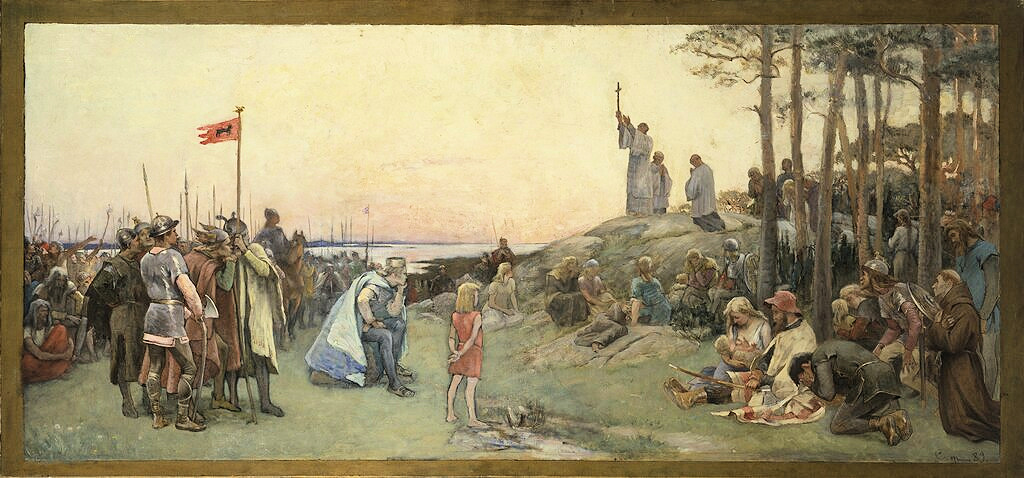
More classic art masterpieces used as illustrations
TL;DR: Ansgar, a ninth-century monk known as “The Apostle of the North,” dedicated his life to evangelizing the Vikings despite repeated setbacks and little visible success. His perseverance shows that true missionary success is measured by faithfulness to God’s call, not by immediate results.
Merciless villains. Bloodthirsty pillagers. Violent arsonists. Savage barbarians.
When used to describe an entire people group, those descriptions sound awful. Yet they are often used to describe the Vikings, Scandinavian seafarers who raided and terrorized parts of Europe for at least three centuries.
To go as a foreign missionary among people known for such violent raids would take courage. It would take a strong sense of call and a great deal of dedication, especially if evangelistic results were meager or even nonexistent, as they often were in Ansgar's ministry. Indeed, dedication certainly marked Ansgar, a missionary whom many now call The Apostle of the North.1
Born in A.D. 801 in what is now France, Ansgar became a Benedictine monk. A series of visions and dreams gave him a clear sense of missionary calling. In 826, while still a young monk, he traveled north as a pioneer Christian missionary to Denmark. He later carried the gospel to Sweden.
Over the next 30 years, political upheaval and Viking raids repeatedly disrupted Ansgar's ministry. His first mission to Denmark ended after King Harald lost power, and a Viking raid destroyed Ansgar's headquarters in Hamburg in 845. He regarded those events, however, as temporary setbacks rather than reasons to abandon his calling. His dedication to his call led him to return to Viking territory. One fascinating detail about Ansgar is that his Germanic name is commonly understood to mean “god spear” or “divine spear.”
Evangelistic work in Viking territory was not very fruitful. So Ansgar tried several avenues of ministry, including education and health care. He paid ransoms to release people taken prisoner during Viking raids and campaigned against slavery while working to reduce the horrors of the slave trade. His contemporary and biographer Rimbert wrote that he was "accustomed to working with his hands in the fields and in the forests and was able to endure long-continued fatigue and privation."
Eventually, through Ansgar's preaching ability and holy lifestyle, he did see a few people become interested in the gospel. A few influential leaders showed interest in Christianity, but no widespread movement toward Christianity developed among the general population. By the time of Ansgar's death, Christianity had gained only a fragile foothold in Scandinavia. The small communities he helped establish did not lead immediately to widespread or lasting Christianization. However, Ansgar had been called to the inhabitants of Scandinavia, and he dedicated his life to fulfilling that call.
More than a hundred years after Ansgar's death, many people in Scandinavia embraced Christ. Centuries later, Denmark became a Protestant country and eventually played a significant role in world missions. There was no hint, however, of that ever happening when Ansgar was toiling away seemingly fruitlessly.
Ansgar did not achieve success in the way we sometimes measure it today. But he was dedicated, and that is the type of missionary God can use.
1 Note: Ansgar's name has also been spelled Anskar, Anschar, and Ansgarius.
Ansgar's life exemplifies the importance of a long-term perspective on world missions. Despite few immediate results, Ansgar remained dedicated to his call to share the gospel with the Vikings. Contemporary missionaries can learn from his perseverance, especially in contexts where responses to the gospel come slowly. Measurable results are not always immediate, but faithfulness to God's call and commitment to sharing His love still matter. Like Ansgar, missionaries today must sometimes trust that their labor will bear fruit in due time, even if they do not see it in their lifetimes.
To be sure, Ansgar's historical context and specific challenges may differ from those encountered by modern cross-cultural missionaries. However, his life and work offer valuable insights and principles. By embracing adaptability, commitment, a holistic approach, relational ministry, and unwavering dependence on God, missionaries today can engage unreached people and help spread the gospel worldwide.
“The missionaries of old did not often get to realize the contributions they made, yet they were greatly motivated. Why is this, and what will it take to cause us to again become burdened for the world?” — Christi V., Nazarene Bible College student
Additional 500-word mini-essays are available in the "Doing Missions Well" series published in Engage magazine.
Interesting fact: There is a crater on the Moon named after Ansgar. It uses the Latinized form of his name: Ansgarius.


