TL;DR:
Jeremiah 31:10—“Proclaim it in distant coastlands”—shows that the call to global evangelism was present long before Jesus' Great Commission. Read alongside other Old Testament passages, the verse challenges an exclusive focus on local ministry and points toward proclaiming God's name far beyond home. For ancient Israelites, “distant coastlands” symbolized remote, unreachable places. Churches today should support global outreach alongside local ministry.
Blog post: What is the meaning of Jeremiah 31:10?
What do the words in Jeremiah 31:10 about distant coastlands mean to us today?
When the Hebrews heard the words "distant coastlands"1 recorded in Jeremiah 31, they did not think of enormous cruise ships leisurely wandering around the Caribbean. They did not think about Facebook posts by friends on a cruise ship somewhere or vacationing in Hawaii or on idyllic Greek islands.
For most Israelites, talking about proclaiming the name of the Lord in "distant coastlands" would have been way outside their comfort zone. What they likely thought about was how far away those coastlands might be. They would also have been thinking of the difficulties God's messengers would encounter in reaching those places to proclaim His praise: "Let them give glory to the Lord and proclaim His praise in the islands" -- Isaiah 42:12.
As we know from the Gospel story of Jesus calming the storm, a trip across the Sea of Galilee (which is more of a lake than a "sea") could be a harrowing experience. Or, think about Jonah's story. Then, there is the abundance of folklore about sea monsters and ancient maps with drawings of fearsome creatures devouring ships and sailors. Journeys could also be delayed: Acts describes Paul's voyage from Caesarea to Rome, including a shipwreck and a winter stop on Malta.
Clearly, in the Old Testament, there is an understanding that God's name would be acknowledged, proclaimed, and exalted everywhere. Isaiah talked about it. The Israelites sang about it in Psalm 97:1, "The Lord reigns, let the earth be glad; let the distant shores rejoice."
As for Jeremiah, he prophesied right before and after the Babylonians overran Jerusalem. Rather than being tightly focused on one event, Jeremiah had words for far beyond that moment. In the same chapter in which he talks about the coming New Covenant, Jeremiah mirrors the words of Isaiah 42 and Psalm 97:1 by writing, "Hear the word of the Lord, you nations; proclaim it in distant coastlands." Jeremiah's combination of the New Covenant theme with talk about the nations hearing the word of the Lord foreshadows Christ's Great Commission.
Some believers excuse their lack of involvement in world evangelism by saying, "We have to reach those at home first." These passages in Psalms, Isaiah, and Jeremiah about distant shores and the islands of the sea clearly disagree with such isolationist thinking.
The Great Commission to go and evangelize all peoples would not have been a surprise to anyone versed in the Old Testament. Psalms and Isaiah, among the Old Testament books most often quoted in the New Testament, point us to world evangelism and the far corners of the earth. Jeremiah, whose reaction to the destruction of Jerusalem earned him the label "weeping prophet," looked beyond the devastation of his beloved city to places far away that needed to hear the word of the Lord.
As we reflect on these Old Testament passages, we must ask: Is my local church doing the right things to accomplish the fulfillment of these calls to action? Is what we are doing going to lead Christ-followers to heed the call to proclaim the word of the Lord in faraway places?
-- Howard Culbertson, hculbert@snu.edu
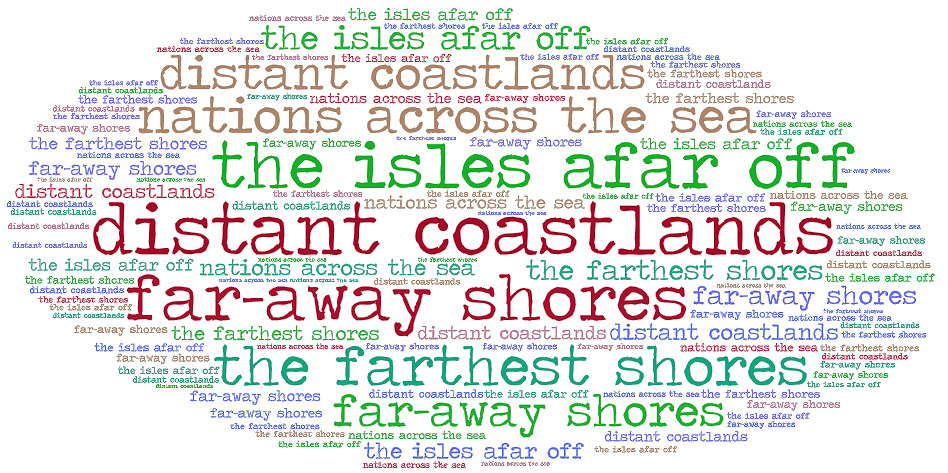
1"Distant coastlands" is the NIV wording. Phrases used in other English Bible translations include "lands far away across the sea," "far-away shores," and "nations across the sea."
This blog post on a world missions Bible passage is one of more than three dozen articles in the "Heart of God" series published in Engage magazine. That series looks at what the Bible says about world missions.
In Jeremiah 31:10, the prophet speaks on behalf of God. He calls on the nations, including those far away, to listen to the word of the Lord. The call extended to nations far from the Promised Land. People in distant places were to hear the message.
The phrase "coastlands far away" points to an audience far beyond the eastern end of the Mediterranean. The wording of the passage makes it clear that the message from God is not narrowly focused on one particular group of people or a single geographic location. It is a message to be proclaimed in all corners of the earth. Isn't that reminiscent of what Jesus would say in his Great Commission (Matthew 28:19-20, Mark 16:15 and Acts 1:8)?


