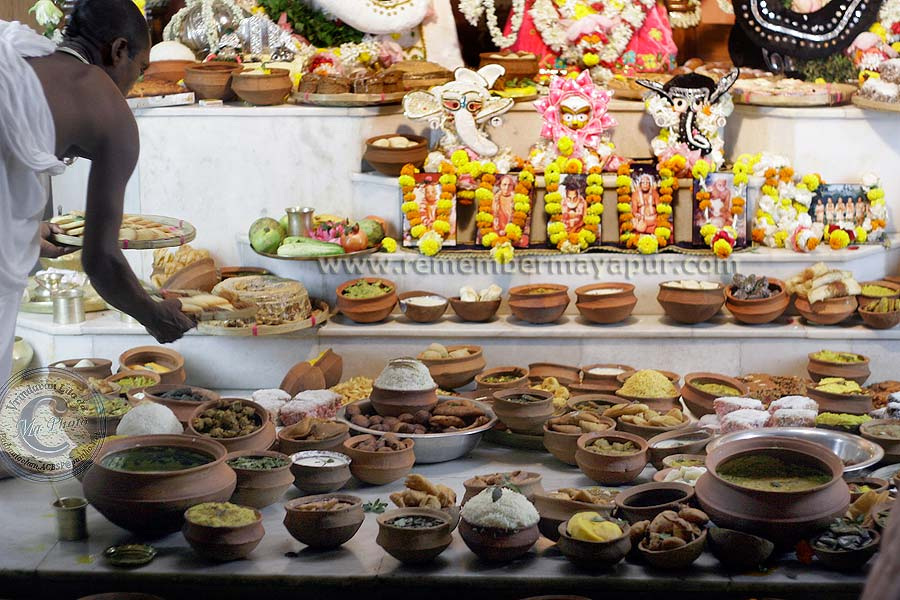
More photos and art masterpieces used as illustrations
TL;DR:
A Christian in South India faces a dilemma when his Hindu coworker offers him food dedicated to Krishna during a workplace worship ceremony. Accepting it could build goodwill but might also imply participation in worship. How should he respond while maintaining his Christian convictions and his relationship with his coworker? The situation echoes Paul's discussion of food offered to idols in 1 Corinthians 8-10.
In this case, accepting the food and receiving a kumkuma mark are understood by the participants as expressions of devotion. How can a Christ-follower maintain his Christian convictions while also building a relationship with a Hindu colleague with whom he hopes to share his faith?
Ramamurti, who was a Christian, looked across the room at the group of print shop workers. They were gathered around the large image of the blue-faced Hindu god Krishna, who had been heavily garlanded with marigolds and tinsel. Ramamurti looked at the plate of food that had just been taken from in front of the god and was now being offered to him. What should he do?

It was Friday, and Ramamurti realized that he had arrived just as the weekly prayers to Krishna, the Hindu deity revered at this print shop, were drawing to a close. Like many businessmen in this city in South India, the printing shop owner personally paid for employees to purchase coconuts, bananas, and sugar to offer at the weekly puja ceremony (a Hindu worship ritual).
The print shop where Ramamurti had just arrived was doing well. The owner believed that the prosperity of his printing plant was a sign of divine blessing because of his faithful offerings to the god.
As assistant editor of a Christian magazine, Ramamurti was responsible for seeing that the publication was properly printed and came out on schedule. That day, he had several urgent matters to take care of, so he had come to the print shop earlier than usual. Before realizing that the puja ceremony was still going on, Ramamurti had hurried into the room, and the press foreman, Ravi, had seen him.
As they had worked together over the past months, Ravi and Ramamurti had developed a close relationship. Ramamurti hoped to win Ravi to faith in Jesus Christ someday. Right now, however, things seemed to be going in the opposite direction. Ramamurti's friend was pulling him toward the group receiving food that had been offered to Krishna at the little shrine in the print shop.
After eating, each person received a spot of kumkuma (colored powder) on the forehead. In the practice described in this case, the mark signified purification through eating food that had been offered to the deity. Ramamurti knew that for Hindus like Ravi, eating food that had been offered to a god was a sign of goodwill. It was somewhat like the giving or receiving of a Christmas present. But Ramamurti also knew that, for the participants in this ceremony, partaking of the food and receiving the kumkuma powder was a worship ritual.
Ramamurti did not want to damage his relationship with Ravi. He also did not want to compromise his Christian convictions or interfere with his witness to the lordship of Jesus in his life. Ramamurti vaguely remembered Paul addressing a similar issue in one of his letters to the Corinthians. Ramamurti saw Ravi hold out the platter of food toward him, and he . . .
As you consider this case study, do not simply decide what you would do in this situation. Decide what you think would be the proper course of action for Ramamurti, given his beliefs, passions, and life journey.
Seven steps to good case study use
This case study, as originally written by Simon P. David, appeared in Case Studies in Missions, edited by Paul and Frances Hiebert, © Baker Book House. Edited and used with permission. This case study may be reproduced only upon payment of a royalty of 35 cents per copy to: Baker Book House, P.O. Box 6787, Grand Rapids, MI 49516 USA.
-- Howard Culbertson, hculbert@snu.edu
In many Hindu traditions, food is offered to a deity during worship and then distributed to devotees as prasadam or prasad, a sign of divine grace. Devotees regard this food as blessed through its offering to the deity.
For many devotees, receiving and eating prasadam expresses devotion, gratitude, and reverence. It is understood as nourishing both body and spirit. The practices and meanings associated with these offerings vary among Hindu traditions and communities.


