TL;DR:
Missiology is the interdisciplinary study of how the Church carries out its mission of making Christ-like disciples among all nations. Drawing on theology, history, and the social sciences, it examines biblical foundations, cultural dynamics, and practical strategies for evangelism, cross-cultural church planting, and holistic ministry. Students of missiology learn to fulfill the Great Commission with wisdom, humility, and contextual sensitivity.
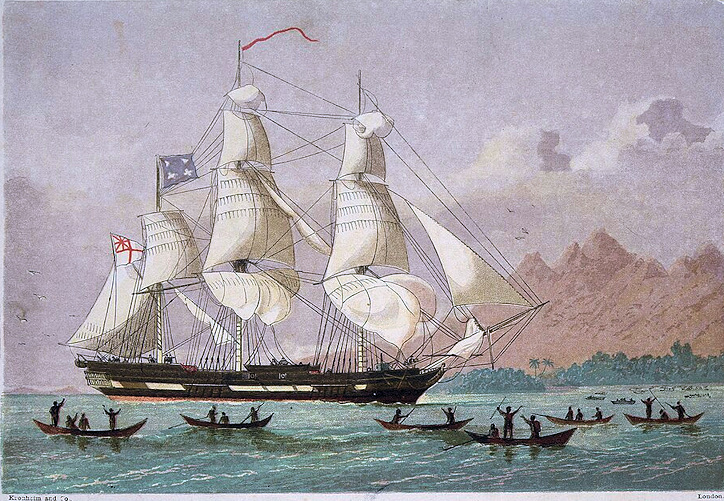
Missionary Ship "Duff" Arriving in Tahiti (1797), lithograph by Joseph Martin Kronheim and Company, 1820
(Image source)
Missiology studies the cross-cultural expansion of Christianity. Its name combines the Latin missio ("sending forth") and the Greek logos ("study" or "discourse").
Its scope includes biblical, historical, doctrinal, and practical theological studies.
Missiology applies tools from the social sciences, such as cultural
anthropology, sociology, and political science to analyze how global dynamics affect the
Church's mission of making Christ-like disciples among the nations.
Missiology uses insights from diverse fields such as agriculture,
education, medicine, economic development, and public health to develop strategies for cross-cultural missionary ministry.
Louis Luzbetak defines missiology:
"Missiology is derived from the Latin missio ("a sending forth
with a special message to proclaim or with a special task to perform") and the Greek
logos ("a study, word, or discourse"). Etymologically,
missiology is a study of the sending forth or expansion of the Church." — from
The Church and Cultures (Orbis)
One helpful definition of missions is "the cross-cultural expansion of the Church of Jesus Christ." Missiologists study that expansion in local, multicultural, and international settings.
As missiologists reflect on the global mission and growth of the Church, they use tools from the social sciences to understand various dynamics. Insights are drawn from
cultural anthropology, ethnology, sociology, geography, and political science.
Missiology seeks to develop strategies for cross-cultural gospel outreach, discipleship, and church planting. In doing their work, missiologists interact with a wide range of disciplines and fields of service, especially agriculture, education, medicine, and public health.
Want to explore missionary service? The study of missiology can help prepare you.
Christian missions journals Consider subscribing to at least one
of these.
Evangelical Missions Quarterly Geared toward missionary practitioners, EMQ provides a forum for the exchange of concepts, strategies, and ideas.
International Bulletin of Mission Research Interdenominational quarterly with emphasis on mission history; great book reviews; writers come from varied backgrounds ranging from Roman Catholicism and conciliar groups to Protestant fundamentalism.
Missiology: An International Review Written primarily for missiologists, missions professors, researchers, and practitioners. This is an academic rather than a popular quarterly.
Want to help the missions program of your local church? Check out the resources on this
website for Nazarene Missions International (NMI) groups.
Nazarene Bible College's world missions course via distance education
Global evangelism—a six-week, fully online course that looks at biblical foundations, missions history, the importance of culture,
today's missions methods and practices, the work yet to be done, and a case study of one denomination's world missions efforts (the Church of the Nazarene).
Jonah's story is about more than disobedience. He is the reluctant missionary of the Old Testament who refuses to bring his heart into harmony with God's heart.
Missions information and facts
Effective missions mobilizers need reliable information. Knowing what is happening also helps us pray specifically. [ more
]
"While looking at your website, I have been very impressed with both the volume of information and the thoroughness with which you explore missions." — Jack L., Arkansas, USA
Snapshot of the ideal graduate from a world missions program
Adoniram Judson's son wrote that his father—a pioneer missionary
to what is now called Myanmar—was an ideal missionary because of his "scholarly tastes,
affectionate disposition, and fervent piety." That's a good combination. Here's a longer list:
The graduate would be an individual of deep
spirituality. Keyword: Faithfulness
The graduate would approach other cultures with curiosity and humility and would desire to interact with people whose backgrounds differ significantly from his or her own. Key thought:
Willingness to study and adapt
The graduate would be passionate about achieving long-term Kingdom goals rather than being
content with short-term successes.
The graduate would be committed to the Church as an organism and as an institution. Keyword: Dedication
The graduate would be motivated to become proficient in the language of the people being served. Key thought: Language learning
The graduate could communicate clearly with the home constituency about ministry vision, activities, and needs. Keyword: Mobilizer
The graduate would feel comfortable interacting with and befriending educated people from other cultures.
The graduate would have a "clear missionary vision," that is, a sense of what God has called the
Church to do and where we are in terms of fulfilling that call. Key thought: On fire with
love
The graduate would be, as was said of William Borden, a "striking example of Christian stewardship." The graduate would know how to use available resources strategically and creatively. Keyword: Versatile
What should that ideal graduate have read?
People Raising: A Practical Guide to Raising Support by William P. Dillon—for guidance on raising support
The Great Omission by Steve Saint—for insight into empowering local people in world missions
Passion for the Heart of God by John Zumwalt—for mission history, biblical background, and a passion for missions
Eternity in Their Hearts by Don Richardson—for a look at how God prepares people's hearts
Compassion by Henri Nouwen—a book promoted to participants in the summer Youth in Mission program
Afterword: What might a student of missiology expect to learn?
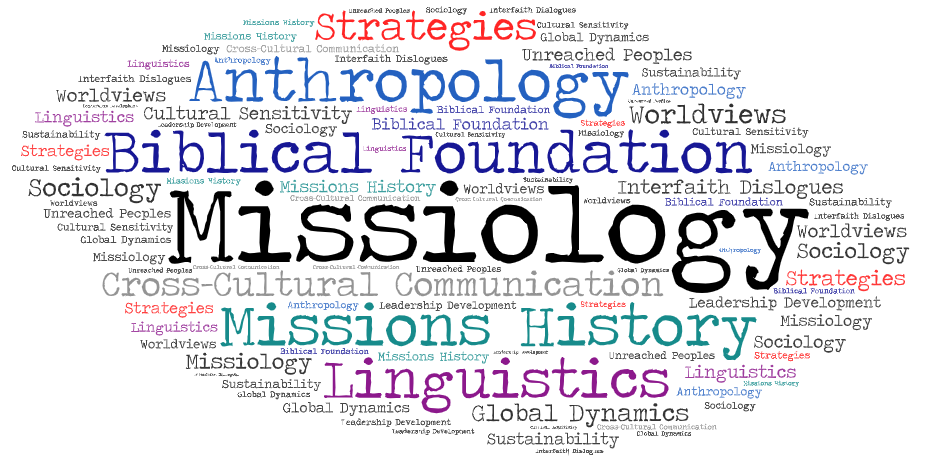
A student of missiology, the academic study of global Christian missions, can expect to study the following subjects:
Biblical and Theological Foundations
The biblical basis for missions as it appears in both the Old and New Testaments.
Theological concepts such as the missio Dei (the mission of God) that have ramifications for the Church.
Church History and Missions
The history of Christian missionary activity, from the early Church through the modern era.
Analysis of important missionary movements and figures.
The impact of colonialism and postcolonialism on missions.
Cultural and Contextual Understanding
Cross-cultural communication and the challenges of proclaiming the gospel in various cultural contexts.
Understanding worldview, cultural dynamics, and social systems.
Principles of contextualization: communicating the gospel and shaping mission methods for local cultures while expressing core Christian beliefs clearly and faithfully.
Strategies and Methods of Mission
Evangelism, church planting, and discipleship strategies.
Approaches to community development and humanitarian aid as part of global missions.
Use of technology and media in missions.
Contemporary Issues in Missions
Globalization and its impact on missions.
The rise of non-Western missionary movements.
Responding to challenges like religious pluralism, persecution, and secularism.
Anthropology and Sociology
Study of human societies, behaviors, and religions.
Insights into how social changes can affect evangelism and discipleship.
Ethical Considerations
Balancing cultural sensitivity with faithfulness to the gospel.
Dealing with past abuses in missions, such as cultural imperialism.
Practical Training
Language acquisition and cultural immersion.
Leadership development and team dynamics in global contexts.
Fundraising, logistics, and partnership-building.
Missiological Research
Analyzing mission trends and patterns through qualitative and quantitative methods.
Examining the theology of religions and interfaith dialogue.
Future Trends
Emerging opportunities for missionary work in urban centers, digital spaces, and unreached people groups.
The role of the local church in global missions.
Missiology aims to critically analyze and improve the theory and practice of global missions. Its goal is to help initiate and guide sustainable, contextualized disciple-making movements across all cultural and geographical boundaries.
Acrostic: Missiology
M — Methods of cross-cultural Christian outreach, I — Investigating contextualization efforts, good and bad, S — Seeking understanding of diverse worldviews, S — Studying barriers that the gospel must cross, I — Integrating theological reflection with practical action, O — Organizing the Church for Great Commission fulfillment, L — Learning from history and exemplary missionaries, O — Opening hearts by reflecting Christ, G — Growing in knowledge and deepening commitment, Y — Yielding to God's call to make disciples among all nations.
In January 1998, Jim Johnson, director of Nazarene Mission Teams in Mexico, died in a
traffic accident while coordinating SNU's Commission Unto Mexico, a large annual short-term
mission trip to northern Mexico over the New Year's holiday involving construction projects,
children's ministry, medical clinics, and soccer ministry.
Jim had helped coordinate all nine of SNU's first Commission Unto Mexico trips.
His widow, Mary Johnson Runion, established an endowed scholarship fund in his memory to aid young people called to be Christian missionaries.
Would you join us in building this memorial scholarship fund? Gifts of every size will help strengthen the scholarship endowment.
To ask about contributing to the scholarship, contact Southern Nazarene University's Development Office. When making a gift, specify the Jim Johnson Missions Scholarship Fund so it is directed to the intended endowment.
 Effective missions mobilizers need reliable information. Knowing what is happening also helps us pray specifically. [ more
]
Effective missions mobilizers need reliable information. Knowing what is happening also helps us pray specifically. [ more
]


