The shortest short course in the history of college journalism
Factors like immediacy, uniqueness, location, and
relevance to readers are what make something newsworthy.
Most American newspaper stories follow a basic structure
and aim for accuracy, concise paragraphs, and varying sentence length.
A good news writer checks facts, attributes information to sources, avoids editorializing, and uses precise, informative language.
A one-day seminar held at Mid-America Nazarene University
Part 1: What makes news?
News is information about events, developments, and issues that are interesting, groundbreaking, or significant to readers. News can lose its immediacy quickly as events develop and new information becomes available.
Events, developments, and questions that matter to readers can provide the basis for news stories.
An alphabet soup of news stories:
Action
Beauty and romance
Critters
Death
Exploits and adventures
Fights and struggles
Government and politics
Humor
Immediacy (is it new?)
Jailbreaks and other crimes
Kids and babies
Location
Mystery and suspense
Novelty
Oddity
Proximity or nearness
Quakes, weather, and other natural phenomena
Real estate and belongings
Size
Timing
Uniqueness
Victory
Woes and anguish
Xenophobia
You (relevance to the reader)
Zany happenings
Part 2: Writing the story
Now that you have the idea, how do you write the story?
Once you have a story with the right elements, how do you go about writing it?
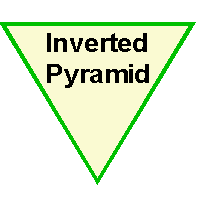
The inverted pyramid: facts arranged in descending order of importance.
Basic rules, from A to Z
A is for Accuracy. Get complete information, complete identification, and complete names. "Almost right" is not enough.
Z is for zeroing in immediately on the story you have to tell. Your article
must sustain interest from beginning to end. If it doesn't, cut it down and change it until it does.
Four don'ts
Don't write fancy prose.
Don't pad your story to make it longer than necessary. Keep it short.
Don't write unsupported opinions or claims. Stick to facts.
Don't be surprised if an editor rewrites your story. Think of it as "improving" your story.
The five W's and one H
A news story should answer:
Who?
What?
Why?
When?
Where?
How?
If any of these elements are missing, it usually means the reporter has not dug out the complete story. It means the reporter failed to get the complete picture.
Lead sentences
A long, overloaded lead sentence can be as objectionable as missing the main point entirely. Do not try to answer all five W's and the H in the first sentence of your story. Determine which of the five W's and the H matter most to this story. Emphasize the most important element or elements in your lead sentence.
Paragraphs
Keep paragraphs concise and sufficiently self-contained that editors can shorten the story without losing essential meaning.
Do not let paragraphs run on and on. Short paragraphs open up copy. That makes the story easier to read.
Follow the inverted pyramid principle and arrange paragraphs in the order of their importance.
Sentences
Do not pack too many ideas into any one sentence. Be especially careful of the lead.
Avoid distracting repetition between consecutive sentences.
Keep sentences short while also varying their length.
Words
Use precise words. Make wording compact. Select each word for maximum effect. Why use a complicated word when a simple one will do?
Use adjectives sparingly. Think three times before using an adjective. Strong nouns and active verbs seldom need qualifiers. Adjectives are cheap.
Eliminate:
Propaganda
Editorial opinion
Superfluous vocabulary
In news stories, avoid both "fine writing" and trite expressions.
Avoid unnecessary repetition, but repeat key terms when clarity requires it.
Keeping your ducks all lined up
Attribution
Give your source. Every story has a source.
Check copy: accuracy, accuracy, accuracy.
Names (double-check spelling)
Numbers (cross-check your figures)
Refrain from editorializing
Keep "I" and "we" out of the story
Avoid inadvertent comment
Don't use loaded words
Avoid adding your own closing moral or exhortation. Attribute any such statement to a source.
Put in details that readers need to know
Don't assume your readers know something. Go ahead and tell them.
I believe that a newspaper is supposed to tell the members of
its community what is happening in that community. For a college student newspaper, that means
more than just covering scheduled events like Homecoming and Fine Arts recitals. It means
getting beneath the surface and finding out what administrators and faculty are discussing and
what student leaders are planning.
I believe that when something is wrong, we must write about the problem. We must try to make
an issue of it so that students, faculty, and administrators will talk about it and perhaps something
will be done. We do some of that on the editorial page. We also do it in the news columns since
that is part of telling people what's happening.
I believe a newspaper's ultimate responsibility is to its readers, not to any amorphous and
undefined "student opinion" or anyone's plans to accomplish some goal. It's our job to tell our readers what is going on.
— Editorial in SNU's student newspaper, The Echo
Afterword: 11 qualities of a good news story
A good news story typically possesses several characteristics that make it engaging, informative, and impactful. Here are eleven of the qualities often found in news stories:
Relevance: A good news story is relevant to its audience. It focuses on topics that are important or interesting to the community it serves, whether that community is local, national, or global.
Timeliness: Timeliness is a core aspect of news reporting.
A good news story will provide information in a timely manner.
Accuracy: Accuracy is a top priority in journalism. A
good news story is factually correct. It is supported by reliable sources and is free from errors or misinformation.
Objectivity: While it's impossible to be completely
objective, a good news story tries to be fair and impartial. It presents different points of view and allows the audience to form their own opinions.
Clarity: A good news story is clear and easy to understand. It uses clear language, avoids jargon or unnecessary complexity, and presents information in a logical and organized manner.
Impact: A good news story explains the consequences of an event or issue for its audience, showing how it affects people's lives, decisions, or community.
Human interest: Human interest elements can add depth and appeal to a news story. Personal anecdotes, interviews with relevant individuals, or stories that connect on a human level make the news more relatable and engaging.
Balance: A good news story represents relevant viewpoints fairly and weighs claims according to the evidence. It avoids bias and sensationalism and seeks to present a comprehensive picture of the topic.
Local angle: A strong local angle in a news story can increase relevance to the audience. This sometimes involves showing how a national or global issue impacts the local community.
Visual appeal: In today's multimedia digital world, visual elements such as photographs, infographics, or videos can increase a news story's appeal and help to communicate information accurately.
Follow-up: Sometimes, a good news story isn't just a one-off report but part of ongoing coverage. Following up on previous stories demonstrates a commitment to thorough reporting and provides context for new developments.