
TL;DR:
Two case studies explore Christian dilemmas around participation in Shinto shrine practices in Japan. Both challenge Christians to balance respect for cultural traditions with their faith convictions and to consider how to remain culturally sensitive without compromising worship owed to God alone.
See these seven steps for effectively using a case study.
Henry Thompson looked at Mrs. Sato. He wasn't sure what to say to her. The neighborhood celebration was tomorrow, so there was no time to call a church meeting to discuss Mrs. Sato's questions. What should he say? Would her participation in the event at the Shinto shrine violate her Christian commitment?
The Thompsons had moved from the U.S. to Japan three years earlier. After studying the language, Henry and his wife moved to Tokyo to plant a church. They carefully built friendships with people in their part of the city and started Bible study groups in their home. Their first converts to Christianity had come from these groups. Mrs. Reiko Sato was one of those converts. She had grown in her faith and had been baptized six months earlier. She was now a committed member of the small Christian congregation led by the Thompsons.
To this point, Henry had known little about Mrs. Sato's life except that she was the only Christian in her neighborhood and that she was a widow. As she sought his advice, he began to learn more about her. She told him that her neighborhood, like most neighborhoods in Tokyo, had an association that everyone was expected to join. Throughout the year, the organization raised funds for worthwhile projects and held neighborhood friendship meetings. She explained that attendance was considered virtually obligatory. Unless someone was seriously ill, not attending a neighborhood meeting would be almost inconceivable.
This year was different, however. Normally, Mrs. Sato's neighborhood held its year-end party in a public hall. This year, neighborhood leaders arranged to hold the celebration at the local Shinto shrine. Since the shrine site needed refurbishing, they had also decided to ask all the participants to make a sizable donation to the refurbishing fund.
Upon hearing where the event had been scheduled, Mrs. Sato regretfully decided she should not attend. One reason was that the space inside a Shinto shrine is considered sacred ground. Each shrine is dedicated to a specific kami, a divine personality who responds to prayers. If Mrs. Sato went to the celebration at the shrine, she knew she would have to pass through a torii, a gateway marking the entrance to sacred space associated with the kami. A torii is considered the point of demarcation between the finite world in which humans live and the infinite world of the gods.
Thinking that Mrs. Sato had somehow misunderstood the invitation to the association's annual meeting, the neighborhood leaders sent several women to talk to her. Mrs. Sato explained that she would not attend this year's party because it was being held at a Shinto shrine where nature deities were worshiped, and ancestral spirits were invoked.
A few days later, the chairman of the neighborhood association came to Mrs. Sato's door. When Mrs. Sato told him she could not attend the festivities at the Shinto shrine because she was a Christian, the neighborhood chairman became angry.
"What is wrong with being a good Japanese?" he asked. "You can be a Christian, but Shinto represents our national spirit. Refusing to attend this year's festivities at the shrine is tantamount to rejecting our country."
Even in the face of such pressure, Mrs. Sato remained firm in her decision not to attend the celebration. In the days that followed, community pressure on her increased. People looked at her with suspicion. Friends and neighbors openly questioned her loyalty to Japan. She found herself dreading leaving the house for her daily shopping and errands. In the end, she went to Henry Thompson for help.
"What shall I do?" she asked him. "Would it be so wrong for me to attend this year's neighborhood celebration even though it is being held at the Shinto shrine? And what should I do about the donation to refurbish it?"
Henry realized that, as a foreigner, it was difficult for him to fully grasp what becoming a Christian in Japan truly meant. The neighborhood association leader seemed to be saying that she should embrace Shinto in addition to Christianity. Even though Henry was keenly aware of his foreignness at that moment, he was Mrs. Sato's pastor and believed he had to provide spiritual leadership in the situation.
He recalled Paul's exhortation to the believers in Corinth to become all things to all people in order to win them to Christ (1 Corinthians 9:19–23). However, he also remembered Paul's warning against being unequally yoked with unbelievers and his call to separate from idolatry (2 Corinthians 6:14–18). Was Mrs. Sato right in thinking this was a boundary she should not cross? Henry thought for a moment and then said to Mrs. Sato . . .
The original version of this case study appeared in Case Studies in Missions, Baker Book House. It may be reproduced only upon payment of a 35-cent-per-copy royalty to Baker Book House, PO Box 6787, Grand Rapids, MI 49516, USA.
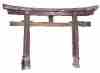
Read this news story and the email received in response to it. How would you respond?
While in Japan in February 2002 for economic talks with Japanese Prime Minister Junichiro Koizumi, U.S. President George W. Bush planned to visit the Meiji Shrine in Tokyo to experience part of Japanese culture. Former U.S. presidents Jimmy Carter and Ronald Reagan had also toured the Meiji Shrine during visits to Japan.
Although President Bush was coming to Japan as a guest of Prime Minister Koizumi, the prime minister said he would skip the shrine visit because it would be politically awkward for a Japanese prime minister to lend official status to a place where ruling emperors were once worshiped as divine.
The Shinto shrine is dedicated to Emperor Meiji, the grandfather of Hirohito, the Japanese emperor during World War II. Emperor Meiji played a major role in transforming Japan from a feudal state into a modern industrial country. The Meiji Shrine is one of several shrines associated with Japan's imperial family and is said to enshrine the deceased emperor's spirit. The shrine was destroyed by U.S. bombing during World War II and rebuilt in 1958.
White House officials said that the president would observe customary sanpai etiquette at the shrine entrance by bowing and clapping. He would also sign the shrine's registry book.
In response to the story about President Bush's visit to the Meiji Shrine, I received the following email. Suppose I asked you to help me compose a response. What would you suggest that I write?
Praise the name of the Lord!
I am a Japanese Christian. We Japanese Christians are shocked by reports that the U.S. president will visit the Meiji Shrine and pray to the Shinto gods while he is in Japan.
Our pastor preaches that we should have no other gods before the Lord our God. Each New Year's Day, ordinary Japanese people go to shrines and pray to the Shinto gods. Many Christian churches in Japan hold a special New Year's Day service to help Christians resist the social pressure to visit shrines then. It is not easy to be a Christian in Japan. The American president's planned prayer to the Shinto gods will greatly hamper our evangelistic outreach. Please understand our situation and pray for us.
May God bless you!
—Takahiko Yamada
What would you say in response to this Japanese Christian?
See these seven steps for effectively using a case study.
—Howard Culbertson, hculbert@snu.edu
Shinto is an indigenous religious and spiritual tradition of Japan. It is deeply ingrained in Japanese culture and history, influencing daily life, rituals, and social customs. Here is a brief overview:
Shinto remains an important part of Japanese society, connecting many people with traditional rituals, the natural world, and Japan's cultural heritage.
S – Sacred connection to nature and kami (spirits)
H – Harmony with the natural and spiritual worlds
I – Inner purity through rituals and cleanliness
N – Nature revered as divine and sacred
T – Tradition and reverence for ancestors
O – Offerings and prayers at shrines
Like acrostics? Here are more of them.


