Expelling Merchants from the Temple: No Room for the Nations
TL;DR:
Jesus' dramatic cleansing of the Temple wasn’t just about opposing exorbitant profiteering. It was a powerful act tied to His passion for world evangelism. Quoting Isaiah 56:7, “My house will be called a house of prayer for all nations,” Jesus condemned the takeover of the Court of the Gentiles because that left non-Jews without a place to worship.
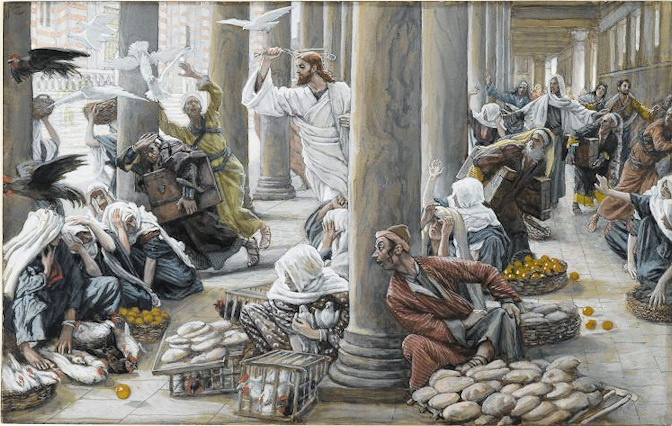
The Merchants Chased from the Temple, watercolor by James Tissot, c. 1886, Brooklyn Museum |
Image Source
All four Gospels tell the story of Jesus expelling merchants and money changers from the Temple.
The cleansing of the Temple shows how much world evangelism was on Jesus' mind in the days before His crucifixion.
When we lightly pass over the last three words of Isaiah 56:7 — "for all nations" — we may miss a key reason Jesus was upset at the merchants and money changers.
In effect, the merchants had “stolen” from the Gentiles their assigned place of worship in the Temple at Jerusalem.
Commentary on Mark 11 — How is Jesus driving the money changers out of the Temple in Jerusalem related to world evangelism?
“And as He taught them, He said, ‘Is it not written: “My house will be called a house of prayer for all nations”?1 But you have made it “a den of robbers.”’” — Mark 11:17
Rarely does this story (which is found in all four Gospels) lead to reflections about world evangelism. That is lamentable, given that Jesus quoted Isaiah 56:7 as the reason for His actions: "My house shall be called a house of prayer for all nations."
Discussions about the Temple cleansing seldom mention Isaiah's “for all nations” phrase. Only Mark includes the whole verse from Isaiah. Ignoring those three words may obscure an important dimension of what happened that day.
Corrupt commerce was certainly bad, but the core issue may have been that the Court of the Gentiles was overtaken, leaving no room for non-Jews to worship. The Temple had ceased to be “a house of prayer for all nations.”
Matthew, Mark, and Luke place the Temple cleansing during Jesus’ final visit to Jerusalem. By Friday, Jesus had died as “the atoning sacrifice for our sins, and not only for ours but also for the sins of the whole world” (1 John 2:2). His concern for all peoples likely weighed heavily as Passover began — perhaps already forming the words: “Go into all the world and preach the gospel to all creation” (Mark 16:15) and “you will be my witnesses ... to the ends of the earth” (Acts 1:8).
What thievery had the money changers committed?
Given what Jesus would face later that week, it's logical His heart was focused on “all nations.” This made Him especially sensitive to the occupation of the Gentile area by money changers. While price-gouging and fraud desecrated the Temple, what likely enraged Jesus was that Gentiles were pushed out. The Temple could no longer serve as “a house of prayer for all nations.”
Jesus’ earthly life began in Bethlehem with no guest room available for His family. Isn’t it ironic that, near the end of His earthly life, He encountered another kind of “no room” message?
This time, it was, in effect, a “No Room for Gentiles” sign in the Temple. Shortly thereafter, Jesus was arrested and crucified — for those very Gentiles! That context may help explain the intensity of His response. Shouldn't our emotions also be stirred when barriers are placed in the way of “all nations” hearing the call to worship?
Reflection Questions
What is the significance of "for all nations" in Isaiah 56:7? Does Jesus’ reference reflect His passion for world evangelism?
Why are discussions about the Temple cleansing often missing the "for all nations" phrase? How central is it to the story?
What was the impact of the Court of the Gentiles being taken over? How does that relate to the Great Commission?
Does the “no room” sign at Jesus' death echo the one at His birth? What do these messages say to the cause of world evangelism?
1 In this biblical context, “nations” refers primarily to the world’s peoples or ethnic groups rather than simply to modern political states. The Greek word ethnē can mean nations, Gentiles, or peoples, depending on the context.↩
Background: The Presence of Money Changers in the Temple
The money changers provided two services:
Temple Tax: Adult Jewish males were expected to pay an annual half-shekel Temple tax. Money changers exchanged Roman or local coins for the required currency.
Animal Purchases: Many travelers bought sacrificial animals at the Temple instead of bringing them from home. Animal sellers provided the sacrifices, while money changers enabled travelers to obtain the currency needed for Temple-related payments and purchases.
Background: The Court of the Gentiles
This was the outermost Temple courtyard during the Second Temple era, open to Gentiles. Here's what we know:
The Court accommodated Gentiles who were not allowed in the inner courts.
It welcomed those drawn to Judaism who wished to pray to Israel's God.
It symbolized God’s openness to all peoples.
It was used for teaching — Jewish leaders often spoke with visiting Gentiles there.
It reflected the cultural diversity of first-century Jerusalem.
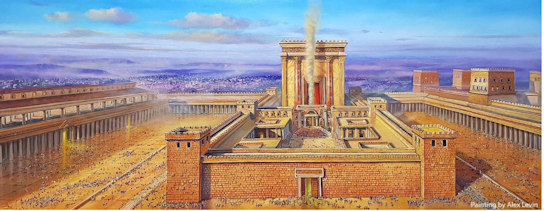
It was a vast outer precinct surrounding the Temple’s restricted inner courts. The entire Temple Mount covered about 35 acres — roughly 26 American football fields, including the end zones — and the Court of the Gentiles occupied much of that broad platform. Its exact acreage is uncertain, but it was by far the largest area of the Temple complex open to the public.
Sadly, this space was overrun by commerce, leaving no room for "all nations."
Noteworthy Quotes on the Relevance of Mark 11:17 to World Evangelism
“Jesus’ cleansing of the temple was not merely an act of purification but a prophetic sign that the temple was to be a place for all nations. By quoting Isaiah 56:7, He emphasized that God's house was intended as a house of prayer for all peoples.” — Christopher J.H. Wright, The Mission of God, p. 526.
“The phrase ‘house of prayer for all nations’ underscores the missionary dimension of Jesus’ ministry. His actions critique any exclusivism that hinders Gentile inclusion in worship.” — R.T. France, The Gospel of Mark, p. 446.
“By declaring the temple a 'den of robbers,' Jesus condemned corruption that turned a place meant for all nations into a marketplace. It’s a call for the church to welcome all ethnicities.” — N.T. Wright, Mark for Everyone, p. 157.