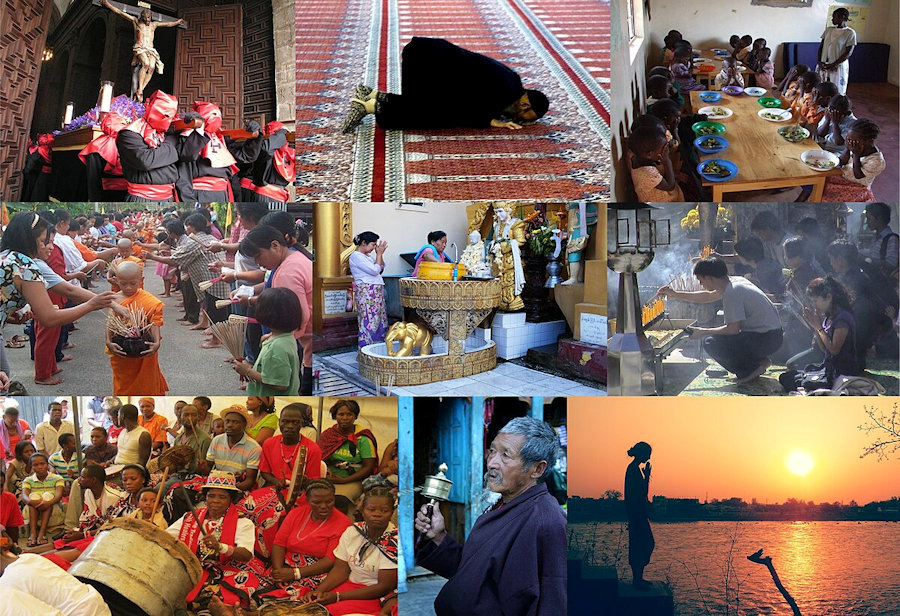
TL;DR: Christians studying other faiths should combine firm convictions with respect, humility, curiosity, critical thinking, compassionate dialogue, and prayer. Test your knowledge of major world religions with a crossword puzzle.
Challenge: Can you solve this puzzle even if you do not have the textbook and did not go on the field trips?

| ACROSS | ||
|---|---|---|
| 3 | Religious books of Hinduism | |
| 4 | The number of "noble truths" in Buddhism | |
| 5 | A Chinese tradition that emphasizes simplicity, harmony with the Tao, and effortless action | |
| 7 | A hierarchical social ordering of people (with no options for upward mobility) that is a fundamental part of the Hindu worldview | |
| 10 | In religions on the Indian sub-continent, the term applied to a holy person (man or woman) acknowledged to be in deep union or communion with a deity | |
| 11 | The major religious tradition of India that is a syncretistic body of religious, philosophical, and social doctrines | |
| 12 | A religious movement organized by Joseph Smith in 1830 that teaches God the Father has a body of flesh and bones | |
| 13 | An umbrella term for indigenous religions that are sometimes called "primal religions" | |
| 17 | The number of times a day that Muslims are supposed to pray | |
| 18 | A group of physical, mental, and spiritual practices used in Hinduism and Buddhism | |
| 19 | A place of worship in many Hindu and Buddhist traditions | |
| DOWN | ||
| 1 | Principles of conduct based on the teachings of a Chinese man who saw human beings as rational and moral creatures who owe obligations to society and the state | |
| 2 | A monotheistic religion that began with a prophet on the Arabian peninsula. Its followers often see religion and state as expressions of the same, single reality that harmonize well with each other. | |
| 6 | A religion that developed in India through the teachings of Guru Nanak and nine succeeding gurus | |
| 8 | The monotheistic religion of the Jewish people, whose sacred writings include the Torah and whose traditions include the Talmud | |
| 9 | A tradition that teaches a path toward liberation from suffering and the cycle of rebirth, with nirvana as its ultimate goal | |
| 14 | The house of worship for Muslims | |
| 15 | A cosmological theory expressing the interdependence of opposite movements in nature, society, and human beings. The concept appears in Confucianism and Taoism as well as in Chinese folk religions. | |
| 16 | A common practice in almost all religions, this is one of the "Five Pillars" of Islam. | |
-- Howard Culbertson, hculbert@snu.edu
Studying other religions as an evangelical Christian must be done with a delicate balance of conviction, respect, and openness. Here are some attitudes to consider:


More word puzzles: Crosswords plus word searches and word scrambles
 Looking for other materials related to World Religions? Click here!