More classic art masterpieces used as illustrations
TL;DR: Boniface’s bold act of cutting down a sacred oak tree demonstrated Thor’s powerlessness to protect it. This power encounter contributed to the spread of Christianity among the Germanic peoples and illustrates how divine demonstrations can complement reasoned truth encounters in spreading the gospel. The page includes reflection questions and an acrostic on the name BONIFACE.
This article about Boniface was number two of a dozen mini-essays published in a "Doing Missions Well" series in Engage, an online magazine produced by the Church of the Nazarene.
Evangelistic efforts often center on communicating biblical truth through preaching, home Bible studies, one-on-one conversations, the distribution of pamphlets, Scripture portions and complete Bibles, and JESUS film showings. In these "truth encounters," gospel truths confront false beliefs through reasoned arguments.
From time to time, though, God also powerfully intervenes in this world in ways that demonstrate His ultimate sovereignty over all things. That's what He did on Mt. Carmel in the showdown between Elijah and the prophets of Baal (1 Kings 18). Sometimes, an event like that helps unbelievers recognize the identity and power of God Almighty. In this way, it can become an evangelistic event that draws people to God.
Those episodes in which unbelievers witness God's powerful hand at work are called "power encounters." Such power encounters occurred periodically in biblical times. Think, for instance, of Daniel in the lion's den or of Jesus casting out demons.
Divine power encounters did not fade away after the first century. They have continued to happen throughout the history of world evangelism. These encounters have included protection from evil forces, survival during fierce persecution, healing, changes in weather, and even dreams and visions experienced by nonbelievers.
One evangelistic power encounter in the early 700s involved a missionary named Boniface. Boniface had entered the ministry in his native England and became a scholar and a teacher. His life as a scholar and teacher was successful and relatively secure. Then he felt called to cross-cultural evangelism and was sent as a missionary to Germanic peoples in what is now central Germany.
Initially, Boniface had little success in turning people from their pagan religions to faith in Jesus. Even those who expressed some interest seemed reluctant to move completely away from their traditional religious beliefs. Finally, Boniface felt led to do something extraordinary.
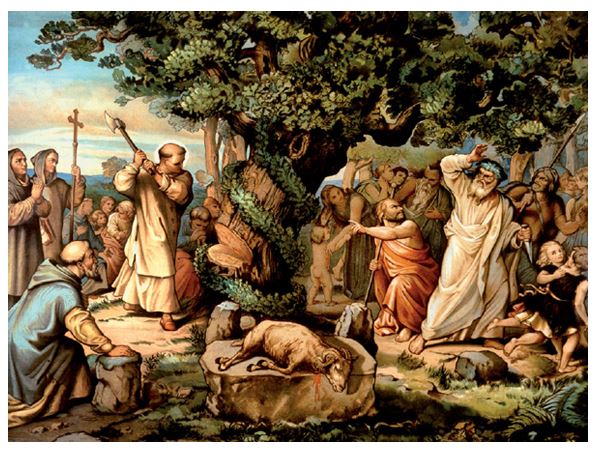
According to later retellings, Boniface announced that he was going to cut down Donar's Oak (also known as Thor's Oak or Jove's Oak) near Geismar. That tree had been dedicated to Thor, the god of thunder and war. Sacred trees and groves have played important roles in various traditional religions. Boniface apparently intended the audacious act to demonstrate Thor’s powerlessness and show the people that the object of their worship could not protect the tree.
In these retellings, a crowd of local people gathered at the tree, confident that Thor would show his power. Perhaps they thought that Thor would strike down this brash foreigner. At any rate, Boniface began chopping at the trunk with his ax. The people waited for Thor to do something, but nothing happened. Then they watched as the tree came crashing down.
According to Boniface’s early biographer, he used the oak’s timber to build a chapel dedicated to Saint Peter. According to the traditional account, this dramatic event became an important symbol of Christianity's advance among the Germanic peoples.
Many truth encounters would follow as the gospel spread across Germany. On that day, however, a power encounter showed who was powerless and who truly was, as Moses said, "the God of gods" (Deuteronomy 10:17).
Truth encounters and power encounters have both played prominent roles in global gospel outreach. Truth encounters involve the oral and written proclamation and teaching of gospel truths. Power encounters demonstrate God's sovereignty over all things in extraordinary ways. Missiologists such as Charles Kraft, Paul Hiebert, and C. Peter Wagner helped develop and popularize this framework.
Boniface’s felling of the sacred oak was understood as demonstrating that Thor was powerless to protect it. Events interpreted as power encounters have sometimes helped open the way for cross-cultural evangelism. Boniface’s ministry became an important part of Christianity’s expansion among the Germanic peoples.
—Howard Culbertson, hculbert@snu.edu


