TL;DR:
Canaan's location along the land routes between Africa and Asia, with connections to Europe, made it a strategic crossroads for trade, travel, and cultural exchange. God's choice of Canaan as the Promised Land may have served His purpose of making Himself known among the nations. Similarly, Jesus' instruction for His followers to remain in Jerusalem before Pentecost placed them where they could proclaim the gospel to the festival's international audience. Acts explicitly says they were to wait for the promised Holy Spirit; the geographical significance is a missionary reflection on that setting.
"This is Jerusalem, which I have set in the center of the nations, with countries all around her." — Ezekiel 5:5, excerpt (NIV)
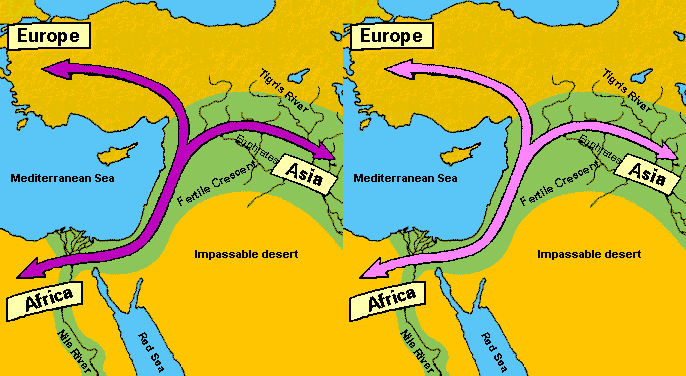
Why did God ask Abraham to uproot his family and move all the way to Canaan? Why did the Lord call him to travel from one part of the Fertile Crescent to another? One possible consideration is strategy. Missiologists have long pointed to the strategic importance of the region that Christians today often call the Holy Land. Ancient Canaan's boundaries varied; it should not be understood simply as the territory between the Mediterranean Sea and the Jordan River.
Ancient Canaan overlapped areas now known as Israel and the Palestinian territories, as well as parts of neighboring countries. The Mediterranean Sea lay to the west, while arid lands to the east restricted travel. Major routes between Egypt and western Asia passed through the region, with onward connections to Europe. This location offered opportunities for God to make Himself known throughout the ancient world.
Maintaining a community in this contested corridor posed enormous challenges. The history of Israel and Judah includes periods of independence, foreign domination, conquest, and exile. Was it a mere coincidence that God placed His people along these routes? Their location invites reflection on their calling to make Him known among the nations. Ezekiel 5:5 describes Jerusalem's central position, although its immediate context concerns rebellion and judgment. The missionary application offered here is an interpretation of that geographical setting, considered alongside passages such as Isaiah 66 and Psalms 9 and 105.
More on God's instructions to Abraham to move to Canaan
Map idea taken from Bible Mapbook by Simon Jenkins, published by Lion Publishing, and reproduced by permission.
As a bridge between continents and empires, the land was a constant battleground down the centuries. Whoever controls Israel controls the land bridge between Europe, Africa, and Asia. The skinny little land bridge that was home to Israel and Judah knows the tramp of many a foreign foot as more powerful nations crisscrossed it en route to great power struggles elsewhere.
An understanding of Jewish history rests on appreciating how Israel’s location on a bridge between Africa and Asia shaped Jewish history in many ways. The "superpowers" of the period were Egypt, to Israel's southwest; Assyria and Babylonia, to Israel's northeast; and, later, Rome and Greece, to the northwest.
As the great powers battled each other through the centuries, they necessarily had to traverse the land bridge on which Israel was located. That means the history of the land of Israel is something like that of the Baltic states, caught between Germany and Russia. As the balance of power swung between those superpowers, conquering armies would march through the countries separating them, sometimes forcing local residents to adopt the culture of the conqueror. Likewise, Jewish history is a story of great powers, wars, invasions, revolts, and exiles.
Just before Jesus' ascension into heaven, He told His followers to stay in Jerusalem and wait for the gift His Father had promised, the Holy Spirit (Acts 1:4-5). Alongside that explicit purpose, might the location also have had strategic significance?
Many of Jesus' followers came from Galilee rather than Jerusalem. In Acts 2:7, the crowd expressed amazement that the speakers were Galileans. The passage does not say that their accents revealed their origin.
Jerusalem was filled with people from many regions during the celebration of Pentecost. What an international audience the city provided for proclaiming the good news! Having Jesus' followers in Jerusalem for that festival may also reflect God's missionary purposes.
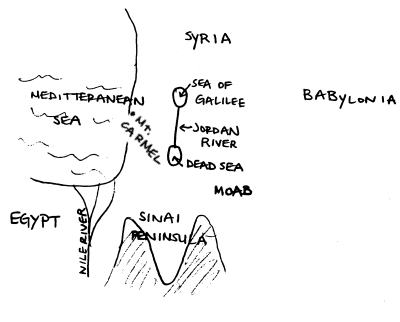
On the first exam in Introduction to Biblical Literature, students may be asked to draw a map of the eastern Mediterranean by hand and indicate the location of several places. Check the study guide for your particular class requirements, including the locations that should be labeled.
Maps will not be graded on artistic quality or precise scale. Below is an example that meets the expectations. Although the drawing is approximate, it shows that the student understands the relative locations of the places and could identify them on a professionally prepared map of the region.
— Howard Culbertson, hculbert@snu.edu
The Levant is a historical and geographical term for a region of the eastern Mediterranean. Its boundaries vary by usage, but it commonly includes Israel, the Palestinian territories, Lebanon, Syria, and Jordan; some definitions also include parts of Turkey or Cyprus. The name comes from the French word levant, meaning "rising," referring to the direction of the rising sun.
The Levant lies along routes linking Africa and Asia, with connections to Europe. Its strategic location has made it a crossroads for trade, migration, and cultural exchange, as well as a frequent arena of conflict.
The region was home to the Canaanites, Phoenicians, and Israelites, among others, and came under the rule of empires such as Assyria. Its position brought different peoples and powers into repeated contact.
Names applied to different parts of the region at different times include Canaan, Judah, Samaria, Galilee, and Palestine. Bilad al-Sham is an Arabic name for the broader historical Syrian region; its boundaries do not correspond exactly to those of ancient Canaan.
Biblical descriptions should be distinguished from geographical names. "A land flowing with milk and honey" describes the land's abundance (Exodus 3:8). "Beulah," meaning "married," is a symbolic name used in Isaiah 62:4 rather than a historical name for the whole Levant.
 | How can we know what God expects of us? What is God's plan for the world? These questions and others are answered in the Old Testament. [ more ] |
C — Connection route for trade and travel,
A — Ancient land where ideas and people met,
N — Nestled among great empires,
A — Artery of cultural and commercial exchange,
A — A passage linking Africa and Asia, with connections to Europe,
N — Nexus of history, where civilizations met.
Like acrostics? Here are more of them.


