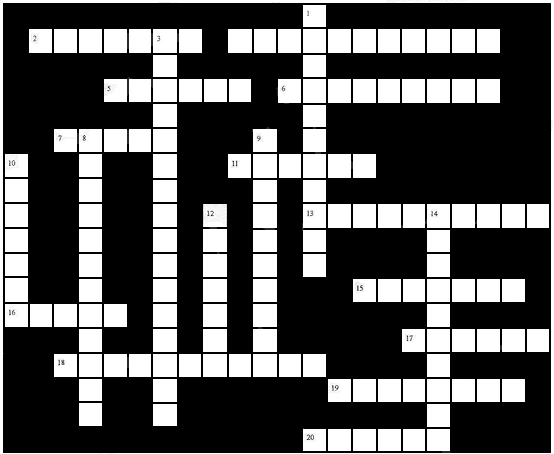
Crossword puzzle from material in Rodney Clapp's A Peculiar People
Chapters: "The Church as Nation-State" and "The Church as Type"
In the course "Ministry, Church and Society," students present much of the textbook material through group presentations, using a variety of methods to communicate its ideas and concepts.
As part of its class presentation, one group created this crossword puzzle to help classmates explore chapters 3 and 4 of Rodney Clapp's book. These chapters describe the church as a body of believers forming a universal society that is distinctly and exhilaratingly Christian.
Use the clues and word bank to complete the puzzle.
Challenge: Can you solve this puzzle using the word bank even if you do not have Clapp's book?
Word bank
- America
- Anthropology
- Arnold
- Binary
- Christ
- Church
- Constantinianism
- Culture
- Distinctly
- Ethos
- Evangelical
- Forgiveness
- Industrial
- Information
- Institution
- Liberal
- Literature
- Political
- Progress
- Public
- Saint
- Spiritual
- True Church
- Visible
Across:
- When it comes to Christian culture and politics, ______ is not the issue.
- ________ Protestantism officially dominated.
- According to __________, culture was "the best that is known and thought."
- Aristotle considered human beings to be this type of animal.
- What one writer said former U.S. President Clinton would never be.
- It has been said that Mother Teresa saw things in these terms.
- During the ________ Revolution, culture was what stood between people and machines.
- Matthew Arnold describes culture as a separate dimension or realm using this type of model.
- Aristotle's "most powerful insight" is that moral life is based on this.
- H. Richard Niebuhr wrote a book titled ________ and Culture.
- Charles Colson holds that this biblical act deals extensively with the evil in one's heart.
- America and the church are continual works in ___________.
- G.K. Chesterton is quoted as saying that America is the nation with the soul of a
__________.
Down:
- We find ourselves in a fast-paced, transitional period because we live in this type of
society.
- Embracing ___________ is a tough habit for American evangelicals to break.
- This is the study of what makes us human.
- Early on, the term __________ referred to all forms of writing.
- In the mid-18th century, most prominent European philosophies saw _________ as synonymous with civilization.
- This can influence every aspect of life when it becomes a way of life that shapes character.
- As we look at history, we assume that some indivisible spiritual reality outside time and space makes up the ______________.
Is your group having problems?
— Howard Culbertson, hculbert@snu.edu
You might also like these


