More classic art masterpieces used as illustrations
Written by Paul Hiebert, with some editing by Howard Culbertson
Venkayya felt the burning forehead of his young daughter. He had prayed fervently all afternoon, and still, the fever mounted. The red spots on the child's face and body left no doubt that she had come down with smallpox.
Venkayya's dilemma began when an outbreak of smallpox struck Muchintala, a small village in southern India. The village elders called the government doctor. He distributed medicine and administered injections. Sadly, these seemed to have little effect on the spreading disease. After several children had died, the elders called in the village diviner to determine the reason for the plague.
The diviner announced that Shitala Mata, the goddess of smallpox who lived in a rock under a tree outside the village, was angry with the village. The diviner reminded the village that five years before, they had offered Shitala Mata only two goats instead of the usual water buffalo at her festival. No festival had been held since then. Since Shitala Mata expected a sacrifice every three or four years, the diviner said she was now angry with the village.
When the elders heard this, they arranged for a water buffalo sacrifice. Messengers went to every house in the village to gather donations to purchase the animal. The elders knew that, to satisfy the goddess, every household needed to contribute something.
When a messenger came to the house where Venkayya and his two younger brothers lived, Venkayya told the man that he and his brothers had become Christians three years earlier. Because of that, they could not contribute to the sacrifice. It would be against their religious beliefs.
The messenger reported this to the high-caste elders, who became angry. How could anyone in the village—especially someone whom they regarded as "untouchable," such as Venkayya—disobey their orders? Summoning Venkayya, they demanded an explanation. He told them that he and his brothers had become Christians and that Christians worshiped no gods but the God of the Bible. Their God, Yahweh, would take care of them, he said.
The elders responded that they did not object if Venkayya and his family worshiped the Christian God. Everyone had the right to worship the deity of his or her choice (ishta devata). But Shitala Mata was something different. She was not a god like Rama, Allah, or the Christian God, all of whom live in the heavens.
Shitala Mata was an earthly spirit who lived near their village. If the village did not keep her satisfied, she would continue to plague the children. Everyone in the village had to contribute something, or Shitala Mata would be displeased. Besides, did just giving her something to eat really constitute worship?
"Even the Muslims," they said, "who worship only one god, gave money to buy the water buffalo so that their children would not die."
Venkayya responded that a Christian could not offer a sacrifice, even to local spirits. The elders grew angrier. It was all right, they said, if he killed his own children by refusing to make the sacrifice, but he was to blame if other village children died. Moreover, he was disobeying the village elders. That was an unforgivable offense.
To show their authority and pressure him to change his mind, the elders placed Venkayya, his brothers, and their families under a village ban. No one in the village could talk to them, sell them goods, or marry their children. If they did, they too would come under the ban.
The next week was difficult for the new Christians. They had to walk to the next village to buy food. Because they were forbidden to draw water from the well assigned to their caste, the women had to fetch it from a stream half a mile outside the village.
When more children died, the elders summoned Venkayya. They told him that they would bar him from working in his fields if he did not contribute a rupee for the offering. Again, Venkayya held firmly to his convictions.
The following week was almost unbearable. The young men of the village prevented Venkayya and his brothers from irrigating their small rice fields. Under the hot sun, the paddy began to wilt. If something was not done soon, there would be no harvest and nothing to live on next year.
Finally, Rangayya and Pullayya, Venkayya's younger brothers, came to him and said, "We must give in to the pressures of the elders, or we will all die. God will understand if we give them a rupee. We will tell him we did not give it as an offering to the spirit but as a tax demanded by the village elders. Besides, Shitala Mata is not a goddess living in the heavens. She is only a local godling living in a rock. Offering her a sacrifice is not worship. It is only food to placate her anger. It is like giving something to a belligerent official to keep the peace."
Four days later, Venkayya's own little daughter came down with the dreaded disease. Venkayya began to doubt his own judgment. So he went to see the missionary who lived forty miles away. The missionary prayed for Venkayya's daughter and exhorted him to stand firm in his refusal to contribute to the sacrifice.
Now Venkayya and his family had prayed all afternoon, but God seemed far away. The medicine the doctor had given for his daughter made little difference to her rising fever. Venkayya wondered whether he had been wrong to refuse to contribute even one rupee to the elders. Local spirits like Shitala Mata were not gods like the God of the Bible. Was it wrong, therefore, to feed them to keep them happy? They were not much different from the officials who made life hard for everyone in the village and needed to be placated with gifts. Maybe the missionary was wrong. He really did not understand the village or the local spirits. Could Venkayya not pray for God to heal his child while also giving a rupee for the sacrifice?
As night came, Venkayya looked at his wife as she pleaded with God for her child's life. Would God heal the little girl? And if God did not, what would he say if the villagers scoffed at his God? Maybe his brothers were right. Maybe he should go to the village headman and give him one rupee to help buy a water buffalo for Shitala Mata. Then, who knows, his daughter might live. And even if she did not, he would not be blamed for the deaths of other children. Then, he could work in the fields, and his family could live in peace in the village.
Finally, he decided to . . .
Seven study guidelines to aid reflection and discussion on this case study.
This case study appeared in its original form in Case Studies in Missions, edited by Paul and Frances Hiebert, Baker Book House. Edited and used with permission. The original publication notice stated that this case study could be reproduced only upon payment of a 35-cent royalty per copy to Baker Book House, P.O. Box 6787, Grand Rapids, MI 49516 USA.
— Howard Culbertson, hculbert@snu.edu
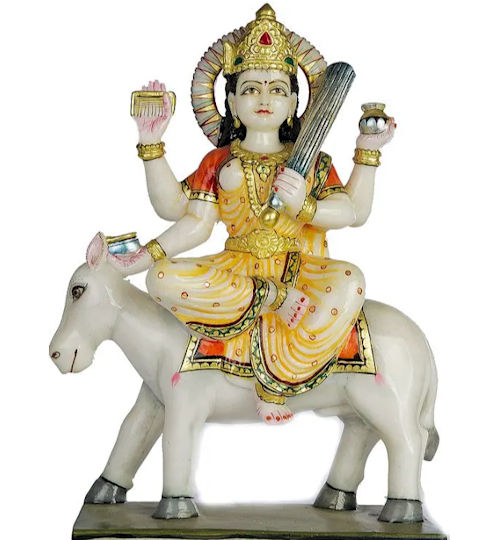
Shitala Mata, also known as Shitala Devi, is a Hindu goddess traditionally associated with smallpox and other infectious diseases. Her name, "Shitala," means "cool" in Sanskrit, reflecting her role in bringing relief and healing.
Shitala Mata is considered a benevolent and nurturing figure. She is usually portrayed riding a donkey and carrying a broom to symbolize her role in sweeping away disease. Her worship often involves rituals and offerings to seek her blessings for health and protection.
Devotees worship Shitala Mata and seek her blessings for the health and well-being of their families and communities. Historically, her worship was associated especially with smallpox; today, devotees may also associate her with protection from other infectious diseases. Her festival, known as Shitala Ashtami, is celebrated with various rituals. It is a major event in some parts of India.


