TL;DR:
From 1200 to 1600 AD, Christianity's global missionary expansion was largely carried out by Roman Catholic religious orders such as the Franciscans, Dominicans, and Jesuits. During this period, religious orders became major forces in cross-cultural evangelism. Francis of Assisi and early Jesuit missionaries helped expand Christianity's worldwide outreach. The orders' organizational flexibility helped them work across a wide geographic area.
The popular image of Christian monasticism often brings to mind hermits, cloisters, and ascetics such as Simeon Stylites. Monastic communities originated in northern Egypt in the fourth century. During its early centuries, much of monasticism emphasized solitude, disciplined communal life, and separation from ordinary society. As scholars would remind us, the words monasticism and monk are rooted in the Greek word monos, which can be translated as "alone."
By the thirteenth century, new religious orders were placing greater emphasis on active ministry beyond the cloister. The movement that had sought to rediscover Christianity by withdrawing from the world and trying to attain holiness by total separation developed into an outward-looking evangelistic movement. During these four centuries—which included the beginnings of European overseas exploration and colonization—religious orders became important centers of missionary training and activity. Historian George Smith asserted that one of the most positive things about the religious orders "was the missionary organization through which Christendom worked up to Wycliffe, Huss, and Luther."1 A list of prominent Western Church, or Roman Catholic, missionaries from this period demonstrates the importance of religious orders in world evangelism. Nearly all the names on such a list were members of religious orders. Relatively few "secular" clergy participated in cross-cultural evangelism. Stephen Neill calls the founding of the Jesuit order in this period "the most important event in the missionary history of the Roman Catholic church."2
Today, numerous Roman Catholic religious orders continue to engage in missionary work. Among the best-known Roman Catholic religious orders are (in alphabetical order) the Augustinians (Order of St. Augustine), the Benedictines (Order of St. Benedict), the Carthusians (Carthusian Order), the Dominicans (Order of Preachers), the Franciscans (Order of Friars Minor), the Jesuits (Society of Jesus), the Missionaries of Charity, and the Salesians (the Society of St. Francis de Sales). Not all of these orders emphasize active missionary work.
Missionary outreach by religious orders received a major impetus with the formation of the Franciscans early in the thirteenth century. Francis of Assisi infused his followers with a missionary spirit. [More on Francis]
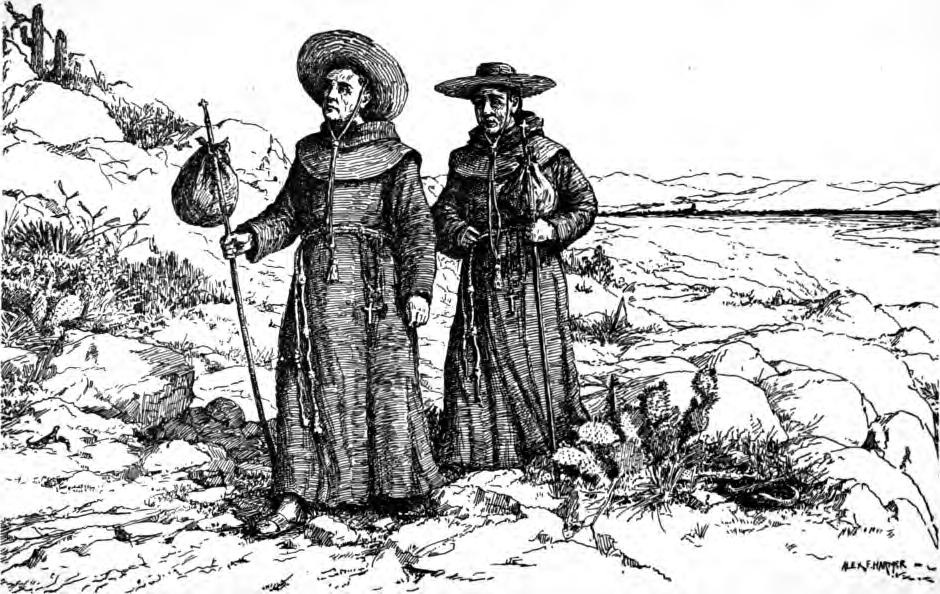
According to an early account, when Francis's group of followers reached seventy-two—the number Jesus sent out in Luke 10—he paired them and sent them out two by two. His commission to each pair was: "Go, proclaim peace to men; preach repentance. You shall increase to a great multitude and shall go on increasing to the end of the world."3
Francis accompanied the Fifth Crusade as a preacher rather than a combatant. While in Egypt, he met Sultan al-Kamil and spoke with him about the Christian faith.
Historian Williston Walker wrote that, from Francis of Assisi on, missionary outreach "was primarily the endeavor of the monastic orders. . . . To the work of these orders, the Christianity of Southern, Central, and large parts of North America is due. . . . They covered the Philippines."4 Roman Catholic religious orders also carried the gospel message to major countries of Asia, such as Japan, China, and India. They were to be found as well in Africa. Of the major continents of the world, only During this period, Australia apparently received none of the sustained missionary activity undertaken by religious orders on the other inhabited continents.
A brief window of opportunity for gospel outreach opened in the Mongol Empire. Missionaries of the Church of the East had carried Christianity into Central Asia centuries earlier, and some tribes later incorporated into the Mongol Empire included Christians. The Mongol rulers generally permitted several religions to coexist within their domains.
Some members of the Mongol royal family were Christians or had close ties to Christian communities. Sorghaghtani Beki, a daughter-in-law of Genghis Khan, was a Christian of the Church of the East. She was the mother of four influential sons: Möngke, Kublai, Hulagu, and Ariq Böke. During the thirteenth century, Franciscan and Dominican envoys and missionaries also traveled to Mongol territories, hoping to establish diplomatic and religious relationships.
According to Marco Polo's account, his father, Niccolò, and his uncle, Maffeo, visited Kublai Khan's court. Kublai, who later established the Yuan dynasty and ruled China from his capital at present-day Beijing, received them courteously and showed interest in the Western world. He asked the brothers to return to Europe as his emissaries and request that the pope send one hundred learned Christians to explain the Christian faith and Western learning.
When the Polos reached Acre, they learned that Pope Clement IV had died and that no successor had been elected. The prolonged papal election took place in Viterbo, where local officials attempted to hasten a decision by restricting the cardinals' provisions and removing the roof of their meeting place. After Gregory X was elected, he appointed two Dominican friars to accompany the Polos eastward. The friars soon turned back, however, and the one hundred Christian teachers Kublai had requested were never sent.
The history of Christianity among the Mongols is a history of "what ifs." We cannot know what might have happened had Western Christians responded more fully. However, there does seem to have been a window of opportunity for Christianity in the Mongol Empire. Sadly, Western Christians did not respond adequately while that opportunity remained open.
Today, the Roman Catholic orders are proud of their missionary past. During a visit to the small town of Assisi in central Italy, a Franciscan friar reminded me that his religious order had evangelized much of the American Southwest.
The effectiveness of these religious orders in cross-cultural missionary outreach was partly due to their organizational flexibility. Each order had its own leadership structure and missionary methods, although all operated within the authority of the Roman Catholic Church. To be sure, such independence at times produced a spirit of competition between the various orders. Even so, one must acknowledge that such competition was not always negative.
What, then, was the Western Church's (or Roman Catholic Church's) missionary strategy from 1200 to 1600 AD? It depended primarily on personnel from religious orders. Latourette sums it up by simply saying that in this period, Roman Catholic missionaries were "monks, and such orders as the Franciscans, Dominicans, and Jesuits had world missions as a major objective."5
— Howard Culbertson, hculbert@snu.edu
From 1200 to 1600, Roman Catholic missions conducted by religious orders played a valuable role in spreading Christianity around the globe. Here are seven things to know about what happened in world evangelism during those four centuries:


 By the 1600s, missionary outreach was beginning to touch several continents. [ read more ]
Evangelizing the Barbarians (400–800 AD)
Evangelizing the Vikings (800–1200 AD)