Should I eat food offered in worship during a Buddhist temple ritual?
TL;DR:
This case study highlights the tension between maintaining interfaith friendships and remaining faithful to biblical principles. A young Christian named Meijung faces a cultural and spiritual dilemma when her Buddhist friend Shuo invites her to join a celebration at a temple. After observing a ritual in which food and wine are offered to the gods, Meijung is invited to share the food. She must weigh friendship and courtesy against her Christian convictions.
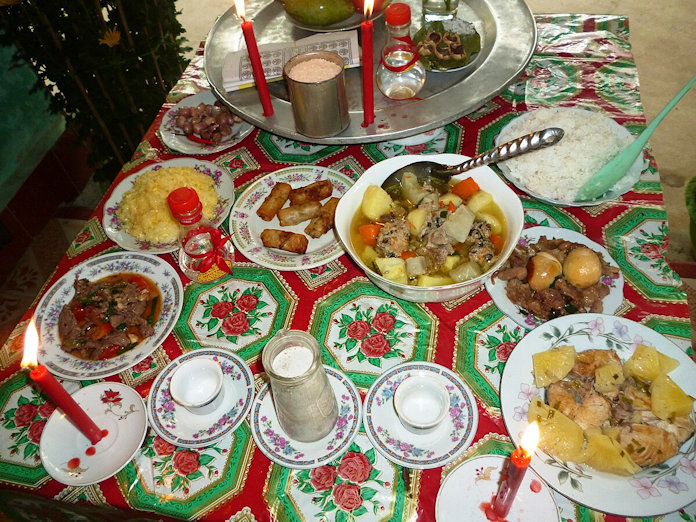
Food offered during worship at a Buddhist Tết festival in Vietnam. Photograph by Phương Huy, 2015.
|
Image source
Religious differences can complicate friendships between people of different faiths.
Friends from different religious backgrounds can face a
dilemma when invited to eat food offered to gods in a Buddhist temple ritual.
An invitation to eat food used in a Buddhist ritual may cause Christians to reflect on
biblical teachings about what defiles a person and what can cause stumbling blocks for
others.
A young Christian named Meijung accepted an invitation to celebrate a
Buddhist holiday with three of her friends. One friend was a Roman Catholic, another was a
Baptist, and the third, whose home they met in, was a Buddhist. After the girls went
together to the temple with their Buddhist friend's family and saw and learned the significance of
the rite, the Buddhist friend's mother invited Meijung and the others to share the food that had
been used in the Buddhist ceremony.
One of the other Christian girls accepted immediately. Shuching declined, saying that
she could not eat food that had been used in a Buddhist rite. It was an awkward moment. Meijung
did not know what she should do.
Meijung, Shuching, Reyhei, and Shuo had been close friends since they met in primary
school in Taipei when each was nine years old. They had shared nearly everything: clothes,
experiences, and opinions. At school, they were inseparable, frequently attending social events
together. Although they practiced different religions, they had often talked about features their
faiths had in common. On a few occasions, they had disagreed about their viewpoints. Although
these conversations were usually animated and sometimes intense, the disagreements did not
threaten their friendship.
Today, however, Meijung was shocked and confused. For the first time in almost eight years
of friendship, a breach had suddenly opened between the girls, and it had happened quickly and
unexpectedly. The three Christian girls had been invited by Shuo, who was a Buddhist, to
celebrate a religious holiday with her.
After arriving at Shuo's home and engaging in girl talk for half an hour or so, Shuo finally
said, "Let me explain this day and the ceremony we will attend."
"Buddhists have many different feast days throughout the year. Fortunately, the one today
falls on a Saturday when we are not in school. Like all faithful Buddhist women, my mother has
prepared special food for today: pork, fish, fruit, and wine. We will take this food and some
flowers to the temple, where my family and I will dedicate the offerings to the gods. After placing the
food at the altar, we will worship and pray for about half an hour, giving the gods time to eat the
food, drink the wine, and smell the flowers. Then we will return home. Any questions?"
"Do you believe the gods consume the food and wine?" Shuching asked.
"Oh yes," replied Shuo.
"Does any of it ever disappear?"
"Not that I can tell, but I believe they eat and drink," Shuo said.
When Shuching appeared incredulous, Meijung responded,
"I can understand. Does the transformation of the food have any similarity to the Roman Catholic understanding of the elements used in
Holy Communion?"
"There is a limited similarity," said Reyhei. "Although the consecrated bread and wine retain their outward appearance, Roman Catholics believe that they become the body and blood of Christ."
At that point, Shuo's mother, father, and two brothers
entered the room. "Are you young ladies ready to go?" the father asked.
"I think so," said Shuo. The girls stood, and they all left for the temple.
The pleasant walk from Shuo's home took only about ten minutes.
Each of the Christian girls—Meijung, Reyhei, and Shuching—had seen the temple many
times. None of the three, however, had ever been inside. It was a 200-year-old structure,
beautiful on the outside and even more impressive within, thought Meijung.
There were sixty or seventy people already inside. Each
family appeared to be engaged in its own private ritual. Shuo indicated a place where her three
friends could sit and observe. Placing the food, wine, and flowers and lighting
the incense at the massive wooden altar took only a few minutes. A period of
quiet prayer followed, during which more incense was lit. To Meijung, each member of Shuo's family appeared
to be deep in thought. Eventually, the father stood, and then so did the others. Shuo turned to her
three friends and whispered, "The gods have had enough to eat." She and her mother then picked up the
dishes with the food on them, poured the wine from the glasses back into the bottle, and placed
all the containers in a basket. Quietly, they all left the temple.
No sooner were they outside than Shuo's brothers excused themselves by saying, "We're
going to watch the regatta that begins at 12:30." The father indicated he was going to get a
newspaper and some pipe tobacco.
As Shuo, her mother, and her three friends began walking toward Shuo's home, the mother
said, "It is lunchtime. Would you girls like to come and share this food with us? I have more at
home because I prepared a lot."
Reyhei immediately said she would like that, but Shuching stopped and said, "I apologize. I
am very sorry. Please do not think I am rude or ungrateful. But I cannot."
"Why not?" laughed Shuo. "Do you have a date this afternoon?"
Lowering her head, Shuching said, "No, I do not have a date."
"Then why don't you join us? We have plenty of food."
"I cannot eat food that has been used in worship."
Meijung had already guessed the reason for Shuching's reluctance, but it was a terribly
awkward moment. Shuo's mother did not appear to be offended, but Shuo blanched.
In a tone of hurt and bewilderment, Shuo asked, "Meijung, what about you? Will you come
and eat with us?"
How should Meijung respond?
What does the Bible say? Five key passages
Matthew 15:1-18
That Which Defiles
15 Then some Pharisees and teachers of the law came to Jesus from Jerusalem and asked,
2 "Why do your disciples break the tradition of the elders? They don't wash their
hands before they eat!" 3Jesus replied, "And why do you break the command of God for the sake of your
tradition? 4 For God said, 'Honor your father and mother' and 'Anyone who curses
their father or mother is to be put to death.' 5 But you say that if anyone declares
that what might have been used to help their father or mother is 'devoted to God,' 6
they are not to 'honor their father or mother' with it. Thus you nullify the word of God for the
sake of your tradition. 7 You hypocrites! Isaiah was right when he prophesied about
you:
8 'These people honor me with their lips,
but their hearts are far from me. 9They worship me in vain;
their teachings are merely human rules.'"
10Jesus called the crowd to him and said, "Listen and understand. 11
What goes into someone's mouth does not defile them, but what comes out of their mouth, that is
what defiles them." 12 Then the disciples came to him and asked, "Do you know that the Pharisees were
offended when they heard this?" 13 He replied, "Every plant that my heavenly Father has not planted will be pulled
up by the roots. 14 Leave them; they are blind guides. If the blind lead the blind,
both will fall into a pit." 15 Peter said, "Explain the parable to us." 16"Are you still so dull?" Jesus asked them. 17 "Don't you see that
whatever enters the mouth goes into the stomach and then out of the body? 18 But
the things that come out of a person's mouth come from the heart, and these defile them."
Mark 7:14-23 14 Again Jesus called the crowd to him and said, "Listen to me, everyone, and
understand this. 15 Nothing outside a person can defile them by going into them.
Rather, it is what comes out of a person that defiles them." [a]17 After he had left the crowd and entered the house, his disciples asked him about
this parable. 18 "Are you so dull?" he asked. "Don't you see that nothing that enters
a person from the outside can defile them? 19 For it doesn't go into their heart but
into their stomach, and then out of the body." (In saying this, Jesus declared all foods clean.) 20 He went on: "What comes out of a person is what defiles them. 21
For it is from within, out of a person's heart, that evil thoughts come—sexual immorality, theft,
murder, 22 adultery, greed, malice, deceit, lewdness, envy, slander, arrogance and
folly. 23 All these evils come from inside and defile a person."
Footnote: a Mark 7:16: Some manuscripts include here the words of Mark 4:23.
Romans 14:13-23 13 Therefore let us stop passing judgment on one another. Instead, make up your
mind not to put any stumbling block or obstacle in the way of a brother or sister. 14
I am convinced, being fully persuaded in the Lord Jesus, that nothing is unclean in itself. But if
anyone regards something as unclean, then for that person it is unclean. 15 If your
brother or sister is distressed because of what you eat, you are no longer acting in love. Do not by
your eating destroy someone for whom Christ died. 16 Therefore do not let what
you know is good be spoken of as evil. 17 For the kingdom of God is not a matter
of eating and drinking, but of righteousness, peace and joy in the Holy Spirit, 18
because anyone who serves Christ in this way is pleasing to God and receives human
approval. 19 Let us therefore make every effort to do what leads to peace and to
mutual edification. 20 Do not destroy the work of God for the sake of food. All food
is clean, but it is wrong for a person to eat anything that causes someone else to stumble.
21 It is better not to eat meat or drink wine or to do anything else that will cause
your brother or sister to fall. 22 So whatever you believe about these things keep
between yourself and God. Blessed is the one who does not condemn himself by what he approves.
23 But whoever has doubts is condemned if they eat, because their eating is not from
faith; and everything that does not come from faith is sin.
Acts 15:19-21 19 "It is my judgment, therefore, that we should not make it difficult for the
Gentiles who are turning to God. 20 Instead we should write to them, telling them
to abstain from food polluted by idols, from sexual immorality, from the meat of strangled
animals and from blood. 21 For the law of Moses has been preached in every city
from the earliest times and is read in the synagogues on every Sabbath."
1 Corinthians 8:1-13
Concerning Food Sacrificed to Idols
Now about food sacrificed to idols: We know that "We all possess knowledge."
But knowledge puffs up while love builds up. 2 Those who think they know
something do not yet know as they ought to know. 3 But whoever loves God is known by
God. 4 So then, about eating food sacrificed to idols: We know that "An idol is nothing at
all in the world" and that "There is no God but one." 5 For even if there are
so-called gods, whether in heaven or on earth (as indeed there are many "gods" and many
"lords"), 6 yet for us there is but one God, the Father, from whom all things came
and for whom we live; and there is but one Lord, Jesus Christ, through whom all things came and
through whom we live. 7 But not everyone possesses this knowledge. Some people are still so accustomed
to idols that when they eat sacrificial food they think of it as having been sacrificed to a god, and
since their conscience is weak, it is defiled. 8 But food does not bring us near to
God; we are no worse if we do not eat, and no better if we do. 9 Be careful, however, that the exercise of your rights does not become a stumbling
block to the weak. 10 For if someone with a weak conscience sees you, with all
your knowledge, eating in an idol's temple, won't that person be emboldened to eat what is
sacrificed to idols? 11 So this weak brother or sister, for whom Christ died, is
destroyed by your knowledge. 12 When you sin against them in this way and wound
their weak conscience, you sin against Christ. 13 Therefore, if what I eat causes my
brother or sister to fall into sin, I will never eat meat again, so that I will not cause them to fall.
When invited to eat food that has been offered at a Buddhist temple, Christians should approach the situation with respect for those who prepared the food while remaining faithful to their own convictions. Here is a suggested action plan:
Understand your own beliefs.
Respect the beliefs of others.
Communicate your personal convictions respectfully and without judgment.