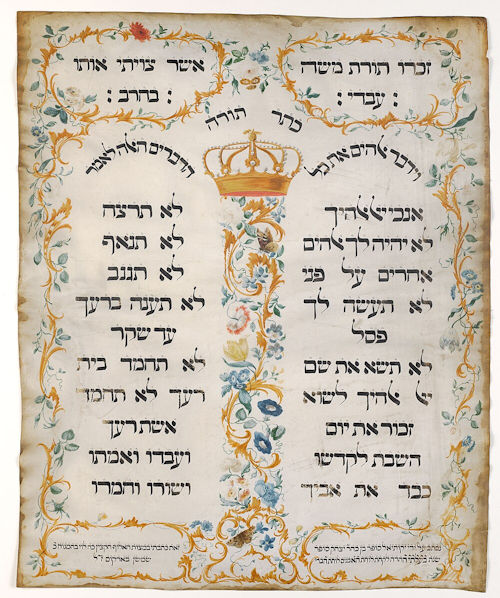
More classic art masterpieces used as illustrations
TL;DR:
This overview of God's Ten Commandments includes a shortened version for memorization, the full text from Exodus 20, historical and cultural context, and reflection questions. It explores how the commandments relate to human rights, justice, and modern political and church life. The biblical view of God's law as loving instruction contrasts with Dante-influenced portrayals of God as harsh.
The Ten Commandments—also called the Decalogue, meaning “ten words”—are ten principles that guide us in living harmoniously with God and other human beings. They appear in Exodus 20, in the second book of the Bible and the Torah. The complete wording in Exodus 20:1–17 has about 300 words. The abbreviated version below, presented in biblical order, has about 65 words.
 This abbreviated version of the Decalogue—the Ten Commandments from God—is usually what is memorized and recited aloud.
Tips on how to memorize Bible verses
In the numbering commonly used by Protestants, the first four commandments address our relationship with God. They emphasize monotheism, worship, and reverence, laying the foundation for spiritual life and calling people to honor divine authority. The remaining six address interpersonal relationships and moral conduct, including honesty, respect, and integrity. Their order suggests a hierarchy in which one’s relationship with God undergirds ethical behavior toward others. The two categories—relationship with God and relationships with other people—reflect the interconnectedness of spirituality and morality.
Commands are orders or directives that are often immediate and situational. They demand action or compliance. A commandment, on the other hand, is more formal and often religious in nature. It is intended to guide conduct over an extended period.
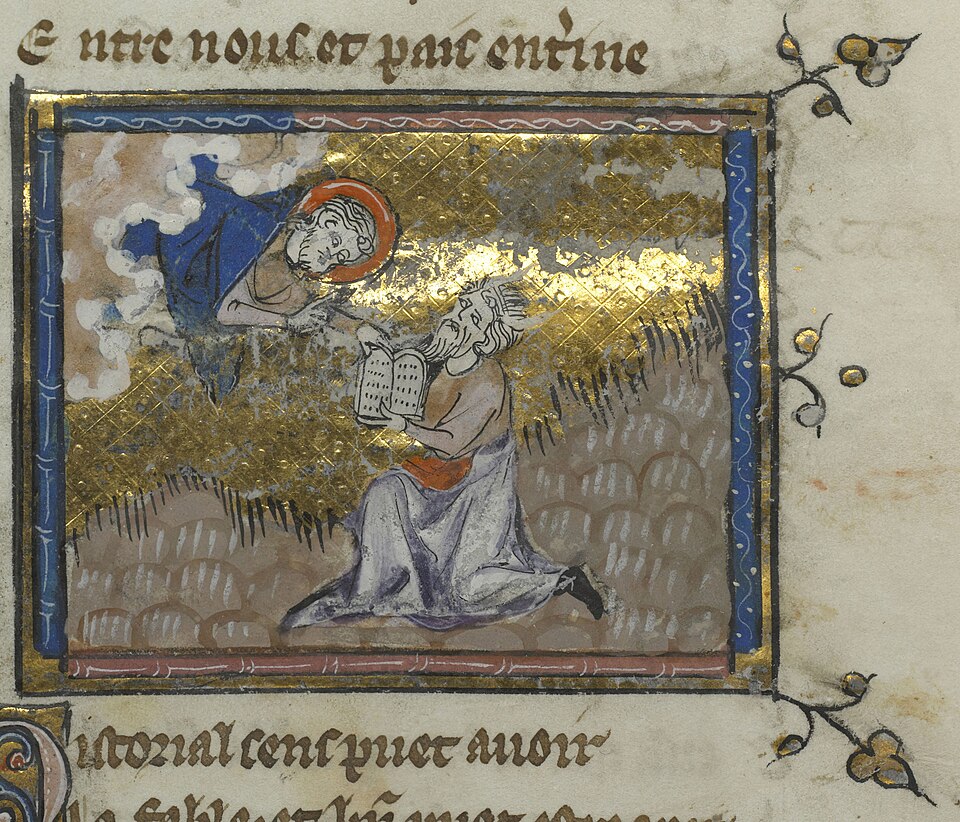
20 1 And God spoke all these words:
2 "I am the Lord your God, who brought you out of Egypt, out of the land of slavery.
3 "You shall have no other gods before me.
4 "You shall not make for yourself an image in the form of anything in heaven above or on the earth beneath or in the waters below. 5 You shall not bow down to them or worship them; for I, the Lord your God, am a jealous God, punishing the children for the sin of the parents to the third and fourth generation of those who hate me, 6 but showing love to a thousand generations of those who love me and keep my commandments.
7 "You shall not misuse the name of the Lord your God, for the Lord will not hold anyone guiltless who misuses his name.
8 "Remember the Sabbath day by keeping it holy. 9 Six days you shall labor and do all your work, 10 but the seventh day is a sabbath to the Lord your God. On it you shall not do any work, neither you, nor your son or daughter, nor your male or female servant, nor your animals, nor any foreigner residing in your towns. 11 For in six days the Lord made the heavens and the earth, the sea, and all that is in them, but he rested on the seventh day. Therefore the Lord blessed the Sabbath day and made it holy.
Exodus 20:1–11, New International Version (2011)
Some Italian cultural perceptions of Christian doctrine have been influenced by the epic poem of Dante Alighieri as well as by the Bible.
In The Divine Comedy, written in the 14th century, Dante tells the story of the Roman poet Virgil leading Dante on a guided tour through Hell, Purgatory, and Paradise.
The epic poem's medieval view of God, humanity, sin, punishment, and reward is also reflected today in many of the paintings and frescoes decorating churches in Italy.
Some Italians have inherited an image of God as an almighty “DON’T.” They picture Him as an angry Creator who is itching to shoot us down at the slightest misstep. In this popular conception, the saints and the Virgin Mary continually intercede with Him on humanity’s behalf.
Well, God is “shooting” at us, but not in a destructive sense. The Hebrew word Torah is related to a verb commonly meaning “to instruct” or “to teach.” In some forms, that verb can also mean “to shoot” or “to point.” Thus, in trying to understand the Torah, we might say that when God is revealing the truth or teaching His people, He is shooting ideas from His own mind into ours. In this light, our translation of Torah as “law” is somewhat impoverished since Torah also signifies teaching and revelation.
At the heart of the Torah—the Jewish name for the first five books of the Bible—are the Ten Commandments received at Mount Sinai. Using these fundamental principles—sometimes called the Decalogue (“ten words”)—as a mirror of the mind of God, it is clear that because He is our Creator, God has claims upon every facet of our lives.
God does not want us to be mere soulless slaves of the law or slaves to a divine despot. Even a superficial reading of the Ten Commandments will make clear that they are not an impossible set of demands. Instead, these principles correspond to humanity's central issues. They are not meant only for angels or for a few people of extraordinary piety, leaving everyone else to pass through Purgatory because of an inability to observe them properly.
A sad relic of this mistaken belief exists in Rome, not far from the American embassy. On the level just below the sanctuary of the Church of Santa Maria della Concezione is a little arched corridor. Along this corridor are five small alcoves whose floors are covered with dirt from the Holy Land. The walls and ceilings of the corridor and of the alcoves are completely covered with various Christian symbols, including crucifixes, a crown of thorns, the Greek letters of Christ's name, and an angel of death. What is startling about these designs is that they are all formed from human bones.

Attached to the wall is a little placard explaining the “cemetery.” Among other details, it states that the skeletal remains of an estimated 4,000 Capuchin monks are “buried” there. “Some of whom,” the placard says, “were holy men.”
What a difference from the Jewish understanding of the Torah! Jewish tradition views the Torah as a way of holiness whose wisdom and guidance are relevant to ordinary people. [ Nine audio sermons on holiness ]
God is shooting at us. He's shooting His wisdom, a code of ethics, and a revelation of Himself. I pray that I'll be a clear enough target for Him to hit squarely!
What relevance do the Ten Commandments that God gave us have for the global push for human rights?
In the numbering commonly used by Protestants, the Bible's Ten Commandments can be divided into two groups. The first four concern our relationship with God. The last six lay down principles for relationships between people.
20 12 "Honor your father and your mother, so that you may live long in the land the Lord your God is giving you.
13 "You shall not murder.
14 "You shall not commit adultery.
15 "You shall not steal.
16 "You shall not give false testimony against your neighbor.
17 "You shall not covet your neighbor's house. You shall not covet your neighbor's wife, or his male or female servant, his ox or donkey, or anything that belongs to your neighbor."18 When the people saw the thunder and lightning and heard the trumpet and saw the mountain in smoke, they trembled with fear. They stayed at a distance 19 and said to Moses, "Speak to us yourself and we will listen. But do not have God speak to us or we will die."
20 Moses said to the people, "Do not be afraid. God has come to test you, so that the fear of God will be with you to keep you from sinning."
Exodus 20:12–20, New International Version (2011)
The worldwide push for human rights did not originate in 1975 with the Helsinki Accords. It did not originate in 1948 with the United Nations' adoption of the Universal Declaration of Human Rights, or even in 1791 with the ratification of the United States Bill of Rights.
A foundational biblical expression of concern for human rights appears in the laws given to ancient Israel. God revealed them to Moses on Mount Sinai. In Exodus 20–23, God speaks clearly about the rights of individuals. He gives Moses laws concerning justice and mercy, including the punishment of criminals and restitution for wrongdoing. Following the Ten Commandments are laws addressing social responsibility, including care for the poor.
Interestingly, this whole section of basic laws for a nation is concerned almost
entirely with what we call domestic affairs. As to national security or foreign policy, excerpts from the
Lord’s words to Moses say: My angel will go ahead of you … I will make all your enemies turn their backs and run.
1
Today the priorities of most governments seem to be the reverse of those God gave to Moses. Military strength, foreign policy, and national security appear to be the number-one priorities of most modern nations.
In our world, Christians must remember that principles of human rights—not national security—are at the heart of God's revealed law.
In a collection of essays titled Against the Stream, Swiss theologian Karl Barth argued that sanctified Christians are not called to live mildly respectable lives. Rather, they are called to swim against the stream, to bear witness to God's judgment of the status quo in this world. Indeed, even a casual glance around our globe will quickly reveal that insisting on justice based upon biblical principles is to swim upstream.
It's difficult to swim against the current. It's easier to close our eyes even when human rights violations occur in our backyards and say, “It doesn't involve me; there's nothing I can do about it anyway.”
Too often, the church has been guilty of letting the world squeeze it into its mold. In his book The Comfortable Pew, Pierre Berton criticized the church for its “abdication of leadership” and its failure to call people to a life of Christian action.
This doesn't mean I am espousing a particular political viewpoint. But I should ask myself some questions. Are my political choices consistent with the biblical concern for human rights? What are the main topics of my political conversations with other people? Do they reflect the concern for justice, mercy, and vulnerable people expressed in Exodus 21–23? Or do I find myself being forced out of biblical principles into a worldly mold where “national interests” or something else becomes the top consideration?
What about my local church? Could it be considered a model community where everyone has the same rights? Does my local church use whatever clout it may have in my city or town to insist on individual rights? Do we have a reputation in the community as a church that really cares about people?
These excerpts summarize several commands: Do not mistreat … Do not take advantage … Do not pervert justice … Do not show favoritism.
2
These are the words of the Lord. They must guide our choices and actions, whether in politics, philanthropy, education, business, humanitarian aid, the judicial system, or the arts.
1 Exodus 23:23, 27, New International Version (2011)
2 Exodus 22:21–22; 23:2–3, 6, New International Version (2011)
“He declared to you his covenant, the Ten Commandments.” — Deuteronomy 4:13, New International Version (2011)
“In the Law, love warns; in the cross, it redeems. Both are the true mirror of Him who thus defines His own character: God is love.” —Guthrie, quoted in Illustrative Notes: A Guide to the Study of the Sunday-school Lessons for 1893 by Jesse Lyman Hurlbut and Robert Remington
I wrote these two devotional blog posts while Barbara and I were serving as missionaries in Italy. They were part of a series of 52 brief devotionals written for The Standard, a weekly Faith Connections take-home curriculum piece for adult Sunday school classes published by the Church of the Nazarene.
T—Timeless words carved in stone,
E—Echoes of Sinai, where thunder boomed.
N—Nations have looked to this moral decree,
C—Covenant words for God’s people to heed,
O—Obedience, justice, and reverent fear,
M—Meant to draw wandering hearts near.
M—Moses stood firm, tablets in hand,
A—A law to guide both heart and land.
N—Not mere rules, but a sacred guide,
D—Directing our steps toward what is right.
M—Moral clarity to light the way,
E—Each command etched deep within the heart.
N—Never forgotten, echoed by grace,
T—They shaped culture, time, and place.
S—Still they call each conscience and soul.
Like acrostics? Here are more of them.
Shavuot (also spelled Shavuos or the Feast of Weeks) is a Jewish holiday traditionally associated with the giving of the Ten Commandments. Biblically, Shavuot began as an agricultural festival marking the wheat harvest and the offering of firstfruits (Exodus 23:16; Leviticus 23:15–21). In later Jewish tradition, it became connected with the events of Exodus 19–20, when God gave the Torah—including the Ten Commandments—to Moses on Mount Sinai. In synagogue services on Shavuot, the Ten Commandments are read aloud from Exodus 20. Shavuot occurs seven weeks after Passover.
Understanding the historical and cultural context of the time when Moses received the Ten Commandments can help us understand them better.
Memorable Quotes About Other Bible Verses


What about spreading the good news worldwide? Could it be considered an eleventh commandment? Here are 120 Old Testament passages that point to world evangelism. One of those passages is in Exodus 19, the chapter immediately preceding the Ten Commandments.
 Susanna Wesley's principle for defining what actions constitute sin [read what she wrote to her son John]