TL;DR:
Before giving the Israelites the Ten Commandments, God called His people to be a "kingdom of priests." It was a call to represent Him to all the world’s peoples. That call was meant to fulfill His promise to bless the world through Abraham’s descendants. Since Paul declares in Galatians that those who have faith are children of Abraham, the call at Sinai means that every believer is called to help reconcile people throughout the world to God.
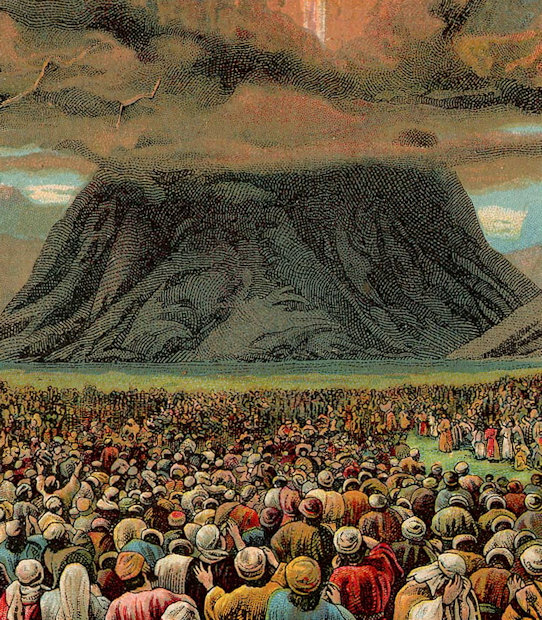
From a card published by the Providence Lithograph Company, 1907 |
Image source
What does God's calling of His people in Exodus 19 mean for us today?
Just before giving Moses the Ten Commandments, God said that His chosen people would be "a kingdom of priests."
"Kingdom of priests" in Exodus 19 means that God wants all His people to do what Paul called "the ministry of reconciliation."
The call at Mount Sinai for God's people to be agents of reconciliation is a key part of how God wants to bring about the fulfillment of His promise in Genesis 12:3 to Abraham to bless all peoples on earth through him.
“You will be a special nation—a kingdom of priests.” — Exodus 19:6, Easy-to-Read Version
Just prior to giving Moses the Ten Commandments on Mount
Sinai, God had something else to say to Abraham's descendants. It was this: "Now if you obey me fully and keep my covenant, then out of all nations1 you will be my treasured possession. Although the whole earth is mine, you will be for me a kingdom of priests and a holy nation" (Exodus 19:5-6, NIV).
"Treasured possession" might have been a heady phrase for a group of formerly enslaved people, and the phrase is still sometimes misunderstood. Being chosen did not mean that Israel was favored merely for its own benefit. The description must be understood together with God's declaration, "You will be for me a kingdom of priests."
The reference to priests does not signal the establishment of the Aaronic priesthood, which
would give structure and organization to Israel's religious life. The priesthood of Aaron and his sons was
established later, beginning in Exodus 28 in connection with the building of the tabernacle. Exodus 19 is
about something entirely different. It is about the fundamental core identity of all who are God's people.
What does "kingdom of priests" in Exodus 19 imply?
By calling them a "kingdom of priests," God was calling all His people to participate in what Paul later described as "the ministry of reconciliation" (2 Corinthians 5:18). This
"kingdom of priests" idea gives meaning to "treasured possession." As a "kingdom of priests," Israel was called to represent God among the peoples of the world.
This priestly calling was outwardly focused. Their priestly calling had a wider horizon: God spoke of "all nations" and "the whole earth." Later, through the prophet Isaiah, God would make this clear with a darkness/light motif, saying, "I will make you a light for the Gentiles" (Isaiah 49:6).
Beginning centuries before the events of Exodus 19, God repeatedly promised that all peoples on earth would be blessed through Abraham and his family (Genesis 12:1-3; 18:18; 22:18; 28:14). The call at Mount Sinai for God's people to be agents of reconciliation was part of the unfolding of that promise.
What is the twenty-first-century takeaway from this for us? Exodus 19 expresses God's intent that His people take the Good News about reconciliation,
redemption, and transformation to the ends of the earth. Paul says that those who have faith are children of Abraham—Jewish and Gentile (Galatians 3:7, 29). That means that if we who call ourselves the people of God truly wish to be God's treasured possession, we must individually embrace our priestly role of bringing the rest of the world into God's presence.
1 Note: In this context, "nations" refers primarily to peoples or ethnic groups rather than only to modern political states. Here the term points to the peoples of the world beyond Israel.
This reflection on a Bible passage is accompanied by 37 others in the "Heart of God" series published in Engage, a monthly online magazine. That series looks at what the Bible says about world missions.
Reflection Questions on "Kingdom of Priests"
What does it mean for God's people to be a "kingdom of priests"? How might this concept relate to the ministry of reconciliation mentioned by Paul in 2 Corinthians 5:18?
How should we understand being a "treasured possession" in light of the "kingdom of priests" description? How might the connection between these two concepts help us avoid misconceptions about the "chosenness" of the Jewish people?
What is the significance of God's call for all of His people to be agents of reconciliation in Exodus 19? How does this relate to the promise to Abraham that all peoples on earth would be blessed through his descendants?
How do we apply Exodus 19 and the call to be a "kingdom of priests" to God's people today—His Church—and its mission to bring the Good News to the ends of the earth? What practical steps can believers take to fulfill this calling?
Historical and Cultural Background of Exodus 19:5-6
A Priestly Role for a "Holy Nation"
Understanding the historical and cultural contexts surrounding Exodus 19:5-6 can clarify this passage. Here are five factors that provide helpful background:
Covenantal Context: In ancient Near Eastern
societies, covenants were binding agreements between parties. Understanding the concept of
covenant helps us see the seriousness and commitment involved in God's promise to the Israelites.
The covenant described in Exodus 19 has similarities to ancient Near Eastern suzerainty treaties, in which a superior party (such as God)
establishes terms with a subordinate party (such as the Israelites).
Identity Formation for God's People: At this point in
the biblical story, the Israelites had recently escaped from slavery in Egypt. They were a newly formed community traveling through the wilderness. Exodus 19 describes their identity as a chosen people with a special relationship with God.
Priestly Role: God declared that the Israelites would be a "kingdom of priests." In ancient societies, priests were regarded as intermediaries between humanity and the divine. This imagery suggests a role for the Israelites in representing God before other peoples. As Yahweh's priests, the Israelites were called to represent God's holiness and mediate His presence in the rest of the world.
Holy Nation: The term "holy" implies being set apart or consecrated for sacred purposes. God calls His people to live in a manner that reflects His character and values. That would distinguish them from other people groups. This holiness includes moral, ethical, and ritual purity.
Cultural Background: Ancient Israel existed within the broader cultural world of Egypt and the ancient Near East. Exodus therefore uses language, symbols, and concepts familiar within that setting. For example, the imagery of God as a king and the Israelites as His subjects was meaningful to people living under the hierarchical structures common in the ancient Near East.
Noteworthy Quotes About Exodus 19:6
“God’s choice of Israel was not a rejection of the nations but a means of reaching them. Exodus 19:6 defines Israel’s vocation in missional terms: to be a priestly kingdom mediating God’s blessing to the world.” — Christopher J.H. Wright, The Mission of God, p. 262.
“The vision of a ‘kingdom of priests’ in Exodus 19:6 is a missionary vision. Israel was to stand between God and the nations—not to hoard the light but to reflect it.” — John Stott, The Contemporary Christian, p. 340.
“Exodus 19:6 is pivotal in understanding Israel’s identity as missional. Priests mediate between God and people—Israel’s call was to bring the nations to God.” — Michael W. Goheen, A Light to the Nations: The Missional Church and the Biblical Story, p. 42.
“The phrase ‘a kingdom of priests’ points to intercession and representation. Israel was elected not for privilege but for purpose—that, through her, the world might know God.” — G. Campbell Morgan, The Crises of the Christ, p. 108.
“From the start, God’s plan included using His people as agents of blessing. Exodus 19:6 is a charter for global mission—Israel was to live out God’s holiness before the nations.” — Walter C. Kaiser Jr., Mission in the Old Testament: Israel as a Light to the Nations, p. 20.
S - Stand in awe at the mountain where God's presence was near I - In the silence, God made His design for faithful living clear N - New beginnings for a people, a fresh start in faith A - A promise of guidance, a covenant to embrace I - In the heart of the desert, God's voice set the pace