Can icebergs, concentric circles, or onions explain culture?
TL;DR:
Cultures have deep, often invisible layers that shape who people are and how they see the world. Like an iceberg, only a small portion of culture—behaviors and customs—is visible, while the vast majority—beliefs, values, and assumptions—lies hidden below the surface. Other analogies, including concentric circles and an onion, have also been used to explain culture. Recognizing these layers and metaphors can encourage deeper cross-cultural understanding.
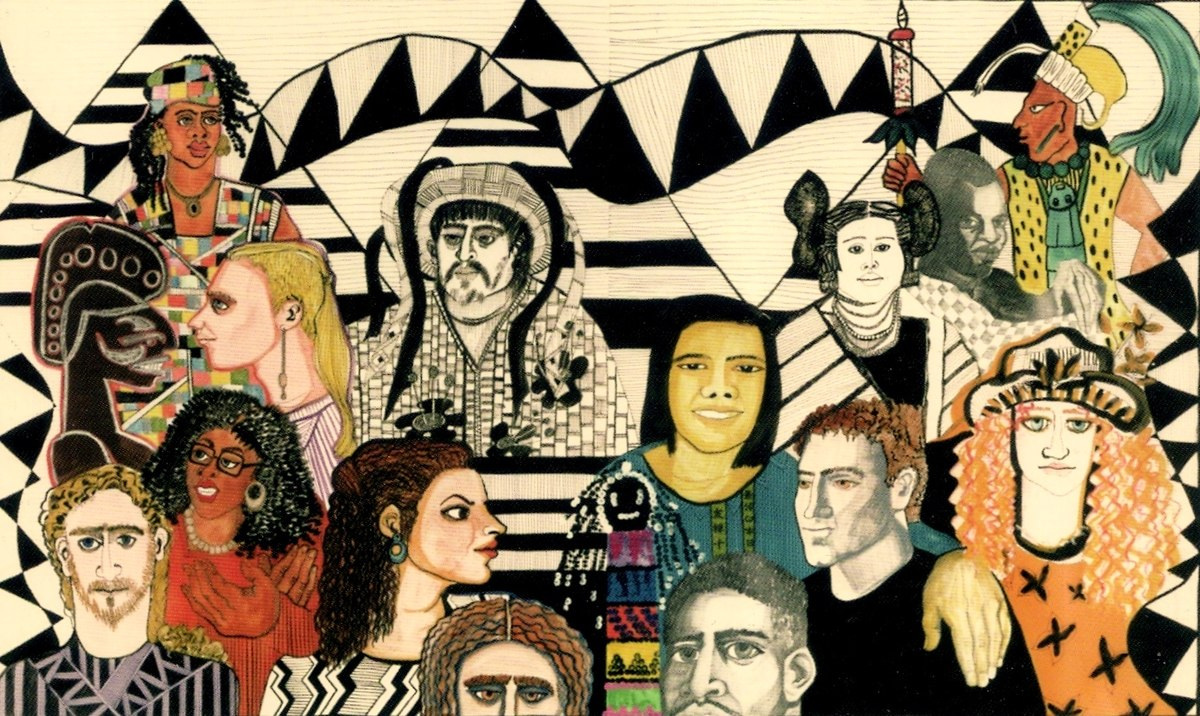
Pure Diversity, mixed media on cotton paper, by Mirta Toledo, 1993
|
Image source
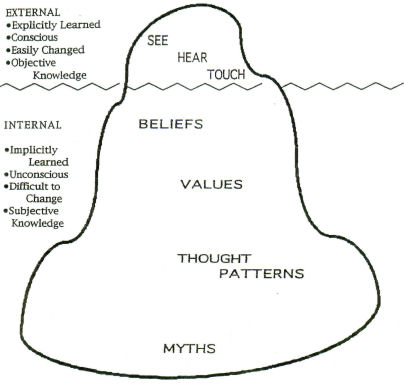
Culture is like an iceberg: There is far more to it than what appears on the surface.
Culture is like a set of concentric circles: Worldview is at the
heart, influencing beliefs, values, and behavior in the outer rings.
Culture is like an onion: It has layers of beliefs, norms, and values, with the core representing unchanging values and assumptions.
Other analogies or metaphors compare culture to a garden, a lens or filter, a toolbox, a mosaic or tapestry, a river, a language, a family recipe, a pot of different flowers, or even the water in which a fish swims.
Three analogies of culture
Culture is like an iceberg
Culture is more closely connected to our sense of identity and self-understanding than we often imagine. What we can readily see and understand of a culture—whether our own or another—is comparable to the visible portion of an iceberg.
Although we know that only a small portion of an iceberg is visible above the water, it can still be difficult to imagine how much lies beneath the surface. Approximately 90% of an iceberg lies below the water's surface. Similarly, many cultural elements, including beliefs, values, and underlying assumptions, lie hidden beneath the surface. We may not even be aware of how deeply our culture shapes our values and influences our view of life, our interpersonal relationships, and other aspects of daily life. The iceberg analogy for culture has been attributed to Edward T. Hall, although that attribution has not been verified.
Iceberg image modified from Gary R. Weaver, "Understanding and Coping with
Cross-cultural Adjustment Stress" in Gary R. Weaver, editor, Culture, Communication and
Conflict: Readings in Intercultural Relations, second edition (Simon & Schuster
Publishing)
Culture is like a set of concentric circles
A concentric circle diagram illustrates how worldview is foundational to beliefs, how beliefs are foundational to values, and how values prompt behavior. Lloyd Kwast describes culture as a series of successive layers through which one moves from observable behavior toward its underlying heart. He explains that cultural values are not selected arbitrarily; rather, they reflect an underlying system of beliefs. At the heart of a culture is its worldview. Kwast cautions that people who share the gospel cross-culturally may see little genuine change if they fail to consider that worldview.
To be sure, Lloyd Kwast's model of culture is, as Kwast himself admits, "far too simple to
explain the multitude of complex components and relationships that exist in every culture."
However, it can be a useful starting point.
Culture is like an onion
The layers of an onion illustrate the visible and underlying dimensions of culture.
The image of an onion is often used to describe the different layers of culture. The outer
layers are the artifacts and products as well as patterns of behavior. The next layers hold the beliefs, norms, and attitudes of that culture. The middle or core of the onion
contains the underlying cultural assumptions and values.
Geert Hofstede created the Cultural Onion model, which depicts culture as layers surrounding a core. The core represents a culture's values, which tend to change slowly. Even when a value appears outdated, it may continue to influence people subconsciously. The first layer around the core consists of rituals or practices embedded in that culture. Those rituals change only slowly. Another layer contains the "heroes," who may be real or fictional people. They both reflect and influence the beliefs, norms, and attitudes of that culture. On the outside are the symbols and practices that are currently fashionable within the culture. The outer layers can be modified, retrained, and relearned. The core—the culture's inner values and assumptions—is different.
How does the iceberg analogy help us to talk about and understand the depth and hidden
aspects of culture? What values and assumptions of our own culture mold us even though they go unnoticed?
Why does the concentric circles analogy put worldview at the heart of a culture? Why can
it be said that beliefs, values, and behavior all stem from this core element?
In what ways does the onion analogy capture the concept of culture as various layers? Why is it
said that the core of the onion, representing values and assumptions, differs in important ways from the outer layers?
What are the limitations of using analogies like the iceberg, concentric circles, and onion to explain culture? How might these analogies oversimplify the complexity and diversity of cultural components?
How can understanding the hidden aspects of culture, as depicted by these analogies, affect cross-cultural interactions and communication? How can these analogies help people deal with cultural differences?
Seven more analogies of culture
To capture the richness of what we mean by culture, that concept has been described using a variety of analogies. Here are seven more of them:
Culture as a Lens or Filter: This analogy proposes that culture acts as a lens through which individuals perceive and interpret the world. Like a pair of glasses, culture determines one's worldview, influencing thoughts, behaviors, and interactions.
Culture as a Garden: Just as a garden requires nurturing, care, and attention to flourish, culture develops and is "nurtured" over time through
interactions, traditions, and shared experiences within a community or society.
Culture as a Mosaic or Tapestry: This analogy likens culture to a mosaic or tapestry composed of diverse elements such as customs, languages, arts,
and traditions. Each component contributes to the overall richness and beauty of the cultural fabric.
Culture as a Toolbox: Similar to a toolbox full of tools for different purposes, culture provides individuals with a set of
resources, norms, and practices to handle social situations, solve problems, and adapt to different environments.
Culture as a Language: Just as language serves as a means of communication, culture provides a way to express and transmit shared
meanings, symbols, and values within a society.
Culture as a Recipe: Like a recipe passed down through generations, culture consists of a blend of ingredients such as traditions, rituals, and beliefs that come together to create a distinct flavor or identity for a group or community.
Culture as a River: This analogy suggests that culture is dynamic and fluid, constantly flowing and changing. Like a river, culture may be influenced by external factors and encounters. These encounters can alter its course.
This collection of analogies offers a variety of ways for us to think about the dynamic complexity of culture. Each analogy or metaphor brings out something important. Together, these analogies can help us see how our culture influences us as individuals and as societies.