Share this page:


TL;DR:
This case study presents a real letter from Rajesh, a Hindu man seeking advice about marrying a Christian woman who converted from Hinduism. Rajesh struggles with conflicting religious expectations. His parents expect her to follow Hindu traditions, while he hopes she will participate in both Hindu and Christian practices. However, she feels doing so would be sinful according to her Christian faith. The page invites readers to reflect on this dilemma, asking discussion questions about differing worldviews, "love conquers all" attitudes, and relevant biblical passages.
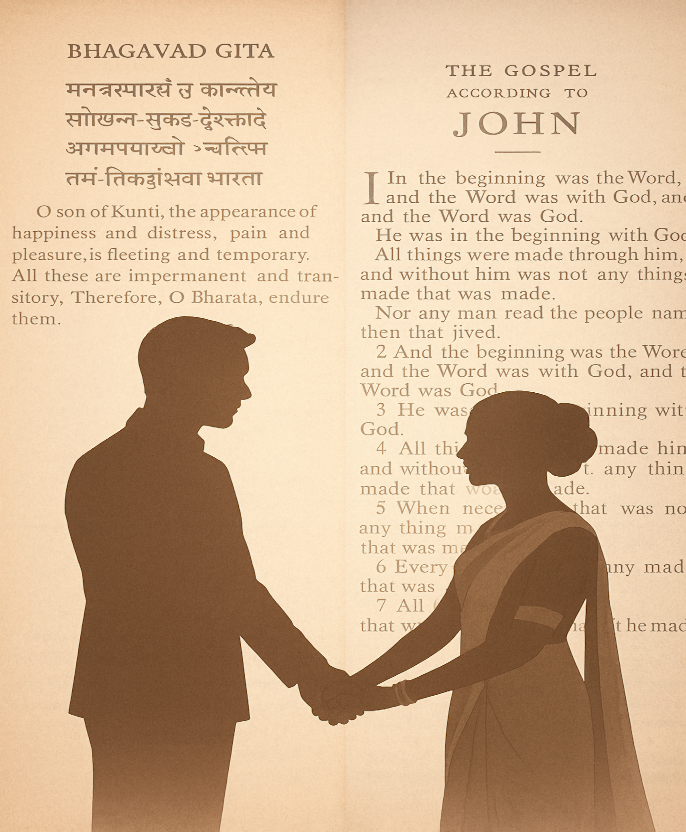
Here is a letter I received from a young Hindu man seeking advice about marrying a Christian woman. The letter is reproduced below. Read it, then consider how you would respond.
Some general case study guidelines are available to aid in your reflection and discussion.
Hi there
I am in a dilemma. I am a Hindu and am trying to decide whether to marry a Christian girl from the Assembly of God denomination (she converted from Hinduism 3 years ago). We are very much in love with each other.
While my parents expect her to follow my religion after marriage, I am of the view that she can follow her Christian religion, but that she should partake in my Hindu religious activities as well. I respect Christianity, but we must have a Hindu marriage. When looking at a marriage partner who will be my other half (two bodies, one soul), it's very reasonable for me to ask her to participate in my religious obligations (which are not many). Wouldn't that be a reasonable expectation of married life? She can still go to Christian worship services and other church activities, and I will accompany her whenever possible.
She has come back to me saying that all the above will be a sin in Christianity and that she will be punished if she participates in the activities of my religion. Because we love each other, it seems like the heart does not agree with the mind.
My priest has advised me to participate in her activities where possible. I respect her choice of religion because, for me, there is only one god. It's just that we all have our own ways of faith. The scriptures of all faiths, including the Christian Bible, are indispensable holy tools that are at our disposal to provide everlasting energy for our life pilgrimage. The ultimate goal of Hinduism is, of course, the attainment of self-consciousness/realization. This is in line with the spiritual truth that our atman is part of the all-prevailing Brahman. Our own pilgrimage, however, needs to be undertaken individually. For this, I will have to go through a cycle of seven births and deaths.
I also realize that other factors like children should be considered.
I like this girl and will find your advice helpful.
It would also help if you could provide me with the details of people who have been in a similar situation. At the same time, it would also help if you could point me to a "best practices" manual for Hindu/Christian marriages, which would give us guidelines and steps to follow.
Kind Regards
Rajesh
Clarification: Rajesh's letter expresses his own understanding of Hinduism. Hindu traditions differ in their explanations of the self, ultimate reality, and liberation. Read his references to "seven births and deaths" and the relationship between atman and Brahman in that context.
— Howard Culbertson, hculbert@snu.edu
Christianity and Hinduism share some values but differ in important ways. The following comparison outlines five important areas of difference. Beliefs vary within both religions, particularly among Hindu traditions.