TL;DR:
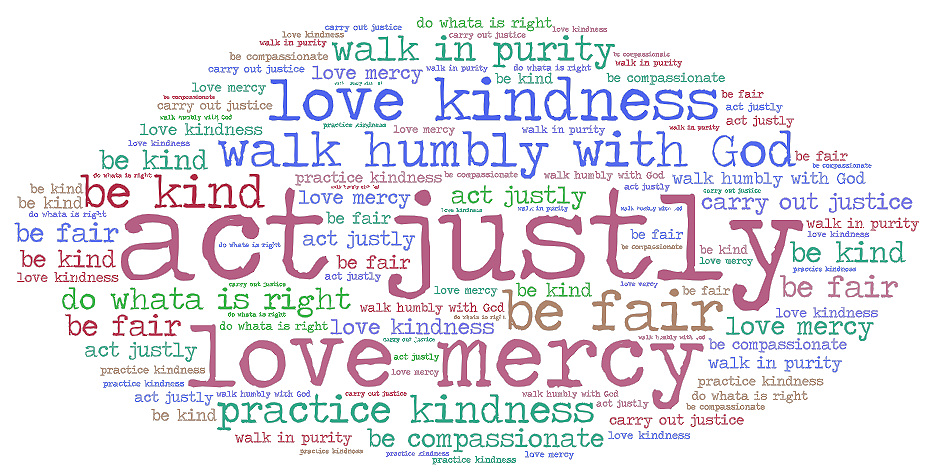
Micah 6:8 spells out God’s expectations for us: to act justly, love mercy, and walk humbly with God. This page highlights parallels between Micah’s message and Jesus’ Beatitudes (Matthew 5). Both passages show how Christ’s kingdom contrasts sharply with worldly values. Bottom line: Micah 6:8 remains profoundly relevant today—it calls believers to live justly, compassionately, and humbly in ways that reflect God’s character and transform society.
What does God want to say to us today through Micah 6:8?
He has shown you, O mortal, what is good. And what does the Lord require of you?
To act justly and to love mercy and to walk humbly with your God.
— Micah 6:8
I remember a visit some years ago with Piera, a former Italian Christian. She said to me, with a sophisticated air, "When I was young, I was really active in the church youth group at Florence. But I'm beyond all that now."
Piera seemed to think she had progressed beyond Christian faith. In reality, she had exchanged the values of God’s Kingdom for the world’s familiar traps.
Of course, the world does often view us as "backward." And once in a while, we have warned each other about the dangers of "trying to keep up with the world."
But the truth is, the world has not caught up with the ideals and requirements of the Beatitudes from the Sermon on the Mount.
In Matthew 5, Jesus reminds us that God's values are often the opposite of those held by the world. These verses clearly describe the kind of lifestyle Jesus expects of His followers. Blessings are promised to those who exhibit Beatitude characteristics.
Matthew 5 has been called "the Constitution of Christ's Kingdom."
Here, we are shown how we can have the privilege of being in Christ's kingdom and reigning with Him -- a privilege human beings lost through disobedience. We are, of course, created to reign with Christ. However, Adam and Eve sought to rule in their own way and thereby became slaves to sin. There, in the Garden of Eden, the human race fell. It did not rise as Piera seemed to think.
What application does this Bible passage have to my life today? First, it reminds me of attitudes and actions that are just as important as the principles found in the Ten Commandments given in Exodus 20.
How does my life measure up to the Kingdom standards of meekness, humility, mercy, peacemaking, and the longing to be filled with righteousness? Is my lifestyle truly shaped by the Beatitudes?
Occasionally, some have facetiously said that the third work of grace is being "petrified." That is just not so. We can be saved and sanctified and still have lots of room to grow in embodying the Beatitudes.
One of the joys of discipling new Christians is watching them make great strides in spiritual maturity. That kind of progress is less visible—and, unfortunately, sometimes nonexistent—in the lives of Christians who have been in the faith for a while.
We should guard against "spiritual petrification" almost as much as outright sin itself. Let's be committed to letting the Holy Spirit use Matthew 5 to help us formulate—and, through His power, carry out—some self-improvement plans designed to make us better citizens of Christ's Kingdom.
Blessed are those who hunger and thirst for righteousness (Matthew 5:6).
I wrote this devotional blog post when Barbara and I were serving as missionaries in Italy. It is one of a series of 52 brief devotionals written for The Standard, a Faith Connections take-home curriculum resource for adult Sunday school classes published by the Church of the Nazarene.
— Howard Culbertson, hculbert@snu.edu
Micah 6:8 says, "He has shown you, O mortal, what is good. And what does the Lord require of you? To act justly and to love mercy and to walk humbly with your God."
Bottom line: Micah 6:8 sets forth values that can contribute to a just, compassionate, and spiritually fulfilling life. This verse is thus particularly relevant today.
Memorable Quotes About Other Bible Verses
M – Move through life with justice in your stride.
I – Inspire compassion with every act of mercy.
C – Choose the humble path over prideful gain.
A – Act not for praise, but in reverence to God.
H – Honor Him by walking closely in His ways.
Like acrostics? Here are more of them.


