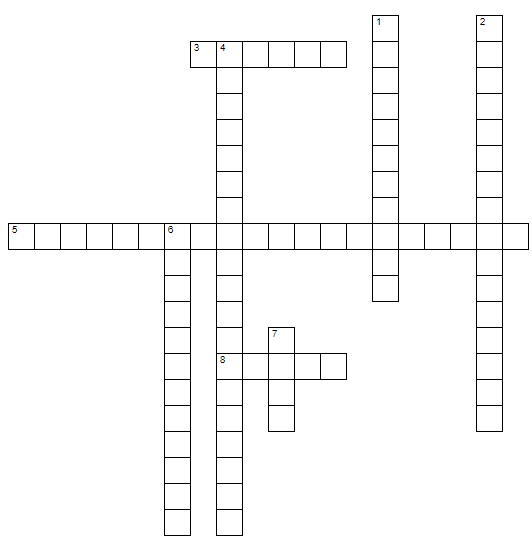
Challenge: Can you solve this puzzle even if you do not have the book by Kottak?
| 3 | A member of the Seneca Nation who contributed to early anthropology and served as U.S. commissioner of Indian affairs |
|---|---|
| 5 | The examination of the cultural diversity of the present and the recent past |
| 8 | A U.S. president whose mother was an anthropologist |
| 1 | An account of a particular community, society or culture |
|---|---|
| 2 | The investigation of relationships between social and linguistic variations |
| 4 | The use of anthropological viewpoints, theory, methods, and data to identify, assess, and solve social problems |
| 6 | The holistic, biocultural, and comparative study of the human species, grounded in respect for human diversity |
| 7 | A classification of human diversity that the textbook describes as lacking a clear biological basis |
"Going over keywords always helps to instill them into the mind. Thanks for one more way to learn!" — Joshua Sparks, Nazarene Bible College student
Cultural anthropology is an academic discipline that focuses on human societies and cultures. It seeks to understand how people around the world organize themselves, create meaning, and interact within their social and cultural environments. Cultural anthropologists examine kinship systems, belief systems, rituals, language, art, and economic practices. Through fieldwork, participant observation, and ethnographic research, they look for the underlying patterns and variations in human behavior and cultural practices. They also analyze power dynamics and social change. Cultural anthropology provides insights into the complexities of human life and helps us appreciate the richness and diversity of human cultures.
Conrad Phillip Kottak is an anthropologist who has authored several textbooks on cultural anthropology. Kottak's work has focused on cultural variation, globalization, and the relationships between culture and social institutions. He is known for his accessible writing style, which makes complex anthropological concepts understandable to students and general readers alike.
Kottak has done research in various parts of the world, including Madagascar and Brazil. His work has helped shape how anthropology is taught and understood in academic settings.
Chapters 2-4 | Chapters 5-7 | Chapters 8-10 | Chapters 11-13
Howard Culbertson, hculbert@snu.edu


 | Looking for other materials related to Cultural Anthropology? [ more ] |