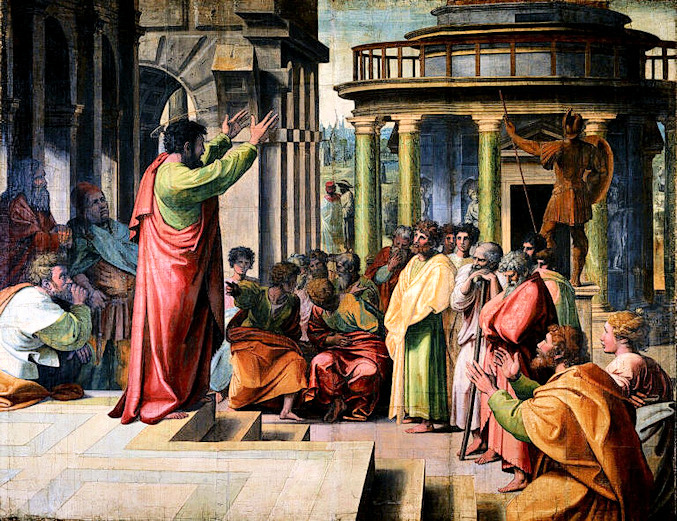
More classic art masterpieces used as illustrations
TL;DR:
Although Paul’s surviving letters do not quote Jesus’ commissioning words, his ministry embodied their message. Paul connected his mission to God’s promise that all nations would be blessed through Abraham. His determination to preach where Christ was not known, establish churches, disciple converts, and carry the gospel toward Spain demonstrates his commitment to making disciples among all nations.
Why do none of Paul’s surviving letters quote the commissioning words of Jesus recorded in Matthew 28:19–20? Isn’t it odd that Paul—often called “the greatest Christian missionary”—never quoted the Great Commission? This is the same Paul who is the focus of a century-old book titled Missionary Methods: St. Paul’s or Ours?
Let’s think about that. Paul’s surviving letters do not quote the commissioning words recorded in Matthew 28:19–20 or Acts 1:8. Yet Luke, the author of Acts and one of Paul’s traveling companions, recorded Jesus’ words in Acts 1:8: “But you will receive power when the Holy Spirit comes on you; and you will be my witnesses in Jerusalem, and in all Judea and Samaria, and to the ends of the earth.” (2011 NIV) Luke also records Jesus’ words this way:
“He told them, ‘This is what is written: The Messiah will suffer and rise from the dead on the third day, and repentance for the forgiveness of sins will be preached in his name to all nations, beginning at Jerusalem.’” (Luke 24:46–47, 2011 NIV)
So, does Paul’s silence mean world evangelism was not on his radar? Absolutely not. Paul referred to himself as “an apostle to the Gentiles” (Romans 11:13). In this context, Gentiles refers broadly to non-Jewish peoples. The Easy-to-Read Version translates Romans 11:13 as “I am an apostle to the non-Jewish people.”
Several years after Paul’s conversion on the road to Damascus, the Holy Spirit led the church at Antioch to commission Paul and Barnabas for missionary work. During successive missionary journeys, Paul evangelized cities throughout Asia Minor, Macedonia, and Greece. Bible publishers often include maps of these journeys. Over a period of 15 to 20 years, Paul planted churches in four Roman provinces. His work was therefore consistent with Christ’s command to “go” in the Great Commission, even though his surviving letters do not quote it directly.
The New Testament reveals Paul’s passion for unreached frontiers. To the Corinthians, he spoke of preaching “in the regions beyond you” (2 Corinthians 10:16). He even mentioned plans to visit Spain—though we do not know whether he reached Spain. Paul’s church-planting ministry reflected the “ends of the earth” vision expressed in Acts 1:8. He lived out the Great Commission, even without quoting it.
Why didn’t Paul cite Jesus’ words? In a sense, he did—by referencing Abraham. God’s promise to Abraham in Genesis 12:1–3 laid the foundation for world evangelism. In Galatians 3:8, Paul says God announced the gospel to Abraham: “All nations will be blessed through you.” To Paul, the Great Commission was not a new concept—it echoed God’s ancient promise. Matthew 28:19–20 carries forward the worldwide purpose revealed in Genesis 12:3 and reiterated in Genesis 18, 22, and 26.
If Paul saw his ministry as fulfilling God’s purpose revealed in Genesis 12—a purpose reflected in Matthew 28 and Acts 1—did he practice what he preached? From Acts and his letters, the answer is yes. Paul preached to unreached peoples, saw converts baptized, and discipled believers toward maturity by establishing churches. He emphasized Christian maturity throughout his writings.
Paul was not an independent missionary. He was sent by a church and usually ministered as part of a team. He partnered with Barnabas, Silas, Luke, John Mark, Timothy, and others. These coworkers helped him fulfill what Matthew 28:19–20 commands. Moreover, Paul wanted all believers engaged in world evangelism. He encouraged congregations to participate in the gospel through prayer, generosity, hospitality, and faithful witness.
Though Paul never explicitly cited Jesus’ Great Commission, he clearly embraced its essence—starting with God’s covenant with Abraham. Paul’s life and ministry reflect a deep commitment to making disciples of all nations.
— Howard Culbertson, hculbert@snu.edu
This article first appeared in Illustrated Bible Life, a curriculum piece published by The Foundry for adult Sunday School teachers. It has been slightly modified for this website.
Paul’s surviving letters addressed particular congregations and situations; they were not intended to provide a complete account of everything he preached or taught. Therefore, their failure to quote the commissioning words recorded in Matthew 28:19–20, Mark 16:15, or Acts 1:8 does not indicate that Paul undervalued the Great Commission. It is also possible that he communicated its message through preaching and personal mentoring. His emphasis on evangelism, discipleship, and outreach across cultural boundaries runs throughout his writings.


