TL;DR:
God’s promise to bless all nations through Abraham and his descendants is foundational to both the Old and New Testaments. God’s call for Abraham to move to Canaan strategically positioned his descendants at a key crossroads of the ancient world. This was an ideal place for them to be a “kingdom of priests” and a light to other nations.
Did God have a strategic reason for asking Abraham to move?
Commentary on Genesis 12
“The Lord had said to Abram, ‘Go from your country, your people and your father’s household to the land I will show you.’” (Genesis 12:1, 2011 NIV)
“On that day the Lord made a covenant with Abram and said, ‘To your descendants I give this land.’” (Genesis 15:18a, 2011 NIV)
Beginning in 1889, the area that became my home state of Oklahoma was opened through a series of government-sponsored land runs. At a signal, thousands of settlers rushed onto lands that the federal government had acquired from Native American nations. Qualified settlers could claim 160-acre homesteads if they lived on and improved the land.
The call and promise in Genesis 12 and 15 were not the proclamation of a one-man "land run." Abraham was not being offered the opportunity to "stake a claim" on land that someone thought needed developing. Nor was God trying to give him a nice "place in the country" in which to raise a family.
God had a reason for asking Abraham to relocate to Canaan, although that reason is sometimes misunderstood. For instance, I have heard people speculate that Abraham and Sarah needed to escape from life in the city because cities can be bad places where evil influences abound. That reasoning doesn't convince me. God was not simply giving Abraham and his family "a place in the country."
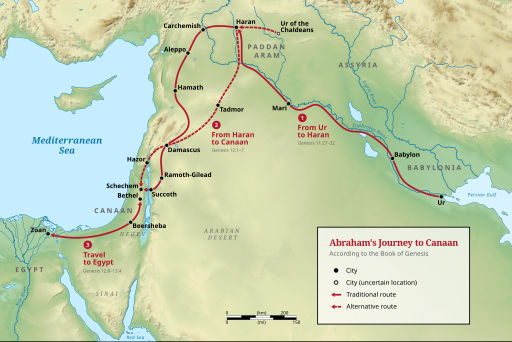
As Abraham's descendants multiplied, God commissioned them to be His message-bearers. Because of Abraham's move to Canaan, his descendants lived on a main thoroughfare of biblical times. Doesn’t that location reflect God’s desire for all people to know that He alone is worthy of worship? The area at the eastern end of the Mediterranean that was later parceled out to the twelve tribes of Israel was a land bridge for the ancient world. Travel to and from three continents—Africa, Asia, and Europe—went through that relatively narrow strip of land between the Jordan River and the Mediterranean Sea.
As empires rose and fell, this area remained a key international traffic artery. Trading caravans traveling from Persia—or even India—to Egypt passed through the region where God settled the people He would call at Sinai to be "a kingdom of priests" (Exodus 19:6). Through Isaiah, God said His people would be "a light to the Gentiles" (Isaiah 42:6; 49:6). Abraham's move positioned his descendants so they could serve as a light for God to people from many nations. The opportunity was there for them to blossom as a "kingdom of priests."
People involved in real estate say that the three most important things about property are: location, location, and location. "Location" was a good reason for Abraham's family to put down roots in what we now call "the Holy Land." Moving Abraham and Sarah near a major transportation route of the ancient world fit well with God's expressed desire that the good news of salvation in Him be known throughout the world (Isaiah 49:6; Acts 13:47).
Like acrostics? Here are more of them.
“Through your offspring all nations on earth will be blessed.” (Genesis 22:18, 2011 NIV)
“Understand, then, that those who have faith are children of Abraham.” (Galatians 3:7, 2011 NIV)
Genesis 12:1–3 is often labeled as "the call of Abraham." Those three verses are, however, more than guidance for one man and his family. When the message is repeated in Genesis 17, God identifies it as a “covenant.” With this covenant—which also appears in Genesis 18 and 22—God took a big step forward in fulfilling a promise about a Redeemer that began unfolding as early as Genesis 3:15.
In selecting Abraham, God chose the family into which the Redeemer would be born. God then asked that family to move to the crossroads of the ancient world and challenged them to be a missional people.
This covenant is foundational to understanding not only the Old Testament but also the New Testament writings. We encounter Abraham's name about 70 times in the New Testament. That is not just because Abraham was the great-grandfather of the men whose families became the 12 tribes of Israel. It is because he and his descendants—spiritual and biological—were to be channels of God's blessing to the whole world.
When people reflect on the first verses of Genesis 12, they often see only promises of land, numerous descendants, and a great name for Abraham. To be sure, there are promises of those things in Genesis 12:1–3. However, this covenant is about far more than land, multitudes of offspring, or a man's legacy. This covenant, called "everlasting" in Genesis 17, is about bearing the news of the Messiah and His redeeming work to all peoples.
In Genesis 12:3, God reveals His purpose to bring blessing to all the earth. That blessing was not about wealth, health, or other things that often cause people to say, "God has blessed me." Galatians 3:8 connects the blessing God’s people are to share with the good news of the gospel.
There are no if clauses in this covenant. So, in a sense, it is unconditional. On the other hand, it is clear that the people of God are blessed to be a blessing. As Bob Sjogren and other missiologists have noted, this covenant has a "top line" of blessing and a "bottom line" of responsibility. The message should have been unmistakable: with privilege comes responsibility.
That responsibility was restated by Jesus in His Great Commission of Matthew 28:19–20. The "go ye" of that Great Commission is a reaffirmation of what God had said two thousand years before to Abraham: “All peoples on earth will be blessed through you” (Genesis 12:3, 2011 NIV).
— Howard Culbertson, hculbert@snu.edu
These reflections are among more than three dozen articles in the "Heart of God" series originally published in Engage, an online missions magazine. That series looked at what the Bible says about world missions.
“The Church’s commitment to world evangelism reflects how deeply it understands both the blessing it has received and its responsibility to share that blessing.” — Kevin Juliano, Northwest Nazarene University student
The phrase "blessed to be a blessing" has roots in several biblical passages, particularly in the Old Testament (Hebrew Bible). One prominent example is in Genesis 12:2–3, where God speaks to Abraham:
“I will make you into a great nation, and I will bless you; I will make your name great, and you will be a blessing. I will bless those who bless you, and whoever curses you I will curse; and all peoples on earth will be blessed through you.” (Genesis 12:2–3, 2011 NIV)
In this passage, which is repeated to Isaac (Genesis 26:3–5) and Jacob (Genesis 28:13–15), God promised to bless Abraham and make him and his descendants a blessing to all people on earth. God made clear that the blessings received were not solely for Abraham's benefit. He said they would extend to others around the globe. This concept is reiterated throughout the Bible. It is, therefore, important that Christ-followers understand they have been blessed in order to be channels through which the blessing reaches others.
Historical and cultural context is important when interpreting any ancient text, including Genesis 12:1–3 and 22:18. In the latter passage, God promises Abraham, “Through your offspring all nations on earth will be blessed, because you have obeyed me” (Genesis 22:18, 2011 NIV). Let's look at half a dozen historical and cultural factors:
Being aware of historical and cultural details like these six items can help us appreciate the richness of Genesis 22:18. They help us see the global significance of God's promise to Abraham as its fulfillment has unfolded over the centuries.
Noteworthy Quotes About Other Bible Verses
Like acrostics? Here are more of them.


