TL;DR:
Revelation 7:9 pictures a multitude from every nation, tribe, people, and language worshiping God. This vision points to the fulfillment of God's promises to Abraham and through Isaiah, bringing scattered humanity together before His throne. It encourages believers to participate confidently in world evangelism. The page also briefly compares other religions' beliefs about the end times.
What does the Holy Spirit want to say to us through the words of Revelation
7:9?
William Long said that our spirits should soar at the
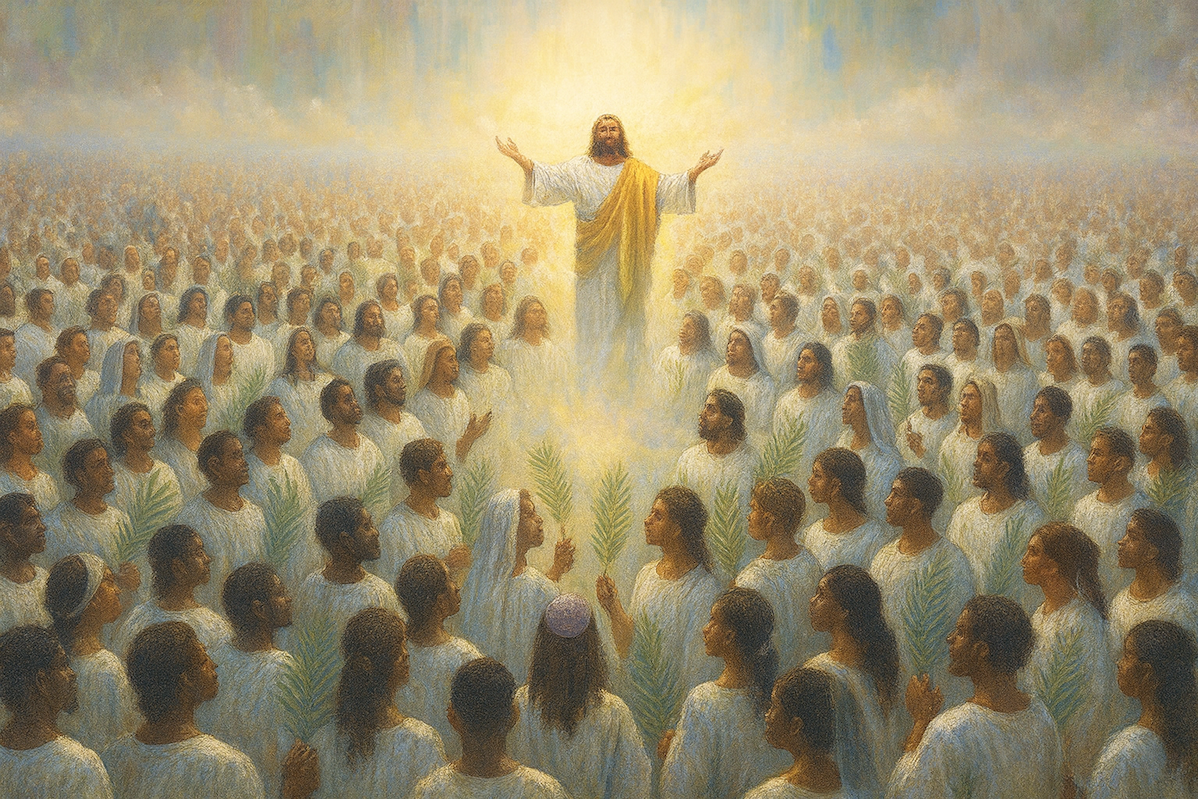
imagery in Revelation 7:9 of a "great multitude" from "every nation, tribe,
people and language" giving praise to God.
John's vision in Revelation 7:9 shows people scattered among the nations
united in worship while retaining their diversity.
The promise of blessing for all peoples made to Abraham in
Genesis 12 can be thought of as one "bookend" of salvation history. John's "look across the
finish line" in Revelation 7:9 is the other bookend of that story.
Other world religions also have beliefs about end times.
World Missions: The Heart of God
Commentary on Revelation 7
"After this I looked, and there before me was a great multitude that no one could count, from every nation, tribe, people and language, standing before the throne and before the Lamb."
-- Revelation 7:9, NIV 2011
In a sermon preached while the Olympic Games were going on one summer, Lutheran pastor
David Rockhoff told his Kenosha, Wisconsin, congregation that Revelation 7 gives us a "look across the
finish line." In verse 9, John describes people from all over
the world at the throne of God giving praise to King Jesus.
That heavenly image of a huge crowd of born-again believers from around the globe should
not surprise anyone familiar with Scripture. Indeed, when what John the Revelator described
comes to pass, it will fulfill God's promises and declarations concerning
Abraham, Isaiah, and the apostles. God's messages to them included such things as:
Genesis 12:3, 22:18 -- A promise that through Abraham and his descendants (spiritual as well as biological), "all nations on earth" will be blessed.
Isaiah 42:6 and 49:6 -- God commissions His servant as a light for the Gentiles, extending His salvation to the ends of the earth (see especially Isaiah 49:6).
Matthew 24:14 -- Jesus' declaration in response to His disciples' question about His coming and the end of the age: "This gospel of the kingdom will be preached in the whole world as a testimony to all nations, and then the end will come."
Acts 1:8 -- The promise of the Holy Spirit with the result that "you will be my witnesses . . . to the ends of the earth."
These four groups of passages point to God's worldwide saving purpose, whose fulfillment
is pictured in Revelation 7:9. Presbyterian minister William Long was
right when he wrote that our spirits should soar at the imagery of a "great multitude"
from "every nation, tribe, people and language" giving praise. For those believers who
have prayed, given, and even gone for the cause of world evangelism, the sight will be joyous.
In the Genesis 11 Tower of Babel story, language differences divided and scattered
humanity. John's vision shows people once scattered among the nations united in worship while retaining their diversity.
This vision should inspire us to welcome people across cultural and national boundaries.
As God reached out to His rebellious and lost creation, He made some promises to Abraham
and others. The vision John recorded in Revelation 7:9 is about those promises coming true.
Because of this, the promise of a blessing for all peoples on earth made to Abraham at the beginning of the Old Testament can be thought of as one "bookend" of salvation history. At the end of the New Testament, John's "look across the finish line" is the other bookend of that wonderful story in which we are called to actively participate.
This article on a biblical passage about world missions is one of more than three dozen in the "Heart of God" series published in Engage magazine. That series looks at what the Bible says about world missions.
Reflection Questions
How does the image of the "great multitude" in Revelation 7:9 connect with the promises made to Abraham, Isaiah, and the apostles about world evangelism?
In what sense does Revelation 7:9 reverse the scattering at Babel, and how does John's vision preserve cultural and linguistic diversity?
Why is the image of people from every nation, tribe, people, and language giving praise to God so encouraging for believers who have prayed, given, and gone for the cause of world evangelism?
How might the promise of blessing for all peoples made to Abraham at the beginning of the Old Testament connect with John's "look across the finish line" in Revelation 7:9 at the end of the New Testament?
How can we participate in God's mission, pictured through the promises to Abraham and the multitude in Revelation 7:9?
Five Key Lessons from the Multitude Before God's Throne
Revelation 7:9 describes a vision seen by John the Apostle during his exile on the island of
Patmos. In this vision, John saw people from every nation, tribe, people, and language standing before the throne of God and the Lamb, wearing white robes and holding palm branches. This vision is important to Christ-followers for several reasons:
The gospel has a worldwide reach that welcomes all. The vision demonstrates the welcoming global scale of God's salvation. The picture in Revelation 7:9 makes clear that God's love and grace are not reserved for a particular ethnic group, nation, or culture. Instead, His love and grace are extended to everyone everywhere. John's description of the crowd before the throne speaks to me of the value of every individual.
Prophecies will be fulfilled. The vision of the multitude should remind us of numerous Old Testament prophecies, including those found in Isaiah and the Psalms that speak of people from all nations coming to worship God. This fulfillment is also an expression of the continuity between the Old and New Testaments. God's overall objective has remained the same throughout human history.
There's hope and encouragement for today. John's vision provides hope and encouragement for persecuted Christians. His description of the vision can reassure all believers that despite suffering and persecution in the present world, there will be ultimate victory and vindication for those who
remain faithful to God. It should remind us that our struggles are temporary and that an eternal reward awaits us.
There's victory and redemption awaiting God's people. The white robes worn by the multitude symbolize purity, victory, and redemption through the blood of the Lamb (Jesus Christ). They signify that those in the vision have been cleansed from sin and are now beneficiaries of Christ's victory over sin and death.
Worship and adoration are coming! The scene depicts a heavenly worship gathering, where an enormous multitude praises God and rejoices over what the Lamb has done. This points to the central role of worship in the life of Christ-followers and to the ultimate purpose of human existence -- to glorify and enjoy God forever.
It's no stretch to say that the scene described in Revelation 7:9 is rich in theological significance. It speaks to
the themes of God's open arms, redemption, victory, hope, and worship. It has inspired and strengthened believers throughout history by reminding them of the ultimate triumph of God's kingdom and the eternal fellowship of the redeemed.
"Revelation 7:9 is the great finale of the Great Commission. Every nation, tribe, people, and language will be represented before the throne -- and that is not a possibility; it's a certainty. Missions exists because worship doesn't -- yet." -- John Piper, Let the Nations Be Glad!, p. 35 (third edition).
"The end isn't going to come until all the nations have heard" -- Amanda Dimperio, quoted in Myriah Snyder's "Global missionary partners vital to Revelation 7:9 vision" (International Mission Board, July 8, 2021). The article also emphasizes sending believers across national boundaries to fulfill the Great Commission.
"No matter how the human family might be categorized, divided, or related, people from all categories or groupings will be reached, and some from each will become part of the new people of God." -- Craig Ott and Stephen J. Strauss, Encountering Theology of Mission, p. 93.
Beliefs about humanity's future vary both among religions and within each tradition. These brief descriptions offer a starting point for comparison with the Christian vision of redeemed people worshiping God in Revelation 7:9.
Buddhism: Buddhist traditions emphasize liberation from suffering. Many also anticipate Maitreya, a future Buddha who will succeed Gautama Buddha and teach anew. This expectation differs from the biblical picture of the redeemed gathered before God and the Lamb. Source: Dictionary of Buddhism.
Hinduism: Hindu traditions offer diverse accounts of cosmic history, often describing recurring ages rather than a single final end. In traditions centered on Vishnu, Kalki is expected to appear at the end of the present Kali Yuga and usher in a new age. The end of an age should not be confused with the dissolution of the entire universe. Further reading: Kalkin.
Islam: The Day of Judgment, or Qiyamah, is central to Islamic teaching about the future. Many Muslim traditions describe signs preceding it, including the Mahdi, the Dajjal, and the return of Jesus (Isa). Interpretations of these figures and the sequence of events differ among Muslim communities. Source: a Sunni account of signs of the Day of Judgment.
Judaism: Jewish teachings include varied understandings of the Messiah, resurrection, a future age of peace, and Olam Haba ("the world to come"). Traditional expectations may include gathering the exiles and rebuilding the Temple in Jerusalem. The Messianic Age and Olam Haba are related concepts, but their relationship is understood differently across Jewish sources and traditions. Source: My Jewish Learning.
Sikhism: Sikh teaching emphasizes living faithfully, serving others, and attaining union with God. Sikh scripture also supports belief in karma and reincarnation. These emphases differ from the Christian vision of a final gathering before God and the Lamb. Source: Sikh Coalition.