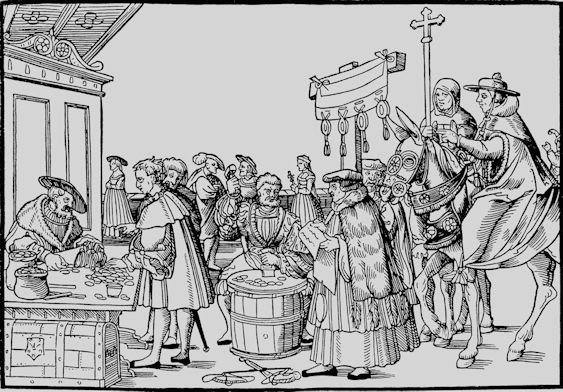
More classic art masterpieces used as illustrations
TL;DR:
At times, the church has allowed materialism to distort its spiritual mission. One notable example was the promotion of indulgences in exchange for monetary contributions to help finance the construction of St. Peter’s Basilica in Rome. Although indulgences did not officially grant forgiveness of sin, their commercialization created the impression that spiritual benefits could be obtained in exchange for money.
Did a church fundraising scheme help ignite the Protestant Reformation?
“When Simon saw that the Spirit was given at the laying on of the apostles’ hands, he offered them money and said, ‘Give me also this ability so that everyone on whom I lay my hands may receive the Holy Spirit.’
“Peter answered: ‘May your money perish with you, because you thought you could buy the gift of God with money!’”
— Acts 8:18–20
Many people consider St. Peter’s Basilica in Rome to be one of the most magnificent church buildings in the world. The sanctuary is more than two football fields long and has about 227,000 square feet of floor space. It is an enormous building.
Of course, its size is not its only impressive feature. Many illustrious architects and artists contributed to it, including Michelangelo. St. Peter’s is noted for its remarkable works of art, ranging from Bernini’s bronze baldachin over the main altar to Michelangelo’s marble Pietà.
Unfortunately,'in his zeal to complete the huge basilica, Pope Leo X relied on a practice that seems foreign to the spirit of Christ. He used revenue generated by indulgence campaigns to help finance the enormous building project. In Roman Catholic teaching, an indulgence did not forgive sin. Rather, it remitted temporal punishment for sin whose guilt had already been forgiven. In practice, however, indulgences were sometimes promoted in ways that made them appear to offer spiritual benefits in return for money. They were often even marketed on behalf of people who had died and were believed to be undergoing purification in purgatory.
Some preachers proved especially effective at promoting indulgences, including Johann Tetzel, who preached in German territories near Saxony. Tetzel turned indulgence promotion into an art. A traditional English rendering of a saying associated with his campaign reads:
When a coin in the coffer rings,
A soul from purgatory springs.
Tetzel’s methods—and, indeed, the commercialization of indulgences itself—would likely have provoked the same condemnation Jesus directed at the commercial activity He encountered in the Jerusalem Temple. Could money actually purchase spiritual favor?
Abuses connected with these indulgence campaigns aroused the ire of a monk named Martin Luther and helped ignite the controversy that led to the Protestant Reformation. [ PowerPoint on Luther ]
Profiteering and commercialism can never be justified in the church simply because they seem to be producing good results. The laudable goal of constructing a church building does not—and cannot—justify questionable means of achieving it.
Of course, Jesus knew that the merchants in the Temple would probably return. But through this dramatic action, He called the people of Jerusalem to restore purity to their worship.
Not long after His cleansing of the Temple, Jesus was challenged by the Pharisees. He responded by telling a story about some vineyard tenants. These wicked men eventually killed the vineyard owner’s son in an effort to seize the vineyard for themselves.
The vineyard tenants represented religious leaders who wanted to take, take, take, and never give. Those leaders viewed the Temple almost as their personal possession.
Jesus knew how they would react when He challenged that view. Once His claim to Sonship became clear to the religious leaders, they responded by putting Him to death.
Jesus used the parable of the vineyard tenants to illustrate that a person’s response to the Son is the key issue. The central issue is not merely how well the vineyard is maintained but how the tenants respond to the owner’s son.
That same challenge faces us today. People still seek religious and material security, forgetting that they are merely workers in the vineyard, not its owners.
Let us be good stewards of the things God has temporarily placed in our hands. Let us also remember that we are only stewards. We should be prepared at any moment to turn everything over to the Owner as an expression of His lordship in our lives.
— Howard Culbertson, hculbert@snu.edu
I wrote this devotional article while Barbara and I were serving as missionaries in Italy. It is one of a series of 52 brief devotionals written for The Standard, a weekly Faith Connections take-home publication for adult Sunday school classes published by the Church of the Nazarene.
The granting of indulgences was historically associated with the Roman Catholic Church. Their commercialization became especially prominent during the late Middle Ages. Indulgences were understood to remit or reduce temporal punishment for sins whose guilt had already been forgiven, whether for oneself or for someone who had died and was believed to be undergoing purification in purgatory.
Here is how it worked:
The original St. Peter’s Basilica, built in the fourth century, had fallen into disrepair by the late fifteenth century. Pope Julius II initiated construction of a new basilica in 1506 to replace the old structure. The sale of indulgences became a major source of revenue for the expensive project. Under Pope Leo X, indulgence campaigns supporting the project continued. In German territories, Archbishop Albert of Mainz commissioned Johann Tetzel to promote the indulgence.
The promotion of indulgences as a way to reduce the time deceased loved ones would spend in purgatory became a major point of contention during the Protestant Reformation. Reformers such as Martin Luther strongly criticized the practice. Luther circulated his Ninety-five Theses in 1517. According to tradition, he also posted them on the door of the Castle Church in Wittenberg. The theses protested the commercialization of indulgences and the impression that spiritual benefits could be obtained through monetary payments.
The Council of Trent, convened by the Roman Catholic Church in the sixteenth century in response to the Reformation, addressed abuses associated with indulgences. While reaffirming indulgences, the council condemned their misuse and ordered the elimination of the financial practices associated with them.
Although indulgences still exist in Roman Catholic theology today, the practice of selling them has been abolished. Indulgences are now granted under specific spiritual conditions and are not exchanged for money.
Purgatory is not explicitly taught in the Bible, though Roman Catholics find support for it in several biblical passages and in Christian tradition. Catholic teaching describes purgatory as a state or process of final purification after death. It is for people who die reconciled to God but who, for some reason, need more cleansing before entering heaven. It is not a second chance for unrepentant sinners.
Protestants reject purgatory because no biblical passage clearly describes an intermediate state or process of punishment and purification. They emphasize passages such as Luke 23:43, Romans 8:1, 2 Corinthians 5:8, and Hebrews 10:14, which portray Christ-followers as forgiven and entering His presence after death. They further note that purgatory is not mentioned in either the Apostles’ Creed or the Nicene Creed.
Purgatory is therefore a concept based on inferences drawn from several biblical passages and early Christian tradition, but it is not plainly or directly described in Scripture or in the two ecumenical creeds named above.


The biblical themes of faithful stewardship, true worship, and responding rightly to the Son appear throughout the New Testament, including in the Gospel according to John.