TL;DR:
Isaiah 55 is a poetic and powerful call from God inviting all people—regardless of background—to freely receive His mercy, pardon, and spiritual fulfillment. The passage uses imagery of water, wine, and milk to symbolize abundant grace offered at no cost. It warns against pursuing things that cannot satisfy and instead urges us to come to God for what truly satisfies. The gospel is to be shared, not shoved. Stories like those of Vincenza and Piero from Italy illustrate how people still respond to God's call today. The page includes reflection questions, an acrostic using the letters of the name Isaiah, and noteworthy quotations from Bible scholars.
What meaning does Isaiah 55 have for us today?
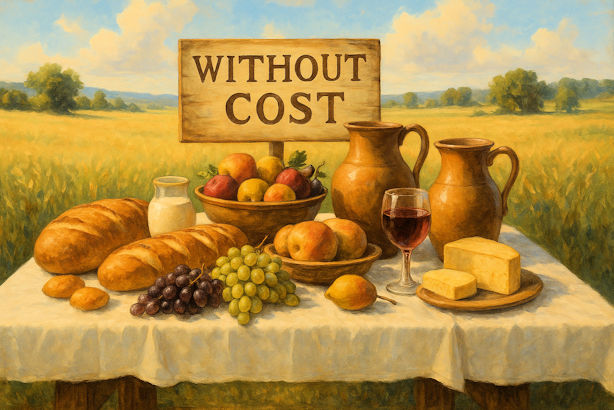
55 1 "Come, all you who are thirsty,
come to the waters;
and you who have no money,
come, buy and eat!
Come, buy wine and milk
without money and without cost.
2 Why spend money on what is not bread,
and your labor on what does not satisfy?
Listen, listen to me, and eat what is good,
and you will delight in the richest of fare.
3 Give ear and come to me;
listen, that you may live."
Isaiah 55 is perhaps one of the Bible's most beautiful expressions of God's offer of freely given mercy to fallen humanity.
Here, in lofty poetic imagery, Isaiah describes the fullness, freeness, and excellence of God's invitation. The lesson to be learned from Isaiah 55 is that everyone who is thirsty — men and women, young and old, sinners and backsliders, and people from nations both great and small — is invited to come and receive the blessedness of God's mercy and abundant pardon. Can people "lose" their salvation?
It is indeed appropriate that Isaiah 55 is included in the "Classic Devotional Passages" series, part of the Enduring Word Bible Commentary ministry.
Across the centuries, Isaiah's ringing cry comes today to each of the earth's eight billion inhabitants. Isaiah's plea for everyone to share personally in the everlasting covenant needs to be heard today more than ever. Our world needs to hear and heed Isaiah's call: "Let the wicked forsake his way and the unrighteous man his thoughts, and let him return unto the Lord."
What a thrilling experience it is to join others who have responded to this invitation to everyone who is thirsty.
The following accounts of Vincenza and Piero are based on my personal recollections from our years of missionary service in Italy.
In the early twentieth century, an Italian man emigrated from his home near Naples to the United States. He dreamed of getting rich in America. Years passed, but he did not become rich. Then someone showed him how he could receive the spiritual nourishment Isaiah described as being offered "without money and without cost." He responded by forsaking his unrighteousness and embracing Jesus as Lord and Savior.
In a letter back to his sister, Vincenza, he wrote a glowing testimony of his conversion. It would have been natural for her to respond like many nominal Italian Christians do to that kind of testimony: "I think you're on the right track. But I was born into this religion (Roman Catholicism), and it's too late for me to change now."
Tragically, although Italy is home to Christianity's largest denomination, many Italians live in spiritual darkness. For some, religion is primarily part of their cultural heritage, accompanied by the belief that inherited religious traditions should never be exchanged for anything else. Consequently, the message of Isaiah 55 may go unheard or be ignored.
Vincenza could easily have responded in that vein. But alone in her home, the Holy Spirit began to work in her heart. She began to sense how thirsty she really was, and, on her knees, she responded to God's invitation. When I met her at 80 years of age, Vincenza Granese was one of the spiritual pillars of the Florence Church of the Nazarene.
It happened in a different way with Piero Barbieri. While in prison in Florence, Piero began to sense this thirst while reading a leaflet about the gospel. It had been put in the mailbox of his home by a Swiss missionary who was pastoring the Florence Church of the Nazarene. Piero's wife then took the gospel leaflet to him during one of her visits to the prison.
Piero sent for the pastor, Fritz Liechti, and, with the pastor's help, prayed through to victory. Piero became part of the Florence Church of the Nazarene, his life completely transformed by the grace of God.
Our own stories of how we responded to this great invitation may be more or less dramatic than those of Piero and Vincenza. But the infinite blessings we have received are the same. "Listen, listen to me … and you will delight in the richest of fare."
— Howard Culbertson, hculbert@snu.edu
I wrote this devotional blog while Barbara and I were serving as missionaries in Italy. It is one of a series of 52 brief devotionals published in The Standard, a Faith Connections take-home curriculum piece for adult Sunday school classes produced by the Church of the Nazarene.
"God's love for humanity and theme of redemption can be seen from Genesis to Revelation. So, we must be faithful and consistent in carrying out the Great Commission."
— Theresa Brown, Northwest Nazarene University student
Isaiah 55:1-3 contains an invitation and a promise from the Lord. It urges all who are thirsty to come and receive freely what truly gives life. It declares that genuine satisfaction and fulfillment are found in God. Later verses call people to forsake futile pursuits and turn to the Lord, who offers abundant mercy and everlasting sustenance.
The passage speaks of a covenant of mercy and love. It assures people that God's ways are higher than human ways and that His thoughts are beyond comprehension. Taken as a whole, Isaiah 55 carries a message of hope and redemption. It invites us to partake in the richness of God's grace and the everlasting covenant that He offers to those who become His people.
Like acrostics? Here are more of them.


