TL;DR:
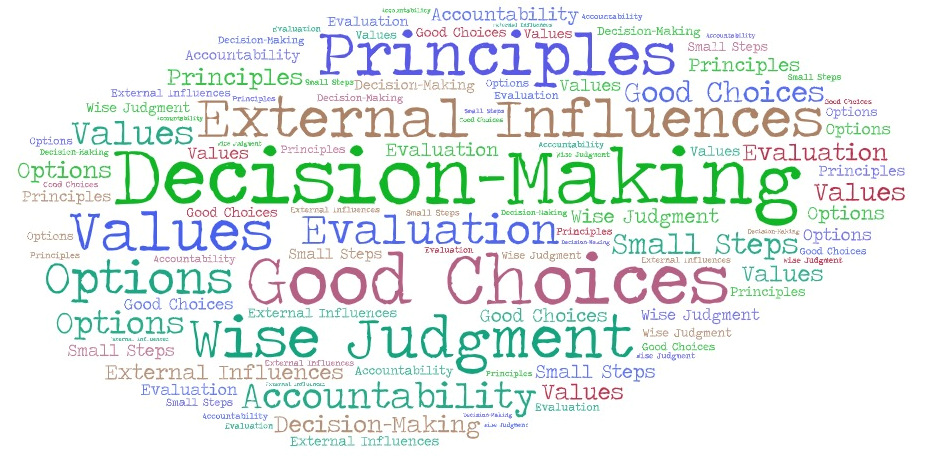
Good decision-making begins with understanding the facts of a situation, moves through personal values and guiding principles, considers external influences and personality, and finally identifies clear choices. An acrostic on the page outlines the process. Supporting quotes from Proverbs, Peter Drucker, Maimonides, and others underscore the importance of courage, experience, and trust in God when making sound, wise choices. A word cloud illustrates page content.
How to exercise wise judgment and make good choices
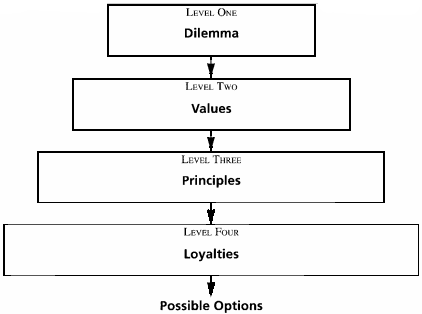
The pyramid model guides us toward wise decisions through four levels: facts, personal values, guiding principles, and external influences.
Move downward through the pyramid—from facts to personal values, guiding principles, and external influences—before choosing a course of action.
"Wise living gets rewarded with honor; stupid living gets the booby prize." — Proverbs 3:35, The Message
This tower or pyramid illustrates how problem-solving in life should proceed from understanding the facts to considering the factors that can guide a decision.
At level one, we ask: "What happened to bring us to this point?"
At level two, we ask: "In what direction do our personal values point us?"
At level three, we ask: "What principles should guide us in making decisions like this? How do the theological positions we hold help us make decisions on issues like this one?"
At level four, we ask: "How do our personalities influence the way we interpret events? Are external factors—such as life circumstances, the political environment, people to whom we are accountable at work or in social organizations, and close friends—influencing us?"
Finally, we identify the available options and make a choice.
Decision-making graphic with the four pyramid levels
Note: This pyramid starts at the top and works toward the bottom. Other decision-making/problem-solving pyramids start at the bottom and work up.
Benefits of Using the Tower/Pyramid Approach to Decision-Making
Clarity and Focus
Top-Down Structure: The pyramid approach begins with the facts at the top and moves systematically through the factors that shape a decision.
Prioritization: Following the levels in sequence keeps the analysis focused and prevents important considerations from being overlooked.
Systematic Analysis
Layered Approach: Decisions are broken down into layers, with each layer focusing on a different aspect of the problem. This systematic breakdown makes it easier to analyze and deal with each component thoroughly.
Comprehensive Evaluation: Going through a checklist, whether mental or written, will reduce the risk of overlooking important details. This evaluation helps ensure that you consider all relevant factors.
Simplification of Complex Problems
Manageable Segments: Dividing the decision-making process into smaller steps makes complex problems more manageable. You can tackle individual parts without feeling overwhelmed by the whole.
Logical Progression: Because the approach follows a logical progression, it is easier to see how individual considerations contribute to the final decision.
Improved Communication
Clear Presentation: Because information is organized in a clear and hierarchical manner, a pyramid structure makes it easier for you to present decisions to others.
Shared Understanding: A structured approach helps stakeholders understand the reasoning behind a decision, leading to better support and alignment.
Efficiency
Focused Effort: The pyramid approach helps direct effort and resources where they are most needed. That improves your decision-making efficiency.
Avoiding Redundancy: Because each layer builds on the previous one, the pyramid approach avoids redundant analysis. It allows you to focus on what matters most.
Strategic Alignment
Consistency with Goals: The top-down structure helps ensure that your decisions align with overall strategic goals. That can lead to more coherent and effective outcomes.
Long-Term Outlook: It encourages you to consider long-term effects and alignment with primary objectives rather than relying on short-term fixes.
Flexibility
Adaptability: The pyramid approach allows for adjustments as new information arises or as circumstances change. It provides a structure that can help you adapt to changing situations.
Scalability: Its versatility means you can apply the pyramid process or structure to large-scale strategic decisions as well as smaller, tactical choices.
"I will do what you have asked. I will give you a wise and discerning heart." — 1 Kings 3:12
Acrostic: Making Wise Decisions
D – Discern the facts with wisdom and care E – Evaluate the options, their risks, and what's fair C – Consider the consequences of each path you could take I – Invite wise counsel when choices are at stake S – Seek clarity through prayer and reflection I – Identify values that guide your direction O – Observe your motives—are they pure and sincere? N – Navigate with courage, not ruled by fear S – Step forward with resolve, trusting God to steer
"Whenever you see a successful business, someone once made a courageous decision." — Peter F. Drucker, The Essential Drucker, HarperBusiness, 2001, p. 26.
"The risk of a wrong decision is preferable to the terror of indecision." — Maimonides, quoted in Mortimer J. Adler, The Great Ideas: A Lexicon of Western Thought, Macmillan, 1992, p. 181.
"Good decisions come from experience. Experience comes from making bad decisions." — Mark Twain (attributed), cited in Paul F. Boller Jr. & John George, They Never Said It: A Book of Fake Quotes, Misquotes, and Misleading Attributions, Oxford University Press, 1989, p. 128.
"Waiting hurts. Forgetting hurts. But not knowing which decision to take can sometimes be the most painful." — Paulo Coelho, By the River Piedra I Sat Down and Wept, HarperCollins, 1996, p. 47.