TL;DR:
God reassured Joshua that He would always be with him, urging him to be strong, courageous, and obedient to His Word. Just as a pilot must trust flight instruments rather than unreliable feelings, believers must depend on God’s guidance instead of personal instincts. Like Joshua, we are called to obey faithfully and trust that God will direct our path, even when visibility is limited.
5 "No one will be able to stand against you all the days of your life. As I was with Moses, so I will be with you; I will never leave you nor forsake you. 6 Be strong and courageous, because you will lead these people to inherit the land I swore to their ancestors to give them.
7 "Be strong and very courageous. Be careful to obey all the law my servant Moses gave you; do not turn from it to the right or to the left, that you may be successful wherever you go. 8 Keep this Book of the Law always on your lips; meditate on it day and night so that you may be careful to do everything written in it. Then you will be prosperous and successful. 9 Have I not commanded you? Be strong and courageous. Do not be afraid; do not be discouraged, for the Lord your God will be with you wherever you go."
As part of my private pilot training, I had to do some "blind" flying: maneuvers aloft relying solely on the instrument panel for guidance rather than looking out the aircraft's windows.
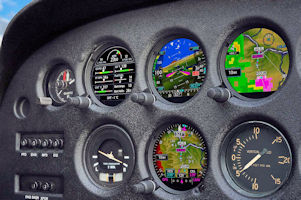
As I prepared to take off with my instructor for my first instrument-flying session, he warned me not to rely on my physical sensations while flying. The instruments — attitude indicator, turn-and-slip indicator, altimeter, tachometer, airspeed indicator, directional gyro, and radio-navigation receiver — were reliable. They could be trusted. But, he said, my physical sensations while flying "blind" could not be trusted.
After we took off from Wiley Post Airport in Oklahoma City, the instructor had me put on a special hood. For the next half hour or so, that hood restricted my vision to the instrument panel. I immediately began to understand what my instructor had warned me about. The plane's vibrations, the engine noise, and turbulence in the surrounding air all combined to tell my senses that the little Cessna 150 was doing things that the instruments denied were happening.
For that half hour or so, I had to force myself to trust those instruments. Even then, my physical sensations would sometimes mislead me. It was reassuring to take that hood off and fly the plane with an eye on the horizon and the ground below.
Instrument flying is an art. It takes intense concentration and complete trust in that panel of instruments. Unfortunately, pilots are like most human beings: inclined to trust themselves first of all. Inexperienced pilots who unexpectedly find themselves in dense clouds may be forced to fly solely by their instruments. They may begin to trust their physical sensations more than those instruments, and they came out of the clouds upside down, all the while convinced that they were right-side up until they saw the ground.
Long before the Wright brothers put their flimsy contraption atop a hill at Kitty Hawk, the Lord instructed Joshua to combine intense concentration on his "instrument panel" with complete trust in those "instruments."
Moses died on the brink of Israel's anticipated "flight" into the Promised Land, and Joshua was handed the controls of the "plane."
In the first chapter of the book bearing his name, the account records the preflight instructions he received from the Lord. The Lord challenged him not to trust his own sensations but to observe intently the instrument panel he'd been given and to respond without hesitation to the indications of the divine compass.
Ahead of Joshua lay a monumental task. He did not know everything he would encounter, nor did he need to know. The Lord had assembled an adequate panel of indicators to guide the flight for which Joshua was to be the "pilot." The Lord said these indicators could and should be trusted without misgivings.
Even today, the Lord gives us reassuring promises, as He did to Joshua. To fully enjoy His promises, we must trust and follow the navigation instruments He has given us.
Have you been guilty of coming out of the clouds upside down? Following our own impressions and sensations can lead us dangerously off course. God has given us an instrument panel for the journey. Let's trust it!
I wrote this devotional blog post while Barbara and I were serving as missionaries in Italy. It is one of a series of 52 brief devotionals written for The Standard, a weekly Faith Connections take-home curriculum piece for adult Sunday school classes published by The Foundry.
Trusting God's guidance demonstrates our confidence in His wisdom, which surpasses our understanding. It is an act of faith that acknowledges our need for His steadfast presence amid life's uncertainties. Whether we are experiencing moments of joy or facing trials, God's guidance can provide the strength and resilience we need. Although the road ahead may be winding and challenging, God can show us the way.


