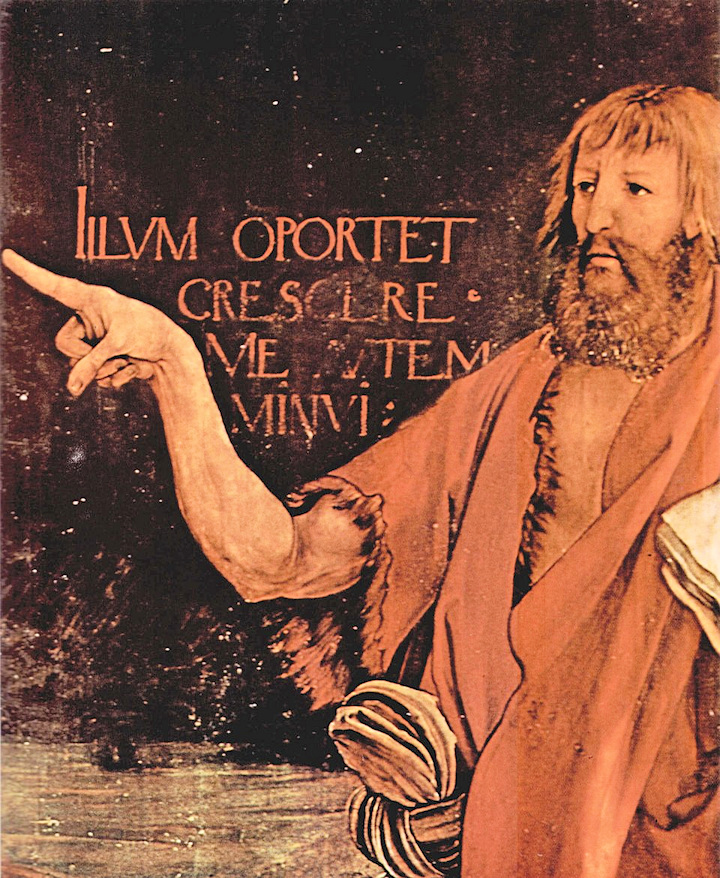
More classic art masterpieces used as illustrations
TL;DR:
John the Baptist fulfilled some of Isaiah's words by pointing people to Jesus rather than to himself. Though John the Baptist attracted crowds, he humbly redirected attention to the coming Messiah. His example challenges us to ask: Are we pointing people to Someone greater, or are we mostly concerned about ourselves? Preparing the way means living with humility, love, and courage so others can see Jesus through us.
What implications does John the Baptist's preparation of the way for Jesus have for my life?
4 As it is written in the book of the words of Isaiah the prophet: "A voice of one calling in the wilderness, 'Prepare the way for the Lord, make straight paths for him.'"
15 The people were waiting expectantly and were all wondering in their hearts if John might possibly be the Messiah. 16 John answered them all, "I baptize you with water. But one who is more powerful than I will come, the straps of whose sandals I am not worthy to untie. He will baptize you with the Holy Spirit and fire. 17 His winnowing fork is in his hand to clear his threshing floor and to gather the wheat into his barn, but he will burn up the chaff with unquenchable fire." 18 And with many other words, John exhorted the people and proclaimed the good news to them.
"They're without a pastor."
The words fell on me like a lead weight. It was the final Saturday night of a 10-day district missionary tour. I had just learned that the small church where I was scheduled to speak the following morning was between pastors.
That bothered me. I had the premonition that in a few hours, I would arrive at a church where confusion would reign. There might be no one really "in charge." I was tired. I had been in a different bed every night for 10 days, eating at a different table every day. I didn't relish the thought of having to fill the role of pastor for a congregation.
Sure enough. The next morning, when I arrived, there was some confusion in the air. Some thought I should speak in Sunday school instead of the worship hour. Others wanted me to just project pictures of our work and talk about them, something I prefer not to do on Sunday mornings.
The whole situation was unnerving. I silently prayed for a measure of grace, then announced what I thought we ought to do. I then sat down to await the beginning of Sunday school.
We did have a good service that morning, and I even wound up teaching a Sunday school class. But later that day, the Lord began to work me over.
I should have been less concerned about being tired and homesick. I could have taken charge a bit more. Perhaps I could have offered to be more flexible in what I had planned to do.
In short, the Lord showed me that I had been more concerned about having my own way prepared than I had been about preparing His way. I hadn't prepared the way for the Lord that Sunday morning as I should and could have.
John the Baptist's life speaks to us at that point. No doubt, John was strongly tempted to take the glory for himself. But he didn't. He talked about Someone even greater—much greater, he said—whom his listeners should follow. As had been prophesied in Isaiah 40:3–5, John pointed the way to Jesus.
I've been evaluating my life with the question: Am I preparing the way for the Savior? Will He be pleased to step into the situation I have just helped to create? If He wouldn't be pleased, then am I open to His Spirit's ethical correction and cleansing?
In the late 1800s, the novel In His Steps by Charles Sheldon got people asking the question: What would Jesus do in this situation? Maybe there's another, even better question we should be asking ourselves: Are we preparing the way for Him?
The best thing we can do in our Christian lives is to offer a humble and courageous witness to Christ as Savior. Are we too often talking about ourselves, even about our Christian lives, when we ought to be pointing the way to Someone greater than we are—much greater?
Are we preparing the way for the Savior with our lives and our lips—as John the Baptist did? Are we as humble, sacrificial, and courageous in our witness as he was?
I wrote this devotional blog post while Barbara and I were serving as missionaries in Italy. It is one of a series of 52 brief devotionals in The Standard, a weekly take-home resource in the Faith Connections curriculum for adult Sunday school classes published by The Foundry.
— Howard Culbertson, hculbert@snu.edu
As Christ-followers, we can "prepare the way" for Jesus by living lives of genuine love, compassion, and humility. This involves embodying His teachings through our actions. It means showing kindness to others and practicing forgiveness. To "prepare the way" for Jesus and to point people to Him, we need a spirit of hospitality that is welcoming to those who are marginalized or in need. By nurturing relationships built on trust and understanding, we create spaces where the love of Christ can be experienced. We can also engage in prayer and reflection that allows God to transform us. Ultimately, by living out Christ's teachings, we can open the door for His presence to be felt in the hearts and minds of other people.
Memorable Quotes About Other Bible Verses
F — Faithful to the calling,
O — Obedient to God's voice,
R — Repentance they proclaim,
E — Ever pointing beyond themselves,
R — Running ahead to clear the path,
U — Unwilling to seek personal glory,
N — Nurturing truth in every word,
N — Needing nothing but God's approval,
E — Empowered by the Spirit,
R — Reflecting the light of the One to come.


 | Sustained church health and growth are more likely if a pastor stays a long time. So, why is the average pastorate in the USA for Nazarene pastors only about three years? [ more ] |