Messianic terminology: Dictionary to aid communication
TL;DR:
Messianic Judaism is a modern movement centered among Jewish followers of Yeshua (the Hebrew form of the name rendered "Jesus" in English), whom they recognize as the Messiah, while continuing to observe many historic Jewish traditions and worship practices. Messianic Jewish terminology — words and phrases that express faith in a culturally Jewish way — can help overcome barriers created by centuries of antisemitism. Non-Jewish Christians may find these alternative terms helpful in cross-cultural conversations about their faith.
Pontificating or Communicating? How Are We Talking About Jesus?
A study in contextualization [
more ]
Language can both help and hamper us in cross-cultural communication. If we insist on using language "our way," we may not communicate effectively across cultures. If, however, we can focus on communicating rather than pontificating about the "right way" (a.k.a. "our way"), then language can be a powerful tool for us.
The following material is written in Messianic Jewish
terminology and style. It shows us the challenges we Christians [ more ] face in cross-cultural communication with Jews.
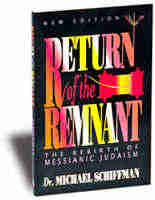
This material is based on Return of the Remnant: The Rebirth of
Messianic Judaism by Michael Schiffman. © 1992, Messianic Jewish Publishers.
Used by permission. Available through Messianic
Jewish Resources.
Messianic believers use this terminology because they see it as reflecting how faith in the Messiah
was expressed in its earliest stages. They prefer to speak about their faith in the Messiah in a manner consistent with their Jewish heritage
and culture. Belief in the Messiah is consistent with being Jewish. He is the fulfillment of God's
promises to Israel.
Using Messianic terminology can nurture faith in the Messiah among children, friends, and family members
in a manner consistent with Jewish heritage. Messianic terms communicate biblical truth without
the negative baggage of historical antisemitism.
Terms to use
- Yeshua
- Yeshua is the Messiah's name. Yeshua is a Hebrew word that
has the root meaning salvation. In a paraphrase of Matthew 1:21, a heavenly messenger told Joseph to call His name Yeshua
[salvation] because He would save His people from their sins.
Rendered in Greek as Ἰησοῦς (Iēsous), the name passed through Latin before taking the English form
Jesus. Messianic Jews use Yeshua
instead of Jesus because Yeshua is how His name was pronounced when He walked
the earth.
Through the centuries, Jewish people have suffered persecution "in the name of Jesus." Because of that history, the name "Jesus" can evoke associations with hatred and antisemitism for some Jewish people. On the
other hand, the name Yeshua proclaims Messiah as a Jewish option for Jewish people, as well as for non-Jews.
- Messiah
- Messiah is used instead of Christ. The English word
Messiah is derived from the Hebrew word Mashiach (which means
"anointed one"). Christ is the English equivalent of the Greek word
christos (which, like "Messiah," means "anointed one"). Jumping back over the Greek word to the original Hebrew term hammers home the fact that the Messiah is for Jewish people and not exclusively for Gentiles.
- A second reason for using this term is that — as with the name Jesus — countless Jewish people have been persecuted and killed by those claiming
to act on behalf of Christ. To many Jews, the word Christ is not simply a non-Jewish word
derived from Greek. "Christ" is a word that has carried anti-Jewish connotations.
- Believer
- Instead of "Christian," Messianic Jews use "believer." To many Jews, the word "Christian"
brings up memories of people who have bullied, hated, and persecuted Jews for two millennia.
Although the term Christian appears in the Bible, it is used only three
times in the New Covenant Scriptures (Acts 11:26; 26:28; 1 Peter 4:16). The New Covenant Scriptures also frequently call
Yeshua's followers "believers." The word "believer" can be used for those in
Messianic circles, as well as for those in traditional churches who believe in Yeshua
and truly seek to follow Him. By using the word believer, the focus is placed on a
person's commitment to follow the Lord without the distraction of the negative baggage of those
who used the label "Christian" but who did not walk as our Lord walked.
- Messianic
- Messianic describes a Jewish expression of biblical faith centered on the Messiah. Messianic congregations may include both Jewish and Gentile believers, while Messianic Jews specifically refers to Jewish believers.
- Congregation
- Messianic congregations are not called churches. Jewish people often associate churches
with antisemitism. In the past, and in some places today, antisemitism has come from those
who profess to be believers, from both clergy and laity. Ecclesia refers to people and
not to buildings. The term congregation similarly refers to an assembled community. James 2:2 uses the Greek
word commonly translated "synagogue" to refer to an assembly. For this reason, the term
congregation, or even synagogue, is the most appropriate one to describe organized gatherings of Messianic believers.
- Covenant
- This term refers to a testament in the sense of an agreement or covenant. Instead of saying Old
Testament and New Testament, Messianic believers refer to the two halves of the Bible as the Old
Covenant, or Tanakh (its Hebrew name), and the New Covenant, or Brit
Chadasha (Hebrew for New Covenant).
- Tradition
- Jewish cultural and religious practices, whether in their original forms or adapted to reflect Messianic beliefs.
- Liturgy
- Jewish liturgical elements in Hebrew, English, or both that may be part of a Messianic
worship service.
In addition to the above terms, some Messianic believers replace a letter in God and Lord with a hyphen, writing G-d and L-rd, as a sign of reverence. Similarly, many
Gentile believers capitalize the initial letters of references to God and Lord, although the ancient Hebrew and Greek manuscripts did not use capitalization in the same way modern English does.
Words and phrases to avoid
The following terms bring to mind historic antisemitic images rather than reflecting a Jewish cultural expression. Therefore, most Messianic Jews do not use them.
- Christian
- According to Acts 11:26, the disciples were first called Christians in Antioch. Although the word Christian is used only three times
in the New Testament, it eventually became the commonly used title for Gentile
believers. As the early communities of Jewish followers of Jesus diminished, Christian emerged
as the primary title for members of believing congregations. Over the centuries, the term also
became associated with those who hate Jewish people and who have rejected everything Jewish.
Since Christian is (1) not explicitly applied specifically to Jewish believers in Scripture and (2)
carries a negative historical reminder of antisemitism, the term Messianic is used
instead. This word identifies Jewish believers as followers of the Messiah without the negative
overtones that "Christian" has accumulated. [ See Believer ]
- Conversion
- To most Jewish people, conversion means turning away from being Jewish to become a Gentile. Biblically, of course, conversion refers to repentance (i.e., turning to God). To communicate this same idea, in Messianic circles, a person is said to have
become a believer or to have become Messianic.
- Baptism
Messianic Jews speak of believer's immersion. That's because the word baptism brings to mind memories
of the forced conversions and baptisms perpetrated against Jewish people by antisemites.
Horrible things, including forced baptisms, were done in the name of Jesus. Sadly, people have
profaned the name of the Messiah by deeds contrary to His teaching.
In Jewish experience, baptism has sometimes been perceived as symbolizing departure from Jewish identity and entrance into a non-Jewish church. So, when Messianic
Jews talk about the immersion of new believers in Jesus as the Messiah, they call it a Messianic mikvah, an act with origins in
ancient Jewish practice. Calling it a mikvah avoids having the ritual linked to acts of antisemitism or other negative issues associated with the Christian Church. Saying mikvah calls attention to the true Jewish roots of the Christian faith.
- Cross
- For Jewish people, the cross can evoke memories of persecution inflicted on them by people
invoking Jesus' name and waving small crosses. Jewish believers prefer to focus on the real
meaning of that cross and what happened because of it. That's why they may refer to the cross on which the Messiah died as an altar or an execution stake.
- Years as A.D. and B.C.
- Dates are cited with the initials C.E. for "Common Era" or B.C.E. for "Before the Common
Era." Jewish people prefer these neutral phrases instead of B.C. and A.D., which stand for "Before
Christ" and the Latin anno Domini, "in the year of the Lord."
— Howard Culbertson, hculbert@snu.edu
Afterword: What Is Messianic Judaism?
The modern Messianic Jewish movement has roots in the 19th century and took recognizable institutional form during the 1960s and 1970s. Messianic Jews identify as Jewish and also believe that Jesus of
Nazareth is the long-awaited Messiah. The broader movement also includes some Gentile participants. Combining elements of Judaism and Christianity,
Messianic Jews uphold Jewish traditions, observe Jewish holidays, and celebrate Jewish rituals
while embracing the teachings of Jesus Christ recorded in the New Testament.
Messianic Jews often gather in congregations known as Messianic synagogues. Their
meetings blend Hebrew liturgy with Christian worship. The movement's theology varies widely.
Some adherents emphasize their Jewish heritage. Others focus more on the practices and worship forms of evangelical Christianity. Despite controversy within both the Jewish and Christian communities, Messianic Judaism remains a distinctive and complex religious movement.
 Jewish information on the
Internet
Jewish information on the
Internet
Related articles


