At What Age Do Americans Become Christians? Statistics and Research
TL;DR:
Research from the Church of the Nazarene, Barna Group, and others shows that around two-thirds of American Christians made their initial commitment to Jesus before age 18. Many lifelong Christians and even missionaries first sensed God’s call during these formative years. While conversions in adulthood do occur—often prompted by major life transitions such as marriage, parenthood, or a crisis—they are less common. Bottom line: The best opportunity for evangelistic impact in America is during childhood and early adolescence.
Evangelism statistics: How old are people when they become Christians?
- Information from several surveys reveals the ages at which Americans typically make an initial commitment to Jesus Christ.
- According to surveys, a large proportion of American Christians made their initial commitment to Jesus during childhood or early adolescence.
- The probability of an American becoming a Christ-follower decreases with age.
“I have been reminded of your sincere faith, which first lived in your grandmother Lois and in your mother Eunice and, I am persuaded, now lives in you also.” — 2 Timothy 1:5
Ages at which Americans say they first placed their faith in Jesus of Nazareth as the promised Messiah and became evangelical, born-again Christians
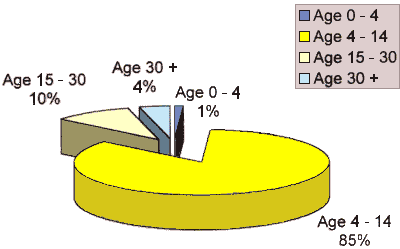
The data in the pie chart comes from research conducted at the Global Ministry Center of the Church of the Nazarene.
Another survey cited by the International Bible Society (now Biblica) indicated that 83% of Christians make their first commitment to Jesus when they are children or young adolescents between the ages of 4 and 14. Surveys conducted by the Barna Group indicate that American children ages 5 to 13 have a 32% probability of accepting Christ, while the probability for young people ages 14 to 18 falls to 14%. Adults ages 19 and older who do not identify as Christians have just a 6% probability of becoming Christians.
These findings illustrate the importance of encouraging children to consider following Christ and welcoming him as Savior and Lord.
Because the slice representing ages 4–14 is so large, some talk about a “4–14 Window.” In addition, many people serving as career cross-cultural missionaries have testified that they first sensed God calling them to missionary service between the ages of 4 and 14.
Jesus said, “Let the little children come to me, and do not hinder them, for the kingdom of heaven belongs to such as these.” — Matthew 19:14
How can you begin a conversation about your spiritual journey and God’s invitation to trust Jesus of Nazareth as Savior and Lord?
— Howard Culbertson, hculbert@snu.edu
Afterword — Other Studies
The results of studies examining the age at which Americans make an initial commitment to Jesus Christ vary depending on the denomination, religious background, and specific criteria used. However, research on Christian conversion and religious affiliation by several organizations does show some general patterns.
- Childhood and Early Adolescence: The majority of Americans who identify as Christians report making an initial commitment to Jesus Christ at a young age, often before age 18. According to various studies, including research conducted by Barna Group and Pew Research Center, many people in the United States report adopting or confirming their Christian faith during childhood or early adolescence. Barna Group’s research has indicated that nearly two-thirds of people in the United States who identify as Christians made their commitment to Christ before age 18. A substantial proportion (about 43%) reported becoming Christians before age 13.
- Late Teens and Early 20s: Another key period for making a faith commitment or deepening one’s faith is the late teens and early adult years, particularly ages 18 to 25. During this period, many young people experience life changes, such as leaving home for college or work. Those changes can lead them to examine or reaffirm their faith. About 20–25% of Christians report making a faith commitment during this stage of life.
- Adulthood: While the majority of initial commitments to Jesus Christ occur during childhood or youth, some people embrace or return to Christianity in adulthood. Life events such as marriage, parenthood, or a crisis sometimes lead adults to become more religious. Around 10–15% of American Christians report making an initial commitment to Christ after age 30.
Bottom line: The most common time for Americans to make an initial commitment to Jesus Christ is well before age 18. A smaller percentage make that commitment or deepen their faith during their late teens, early adulthood, or later life.
Reflection Questions: The Age of Christian Conversion in the United States
- What challenges or barriers might make it harder for American adults to embrace faith in Christ than for children or teenagers?
- Why do you think young children and preteens are often receptive to sensing a call to vocational ministry? How can churches and parents nurture and affirm such callings at an early age?
- How significant is the role of family in shaping a child’s spiritual journey? What can families do to create an environment where children are more likely to place their faith in Christ?
- What evangelistic strategies could be effective in reaching adults who have a lower probability of conversion?
- How might life events, such as crises or major transitions, open the door for faith conversations with adults?
Reminder
Note: This data reflects surveys taken in the United States of America. Statistical data from research elsewhere in the world may show different patterns.
You might also like these
More recommended links


