TL;DR:
The tearing of the Temple curtain in connection with Jesus' death symbolizes the opening of a new era of grace and direct access to God through Christ. Commonly understood to have been the curtain before the Holy of Holies, it symbolized restricted access to God's presence. Its tearing from top to bottom points to God opening the way for all people to approach Him through Christ. Jesus' sacrificial death made salvation available to everyone. This devotional includes historical and theological background, reflection questions, and quotations from biblical scholars.
What is the meaning of the Temple curtain being torn in two in connection with Jesus' death?
"This is love: not that we loved God, but that he loved us and sent his Son as an atoning sacrifice for our sins" — 1 John 4:10 (NIV 2011)
Week 20
For nearly a decade, Barbara and I lived in a country in which a large majority of the population claimed to be Roman Catholic. Because of that particular religious environment, one phrase in the Bible's crucifixion narrative has come to have a rich meaning for us.
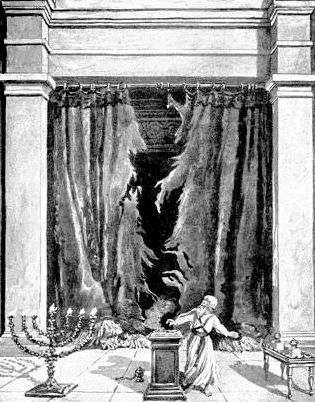
Luke mentions the tearing of the Temple curtain immediately before reporting Jesus' death: ". . . and the veil of the temple was torn in two" (Luke 23:45, NASB). That's all. Matthew, Mark, and Luke all mention it, but none of them provide further commentary or explanation.
However, the tearing of the Temple curtain is rich in symbolism because it occurred when the new order of grace was ushered in through the sacrificial death of the Lamb of God.
The torn curtain is commonly understood to have been the one separating the Holy Place from the Holy of Holies. It symbolized restricted access to God's presence: only the high priest could enter the Holy of Holies, on the Day of Atonement.
But now, with the death of Jesus, the way was opened into the presence of God for every person. Through Christ, all believers were granted direct access to God, with Jesus serving as the great High Priest.
Unfortunately, Christendom hasn't always appreciated the full meaning of that curtain-tearing, although I was reminded of it every time I visited a Roman Catholic basilica or cathedral in Italy.
Along the side walls, I often saw elaborate wooden confessionals. These reflect the Roman Catholic practice of private confession to a priest, also called auricular confession.
In Roman Catholic practice, the faithful confess grave sins to a priest, who pronounces absolution and assigns an act of penance. The assigned penance may involve prayers or other acts expressing repentance and a desire to live differently.
To me, requiring priestly absolution seems difficult to reconcile with the direct access to God symbolized by the torn curtain. It is as though the curtain has been sewn back together to separate ordinary people from God's presence once more.
I understand the torn curtain as a powerful symbol that, through Christ, believers can approach God without depending on a human priest to pronounce absolution or assign penance. Hebrews 4:14–16 and 10:19–22 affirm the access believers have to God through Jesus, our great High Priest.
Why did God do all this for us? Well, as John writes in his letter: "Not that we loved God, but that He loved us ..." (1 John 4:10, NASB). Because of His love, God went to incredible lengths to save us. I'm afraid that far too often, we don't fully appreciate what Christ did to save us from our sins.
Maybe we have become so familiar with the story that we no longer grasp the significance of Christ dying in our place.
My friend Antonio Capannoli lives in Siena, a centuries-old city about 50 miles south of Florence. A few years ago, I had the privilege of helping Antonio come to faith in Jesus Christ during a conversation in his living room.
Some time later, he told me of being at his mother's home and watching a film portrayal of the crucifixion of Jesus on television. Antonio's mother, who is not an evangelical, walked out of the room, saying it was too awful to watch.
Antonio, on the other hand, sat there, transfixed, tears streaming down his face as he came to realize the awful price Jesus paid for his salvation.
I wrote this devotional when Barbara and I were serving as missionaries in Italy. It is one of a series of 52 brief devotionals written for The Standard, a Faith Connections take-home publication accompanying adult Sunday school lessons published by the Church of the Nazarene.
The tearing of the veil or curtain in the Jerusalem Temple in connection with Jesus Christ's death should be seen by Christians as a momentous event.
The Gospel accounts place the tearing of the curtain in the crucifixion narrative. Christians commonly understand it as a sign of the New Covenant established through Jesus' death and the opening of access to God through Him.
Hebrews 10:19–22 connects believers' confidence to enter God's presence with Jesus' blood and the new and living way opened through the curtain. This provides a foundation for understanding the torn curtain as a symbol of reconciliation with God through Christ.
We believe that Jesus Christ, by His sufferings, by the shedding of His own blood, and by His death on the Cross, made a full atonement for all human sin, and that this Atonement is the only ground of salvation, and that it is sufficient for every individual of Adam's race. The Atonement is graciously efficacious for the salvation of those incapable of moral responsibility and for the children in innocency but is efficacious for the salvation of those who reach the age of responsibility only when they repent and believe. (Isaiah 53:5–6, 11; Mark 10:45; Luke 24:46–48; John 1:29; 3:14–17; Acts 4:10–12; Romans 3:21–26; 4:17–25; 5:6–21; 1 Corinthians 6:20; 2 Corinthians 5:14–21; Galatians 1:3–4; 3:13–14; Colossians 1:19–23; 1 Timothy 2:3–6; Titus 2:11–14; Hebrews 2:9; 9:11–14; 13:12; 1 Peter 1:18–21; 2:19–25; 1 John 2:1–2)
— excerpt from the Articles of Faith, Church of the Nazarene


