TL;DR:
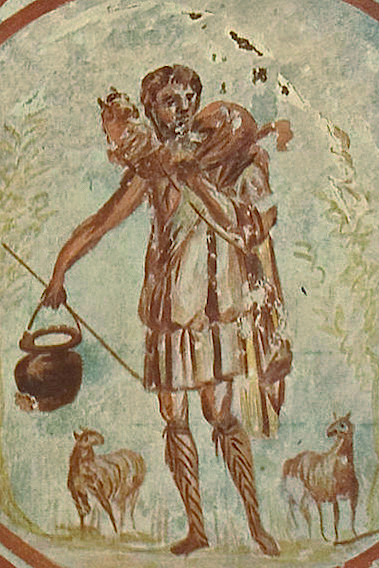
Psalm 23 portrays God as a shepherd who provides His people with rest, guidance, protection, and restoration. It assures believers that even in life’s darkest valleys, God’s presence brings comfort and courage. The page also includes a “shepherd” acrostic, noteworthy quotations, and a third-century painting from the Catacomb of St. Callixtus in Rome depicting a shepherd carrying a sheep across his shoulders.
What is the message of Psalm 23 for us today?
Psalm 23 (2011 NIV)
23 1 The Lord is my shepherd, I lack nothing.
2 He makes me lie down in green pastures, he leads me beside quiet waters,
3 he refreshes my soul. He guides me along the right paths for his name's sake.
4 Even though I walk through the darkest valley, I will fear no evil, for you are with me;
your rod and your staff, they comfort me.
5 You prepare a table before me in the presence of my enemies.
You anoint my head with oil; my cup overflows.
6 Surely your goodness and love will follow me all the days of my life,
and I will dwell in the house of the Lord forever.
In my rough translation from a classic Italian novel, a young lady named Lucia reassures a suffering friend:
"Afraid? Why should I be afraid? We've passed through worse things than a storm of rain before. He who has protected us for so long will protect us now."
Nearby, a young man named Renzo crouched behind that hut, hiding from the authorities. He could hardly believe his ears. That sweet, melodic voice! Could that have been Lucia?
It is a climactic moment for the central characters in Alessandro Manzoni's 1827 historical novel, I promessi sposi (The Betrothed). The voice expressing confidence in the Good Shepherd's care and protection is indeed Lucia's. At long last, Renzo finds her alive.
A classic of Italian literature, I promessi sposi is set in 17th-century Lombardy, when the Spanish-ruled region was plagued by lawlessness and the unchecked power of local noblemen whose armed retainers often ran roughshod over law and justice.
One of these villains is Don Rodrigo. He is determined to prevent Lucia's marriage to Lorenzo Tramaglino, known as “Renzo,” because he wants Lucia for himself. She is forced to flee her peaceful village to escape his clutches.
The novel recounts the ordeals that separate Lucia and Renzo, as well as his efforts to find her amid the turbulence of early 17th-century Italy. Their ordeals resemble the “darkest valley” described in Psalm 23. It was a time of violent bread riots, the ravages of the Thirty Years’ War, famine, and a devastating outbreak of bubonic plague.
In fact, Renzo and Lucia are reunited in a lazaretto for plague victims after he overhears her speaking about the Lord's comfort and care.
Alessandro Manzoni's Lucia is portrayed within the Roman Catholic world of 17th-century Italy. Her reassuring words to a suffering friend nevertheless remind me of Psalm 23's affirmation that trusting God brings rest, peace (shalom), comfort, and triumph over fear.
Psalm 23, one of the most beloved psalms in the Bible, expresses profound theological truths about humanity's relationship with its Creator. Framed in sheep-and-shepherd terms, Psalm 23 tells us a great deal about the nature of God and His desires for us.
God cares for, protects, and even corrects His people, just as a good shepherd cares for his flock. God's presence with us is promised now and forever. That promise includes whatever dark valleys may lie between here and eternity—whether bread riots, rainstorms, or personal suffering.
Our Shepherd's loving care for us includes the renewal and restoration of lives shattered by suffering. To experience the blessings described in Psalm 23, we must trust our Shepherd as fully as a sheep trusts its shepherd.
I don't know what dark valleys you have been through lately. But let me ask you a question. Can you say, "The Lord is my Shepherd"? If you can, then you can also face life's dark valleys with the affirmation, "I will fear no evil."
I wrote this devotional while Barbara and I were serving as missionaries in Italy. It is one of 52 brief devotionals written for The Standard, a weekly Faith Connections take-home publication for adult Sunday school classes published by The Foundry.
— Howard Culbertson, hculbert@snu.edu
Psalm 23 uses the image of a shepherd caring for his flock to describe the intimate relationship between God and His people. Like sheep depending on their shepherd, believers depend on God for sustenance, guidance, protection, and care. Thus, saying “The Lord is my Shepherd” is a declaration of faith, trust, and reliance on God’s loving care.
S – Strong is His love that never fades.
H – He leads us through the darkest times.
E – Ever faithful, His grace abounds.
P – Present with us when life's storms arise.
H – Holding us close through trials deep.
E – Each of His promises He will keep.
R – Restoring the weary and holding them safely in His arms.
D – Delivering us through fear and harm.
Like acrostics? Here are more of them.
Memorable Quotes About Other Bible Verses


