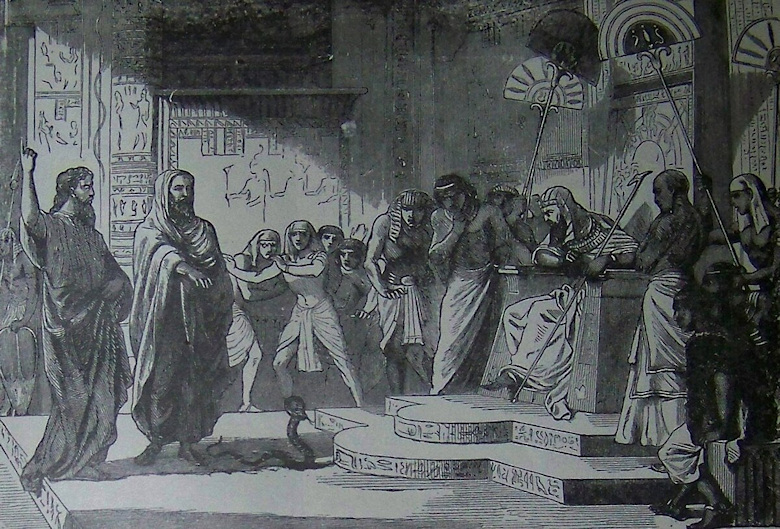
More classic art masterpieces used as illustrations
TL;DR:
Moses’s encounters with Pharaoh reveal both God’s sovereignty and His desire for an exclusive covenant relationship with His people—one that mirrors a marriage bond. Pharaoh’s repeated refusals illustrate the dangers of pride and spiritual blindness, while Moses’ persistence and obedience highlight the endurance of faith under pressure. God calls His followers to respond faithfully, not out of coercion but love.
What lessons for us are there in the Exodus 10 account of Moses’ meeting with Pharaoh?
1 Then the Lord said to Moses, "Go to Pharaoh, for I have hardened his heart and the hearts of his officials so that I may perform these signs of mine among them 2 that you may tell your children and grandchildren how I dealt harshly with the Egyptians and how I performed my signs among them, and that you may know that I am the Lord."
3 So Moses and Aaron went to Pharaoh and said to him, "This is what the Lord, the God of the Hebrews, says: 'How long will you refuse to humble yourself before me? Let my people go so that they may worship me.' 4 If you refuse to let them go, I will bring locusts into your country tomorrow. 5 They will cover the face of the ground so that it cannot be seen. They will devour what little you have left after the hail, including every tree that is growing in your fields. 6 They will fill your houses and those of all your officials and all the Egyptians—something neither your parents nor your ancestors have ever seen from the day they settled in this land till now.'" Then Moses turned and left Pharaoh.
7 Pharaoh's officials said to him, "How long will this man be a snare to us? Let the people go so that they may worship the Lord their God. Do you not yet realize that Egypt is ruined?"
8 Then Moses and Aaron were brought back to Pharaoh. "Go, worship the Lord your God," he said. "But tell me who will be going."
9 Moses answered, "We will go with our young and our old, with our sons and our daughters, and with our flocks and herds because we are to celebrate a festival to the Lord."
. . .
20 But the Lord hardened Pharaoh's heart, and he would not let the Israelites go.
21 Then the Lord said to Moses, "Stretch out your hand toward the sky so that darkness spreads over Egypt—darkness that can be felt." 22 So Moses stretched out his hand toward the sky, and total darkness covered all Egypt for three days. 23 No one could see anyone else or move about for three days. Yet all the Israelites had light in the places where they lived.
24 Then Pharaoh summoned Moses and said, "Go, worship the Lord. Even your women and children may go with you; only leave your flocks and herds behind."
25 But Moses said, "You must allow us to have sacrifices and burnt offerings to present to the Lord our God."
Some years ago, a film titled His Land was used in an evangelistic thrust in Sicily, the island depicted as the "football" being kicked by Italy's boot-shaped peninsula. Produced by the Billy Graham Evangelistic Association, the film portrayed the land and its current Jewish inhabitants through the lens of biblical history. It put particular emphasis on divine prophecies.
After one film showing in Sicily, some left-wing Italian radicals loudly began accusing the church group of being CIA agents who believed the modern state of Israel was under special divine protection.
The church group was not connected in any way with the US government's Central Intelligence Agency (CIA). The apostle Paul says that those who have faith are children of Abraham. God did call the Israelites out of Egypt, and on a special day at Sinai, Israel entered into a covenant with the Lord that can be compared to marriage vows. The New Testament connects all who have faith in Christ with Abraham's covenant family.1
Although the Sinai covenant was not called a marriage ceremony, later biblical language portrays Israel's relationship with God in marriage-like terms. Exodus 10 shows that God called His people to set themselves apart for Him. Later, Moses would refer to the people of God's unfaithfulness to the covenant agreement as "whoring" (KJV) or "prostituting" (NIV).2
That's strong language. However, prophets in the Old Testament, such as Ezekiel and Hosea, used this theme. The use of marriage imagery indicates the kind of exclusive relationship God wants with His people. That includes all Christ-followers today.
The covenant should not be understood as a contract negotiated between equal parties. God took the initiative, established its terms, and invited His people to respond willingly and faithfully.
It's easy to see parallels between this divinely initiated relationship and the covenant at Sinai, as well as the "better covenant" outlined in Hebrews 8.
Neither the inborn merits of the Jews nor a plot by the CIA made them the descendants of Abraham, the "chosen people." The same is true of us. We did not choose ourselves. God has always taken the initiative in wooing us into a covenant relationship by His loving promises.
God's covenant today is divinely initiated, but He invites a willing response. God asks us to respond to His offer of a new covenant "established on better promises" (Hebrews 8:6). He calls us to pledge our lives, our love, and our affection to Him. He wants us to accept our part of the joint responsibility that a covenant always involves.
We are not signing a mutually agreed-upon, haggled-over contract. We are committing ourselves to a covenant established through Jesus' sacrificial death.
In the light of His sacrificial love, can we do less than take our vows seriously? Let's discover the depth of meaning anew in our relationship to God. Let's reciprocate His faithfulness! Let's be faithful to Him because He has been faithful.
— Howard Culbertson, hculbert@snu.edu
I wrote this devotional blog post while Barbara and I were serving as missionaries in Italy. It is one of a series of 52 brief devotionals written for The Standard, a weekly Faith Connections take-home curriculum piece for adult Sunday school classes published by the Church of the Nazarene.
The Exodus 10 account of Moses’ meeting with Pharaoh provides us with at least five lessons for today:
In brief, the Exodus 10 story of Moses’ meeting with Pharaoh can give us relevant insights into the need for qualities such as persistence, humility, faith, justice, and compassion.


