TL;DR:
Jesus' Great Commission (Matthew 28:19-20 and Acts 1:8) is far more than a suggestion. It is a divine command rooted in God's promises to bless all peoples (Genesis 12:3) and reflects the message of almost 200 other Bible passages. It reveals God's global missionary heart and calls every believer to active involvement in world evangelism efforts.
What does "make disciples in all nations" really require in today's world?
The Great Commission, given by Jesus just before His
Ascension into Heaven follows up on God's promises in Genesis that all peoples on earth would be blessed through His people.
First-century Christians seemed to believe that Christ
envisioned evangelism going on everywhere at the same time.
In our pluralistic, postmodern world, some consider Christian ministry abroad to be irrelevant or even offensive. That's not true. Sharing our faith is an act of love and a form of truth-telling. The Great Commission (Matthew 28:19-20) remains central to the Christian faith. We must seek meaningful and respectful ways to engage our world with the gospel.
A world evangelism Bible text? Jesus' Great Commission in Matthew 28:19 and His words in Acts 1:8 come to mind.
Two blog posts on Christ's command in Matthew 28:19-20 and Acts 1:8
Need ideas for a sermon on the Great Commission? Here they are.
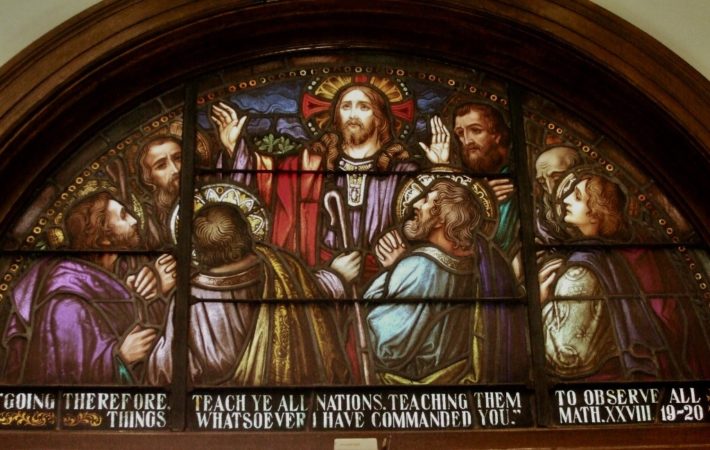
"Therefore go and make disciples of all nations,1 baptizing them in the name of the Father and of the Son and of the Holy Spirit, and teaching them to obey everything I have commanded you" — Matthew 28:19-20 (2011 NIV).
Question: Which Bible verse is most often associated with world evangelism? Easy answer: The Great Commission in Matthew 28:19-20.
Jesus spoke those words after His resurrection, shortly before His ascension. For most Christians, these final words of Matthew's Gospel immediately come to mind in conversations about biblical motives for world missions.
The Great Commission follows up on God's promise that all peoples on earth would be blessed through His people (Genesis 12:3). These words of Jesus Christ also reflect what the Old Testament says about the "light" of salvation reaching "the ends of the earth" (Isaiah 49:6). It's an achievable command. Indeed, Revelation 7:9 describes an end-times vision in which the apostle John saw the results of the fulfillment of the Great Commission.
Why Is the Great Commission Important?
German theologian Thomas Schirrmacher calls the Great Commission the most important passage in the Gospel of Matthew. He says, "The Great Commission in the Gospel of Matthew (28:16-20) is not only the end of the Gospel of Matthew. It is also its climax and its goal."
Memorable Quotes about Jesus' Great Commission
References to Christ's Great Commission abound in material about world evangelism. Here are some samples from the writings of missionaries and missions mobilizers:
"The Great Commission is not an option to be considered; it is a command to be obeyed." – Hudson Taylor, quoted in The Spiritual Secret of Hudson Taylor
"The distinctive mission as defined in the Great Commission is to 'make disciples.'" — Paul Orjala, God's Mission is My Mission p. 12.
"The gospel is only good news if it gets there in time." – Carl F. H. Henry, The Uneasy Conscience of Modern Fundamentalism
"I really appreciate William Carey's use of the word obligation when it
comes to the apostles' role in the Great Commission. I wonder whether using such a strong
term today would make a difference. . . What if we called Matthew 28:19-20 the Great
Obligation? That sounds much stronger and maybe more fitting." — Kristopher Powell,
Northwest Nazarene University graduate student
Reflection Questions
In what ways does the Great Commission relate to God's promise in Genesis and the Old Testament prophecy of salvation reaching the ends of the earth?
What is the church's current challenge in fulfilling the Great Commission? Why is passion so important?
Why do you think many people consider the Great Commission the most important passage in the Gospel of Matthew? Do you think the Great Commission is achievable?
Why do you think surveys show that a majority of churchgoers have no idea what the Great Commission is? What can be done to raise awareness? What can we do to increase participation in supporting world missions?
2. Acts 1:8 — Sequential or simultaneous?
"You will be my witnesses in Jerusalem, and in all Judea and Samaria, and to the ends of the earth." — Acts 1:8, 2011 NIV
Why do we send people overseas rather than just concentrating locally?
Just prior to His Ascension, Jesus talked about the Holy Spirit coming upon His followers. Then, He said to them, "You will be my witnesses in Jerusalem, and in all Judea and Samaria, and to the ends of the earth" (Acts 1:8). For most of us, these words seem parallel to those of the Great Commission of Matthew 28. Others, however, contend that Acts 1:8 is a step-by-step road map.
Therefore, they say, Jesus meant for us to concentrate first on our hometown (our "Jerusalem,"
they say). When evangelization in our hometown is complete, we can go to our Judea, and when we're
finished there, we can go to our Samaria. At some point in the future, we can go to the ends of the earth.
The problem with that interpretation is that it doesn't square with what the Early Church did. It did not proceed to evangelize in a linear or concentric-circle fashion in which outreach in one area had to be completed before moving on to the next circle.
Persecution caused early believers to scatter simultaneously into Judea and Samaria. So,
Philip was preaching in Samaria (Acts 8) before all of Judea was evangelized. The early church
did not seem to struggle over whether to cross geographic boundaries. By the time of Paul's
conversion, there were churches in Gentile cities like Damascus and Antioch in Syria.
Indeed, the Antioch church is the congregation that commissioned Paul and Barnabas as
missionaries.
The one question early on was whether there was a cultural boundary that had to be crossed. In other words, did Gentiles who embraced Jesus need to become Jews? The Jerusalem Council, described in Acts 15, decisively settled that issue. There is no evidence that first-century Christ-followers waited to make sure evangelism in one area was complete before going elsewhere. Later church traditions say that the apostle Thomas planted churches in India and the apostle Andrew evangelized in Greece. Other early church traditions refer to Bartholomew having gone to Armenia and James "the younger" to Egypt. Jude (Thaddeus) may have gone to Persia and Matthew to Ethiopia.
Evangelizing everywhere simultaneously
Clearly, first-century Christians thought Christ envisioned evangelism going on everywhere
at the same time. Apparently, they saw the list of places in Acts 1:8 not as a map to be
carefully followed but simply as another way of saying "make disciples of all
nations" (Matthew 28:19-20) and "preach the good news to all creation" (Mark
16:15).
In the sixteenth and seventeenth centuries, many Protestant Reformers taught a linear
progression ("make sure your hometown is evangelized first and foremost"). They were wrong.
It took people like William Carey to get the Church back to evangelizing everywhere
simultaneously — "from and to all six continents," as some missiologists have expressed it.
Could insisting that world evangelism must proceed linearly (i.e., "I have to take care of my 'Jerusalem' first") be a way of postponing responsibility for evangelizing the rest of the world?
1Note: In the Bible, the word translated "nations" can refer to nations, peoples, or Gentiles, depending on the context. In the Great Commission, it points beyond modern political countries to the world's diverse peoples and cultural groups.
"[Acts 1:8] is both a charge and a promise—a nudge and an assurance. Filled with the power of the Holy Spirit, Jesus' followers from all over will take the good news everywhere to everyone." — Shane Bennett
Some people interpret Acts 1:8 as a step-by-step road map for evangelism. What problems are there with that interpretation?
How did the early church go about trying to fulfill Christ's Great Commission? What does this suggest about the interpretation of Acts 1:8 as a road map?
What cultural boundary issue was settled by the Jerusalem Council? How did this impact evangelism in the early church?
How did many Protestant Reformers in the sixteenth and seventeenth centuries approach evangelism? What was wrong with their approach?
What is the significance of the definition of "nations" in the Bible? How should this determine our understanding of Acts 1:8 as a charge to evangelize the world?
These two blog posts on a world missions Bible passage were two of over three dozen articles in the "Heart of God" series published in Engage magazine. That series looked at what the Bible says about world missions.
Four Things to Keep in Mind About Acts 1:8
It's a call for simultaneous expansion. The structure of the verse suggests geographic expansion rather than laying down a strict chronological sequence. The disciples were in Jerusalem on the Day of Pentecost. Those early believers in Jesus did not wait to "finish" evangelizing one area before moving to the next. They moved outward to Judea, Samaria, and beyond as soon as opportunities arose.
The gospel spreads along travel and trade routes. Persecution also spreads the faith as displaced believers bear witness to Christ in the places to which they have fled to escape danger.
Mission work is always ongoing. No single region is ever completely "finished" in terms of evangelization because of population shifts and the fact that babies are being born who soon become young people and then adults needing the gospel message (if they did not previously hear and embrace it as children).
We must be guided by the Holy Spirit. Jesus spoke about the Holy Spirit's guiding role. The disciples were to be responsive to the Spirit's
leading, which sometimes meant staying in a place longer and other times moving on more quickly.
Think about it: Jesus' words in Acts 1:8 did not mean that the disciples had to completely finish evangelizing Jerusalem before moving on to Judea and Samaria. Nor did He mean that they had to finish in Judea and Samaria before moving to the ends of the earth. His vision was that of an ever-widening group of witnesses empowered by the Holy Spirit, spreading outward from Jerusalem to encircle the entire world.
Memorable Quotes About Acts 1:8
"There should never be any doubt in the mind of any Christian, anywhere in the world, that our Commander in Chief has given an order. To fail to hear this command is deliberate disobedience. The command in Acts 1:8 is that you shall be witnesses throughout the world." — Billy Graham in a radio message, "Words from the Risen Christ"
"The power promised is not political, economic, or military—but spiritual. The Spirit's power makes witnesses, not warriors."
— John Stott, The Message of Acts, page 438. (The Bible Speaks Today series)
"The church's mission is not a human project but a divine mandate, empowered by the Holy Spirit who sends us beyond our comfort zones." — Ajith Fernando, Acts: The NIV Application Commentary
Acrostic: Everywhere
E - Empowered by the Spirit from on high, V - Voices raised to testify, never shy. E - Even to unknown souls in distant lands, R - Reaching out with open hands. Y - You shall be witnesses, bold and true, W - Walking in grace in all you do. H - Holy fire igniting every word, E - Echoes of truth in hearts that hear. R - Regions near and far will see, E - Earth transformed through His decree.
The task remaining and Christian resource allocation
People ask: "How can we be concerned about other countries when there is so
much evangelism yet to be done here at home?"
Here's a graphic that can help answer that question.
Worker-to-need ratio: North Africa has only one Christian pastor or missionary for every two million people.
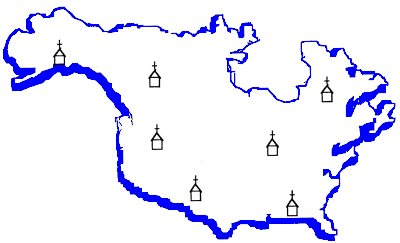
North African ratios applied to the USA/Canada
What if?
If the ratio of Christian workers to the total population in North Africa was applied to the
U.S. and Canada, those two countries would have only 185 full-time Christian workers. Alas,
there would be only about seven Christian churches in those two countries, a tremendous difference from the more than 50,000 churches now existing there.
Can we really comprehend what the church situation in the U.S. and Canada would look like if the
worker-to-need ratio in North Africa were applied to the U.S. and Canada?
Here's a graphic to help us visualize that scenario:
Good news regarding global evangelistic outreach: Reports suggest that 10,000 people
come to Christ every day in one huge Asian country alone.
Information from issues of Mission Frontiers, a publication of
the U.S. Center for World Mission
The challenge to fulfilling Christ's Great Commission: Lack of passion
A. W. Tozer said: "The great ones of the
kingdom have been those who loved God more than others did."
Tozer's statement goes to the heart of the matter. The question for us is: At what point will I tell Jesus
"No"? How far is too far? How much of a sacrifice is too much to pay?
— Nazarene Bible College student Kenny Chapman
What keeps us from fulfilling Christ's Great Commission for our
generation?
In a phone interview done for an assignment in a World Evangelism class, student Angela Wetmore posed this question to Nina Gunter: "From your perspective, what will be the single greatest challenge to world evangelization in the coming decade?"
Nina Gunter's response was:
"Dealing with believers' lack of passion for the lost. People
are so focused on themselves that they do not share God's concern for those who do not know Christ. The single greatest challenge is reviving that passion. Historically, the church has grown most when it ignited in people a desire to reach the lost."
Nina Gunter became a Nazarene General Superintendent after serving as director of Nazarene Missions International, a denominational world missions promotion and mobilization arm.
"The church will soon die . . ."
"The day the Church of the Nazarene loses her interest in foreign missions and rescue work (compassionate ministries), she may run awhile on her reputation, but she will soon die as dead as any formal, ecclesiastical church in the world. May God keep this vision before us"
— A. J. Vallery, superintendent of Bethany Training Home, Memphis, TN, June 16, 1920
"If I truly seek to have the heart of Jesus, I will seek to think the way He thinks, not just
about myself and my ministry, but about the world. I will seek to feel what He feels, to cry over
what He cries over, to laugh about what He laughs about, to see what He sees every day I live. I
will not just sing songs in worship services about honoring Him in all I do. I will seek to prove
my faith and commitment to the vision of Jesus with action. That's the message of James
2:18."
"It is the vision of Jesus that calls me to wake up every day and think about the world. All
too often, the world is out of our vision as Christians; we do not regularly think about it. God sees
the world; He thinks about the world 24 hours a day, seven days a week. As global Christians,
we should too." — church planter Larry McKain in Falling in
Love with the Church, p. 245
Q&A on Christ's Great Commission
Questions and answers about Christ's "Great Commission" (Matthew 28:19-20, Mark 16:15,
and Acts 1:8) that have appeared in internet searches.
1. What is the significance of the Great Commission in Christianity?
It is the clear call for Christ-followers to seek converts to Christianity in every ethnolinguistic people group of the world, rather than being tied to a specific culture.
Christ-followers' obedience to the Great Commission has made Christianity a missionary religion. Note:An ethnolinguistic group is a community of people who share a common language and cultural identity tied to their ethnic heritage.
2. Who were the disciples to whom Jesus gave the Great Commission?
Matthew 28 and Mark 16 describe Jesus speaking to the eleven remaining disciples (sometimes referred to as "apostles"). Acts 1 may describe a broader group of followers. The names of Jesus' twelve chosen disciples can be found (with some variations) in Matthew 10, Mark 3, and Luke 6.
Note: Since Matthew 28, Mark 16, and Acts 1 record post-Resurrection meetings, Judas Iscariot was no longer alive.
3. What exactly did Jesus instruct His disciples to do in the Great Commission?
Jesus told His followers to go make disciples in all the world's ethnolinguistic people groups. The new Christ-followers were to be taught, trained, and mentored.
4. How does the Great Commission relate to the mission of the church?
The Great Commission is the mission of the church.
5. What is the geographical scope of the Great Commission?
It is global in scope. Matthew 28:19 says "all nations," while Acts 1:8 ends with "the ends of the earth."
6. How does the Great Commission impact modern Christian missions?
It is the motivating force (or should be). Because a third of the world's population still
has no access to the gospel message, the Great Commission calls the church to press on until all have heard.
For those on the front lines, it points to discipleship as well as evangelism. Thus, simply spreading the gospel is only part of the task of modern Christian missions.
7. What are some different interpretations of the Great Commission?
Here are three contrasting pairs of interpretations.
Pair 1
The Great Commission was narrowly focused on only those to whom it was given in person.
The Great Commission was to all believers of all eras.
Pair 2
The Great Commission was fulfilled in the First Century by the Apostles and other believers.
The Great Commission must still be obeyed since so many have yet to hear the gospel for the first time.
Pair 3
The Great Commission is narrowly focused on getting people saved.
"Teaching them all things I have commanded you" makes the Great Commission holistic in nature.
8. How does the Great Commission fit with other teachings of Jesus?
Jesus' three parables in Luke 15 are about searching for and finding lost things.
At a village well in Samaria, Jesus calls his disciples to look at the ripened harvest fields. (John 4)
Jesus' words in Jericho at Zacchaeus' house: "The son of man came to seek and to save the lost."
The Lord's Prayer ("your will be done on earth").
The sending out of the 72 to preach the gospel, saying to them, "The harvest is plentiful, but the
workers are few" (Luke 10)
Luke 6:38: "Give, and it will be given to you" (2011 NIV).
Jesus' words in Luke 24:46-47: "This is what is written: The Messiah will suffer and rise from
the dead on the third day, and repentance for the forgiveness of sins will be preached in his name
to all nations."
9. How can individual believers apply the Great Commission in their daily lives?
While not all will be "goers" to the ends of the earth, we can all be senders by supporting world evangelism through prayer, financial giving, and encouragement.
We can also be witnesses to those around us.
10. What role does evangelism play in fulfilling the Great Commission?
Evangelism, in the sense of proclaiming the good news that God has come in the
person of Jesus Christ to reconcile the world to Himself, is a key element of the Great
Commission.
11. How does the Great Commission inspire global outreach and missionary work?
Those who commit themselves to Jesus as their Savior and make Him their Lord
should be more than willing to participate as either senders or goers in the cause of fulfilling that
Great Commission.
12. What challenges did the disciples face in carrying out the Great Commission?
Great distances to travel by land and sea.
Cultural barriers as they moved outside of Jewish circles.
Hostility from Jewish religious leaders and people who served pagan gods.
13. How does the Great Commission emphasize the importance of discipleship and teaching?
In Matthew 28:19-20, Jesus said to make disciples and then teach them
"to obey everything I have commanded you" (2011 NIV).
14. How does the Great Commission relate to the spread of Christianity throughout history?
In many cases, it has been the galvanizing force.
15. What are some practical strategies for fulfilling the Great Commission today?
Work to develop Christward movements rather than just individual conversions.
Raise up indigenous leaders and avoid paternalism by truly
empowering them.
Make contextualization a priority so things don't feel like foreign imports.
Use infinitely reproducible organizational structures and ministry
patterns.
Minister in incarnational and holistic ways.
16. How does the Great Commission intersect with cultural and social contexts?
When the gospel is truly contextualized (as it was for
Jews and Greeks of the first century), Christ-followers will speak out against whatever evil
enslaves people, while the gospel's transforming power will bring out the best in
people.
17. How does the Great Commission influence Christians' thinking about evangelism and outreach efforts?
It means our focus should be "both/and." By that, I mean we need to be passionate
about evangelizing our near neighbors and those on the other side of the globe. Focusing
exclusively on one or the other is only half of what Christ intended.
18. What is the role of prayer in the context of the Great Commission?
"The man or woman at home who prays often has as much to do with the
effectiveness of the missionary on the field, and consequently with the results of his or her labors,
as the missionary." — R. A. Torrey, The Power of Prayer and the Prayer of Power
"The history of revival shows plainly that all movements of the Spirit have started in prayer." — missionary-to-China Jonathan Goforth, By My Spirit, p. 181.
19. How does the Great Commission form the identity and purpose of the church?
It calls us to be outward-focused and to "go."
20. What are some common misconceptions about the Great Commission?
Misconception #1: Involvement in Great Commission fulfillment is optional.
Misconception #2: It is not valid in a pluralistic world.
Misconception #3: The Great Commission concerns only those who feel called by God to go overseas.
Misconception #4: The job of world evangelism is basically done.
Misconception #5: We have to finish the job in our homeland before doing anything elsewhere in the world.
Misconception #6: It involves imposing our beliefs on other people.
Misconception #7: Our only responsibility is for people in our immediate vicinity.
Where does the Bible start speaking about world evangelism?
Where does mission begin in the Bible?
A good place to start is Genesis 1:1. [ more ]
Afterword: Four Reasons Why People Attach Great Importance to the Great Commission
Backed by Authority: The Great Commission is seen as a direct
command from Jesus Christ Himself. Jesus said, "All authority in heaven and on earth has been
given to me. Therefore go and make disciples of all nations" (Matthew 28:18-19, 2011 NIV).
Expressed as a Mandate: Sharing the gospel with people of all ethnolinguistic groups is not an optional activity. The Great Commission
clearly calls for evangelizing everyone everywhere.
Global in Scope: Jesus instructs us to
make disciples of "all nations" (ethne in Greek). People from every ethnic, cultural, and geographical background are included.
Fulfills God's Plan: With almost 200 Bible verses pointing to it, the Great
Commission is clearly in God's plan for humanity.
Eight Bible Verses That Support Jesus' Great Commission of Matthew 28:19-20
Luke 24:46-47 — "He told them, 'This is what is written: The Messiah will suffer and rise from the dead on the third day, and repentance for the forgiveness of sins will be preached in his name to all nations, beginning at Jerusalem.'"
John 20:21 — "Again Jesus said, 'Peace be with you! As the Father has sent me, I am sending you.'"
Romans 10:14-15 — "How, then, can they call on the one they have not believed in? And how can they believe in the one of whom they have not heard? And how can they hear without someone preaching to them? And how can anyone preach unless they are sent? As it is written: 'How beautiful are the feet of those who bring good news!'"
2 Corinthians 5:18-20 — "All this is from God, who reconciled us to himself through Christ and gave us the ministry of reconciliation… We are, therefore, Christ’s ambassadors, as though God were making his appeal through us. We implore you on Christ’s behalf: Be reconciled to God."
Acts 13:47 — "For this is what the Lord has commanded us: 'I have made you a light for the Gentiles, that you may bring salvation to the ends of the earth.'"
Psalm 96:3 — "Declare his glory among the nations, his marvelous deeds among all peoples."
Isaiah 6:8 — "Then I heard the voice of the Lord saying, 'Whom shall I send? And who will go for us?' And I said, 'Here am I. Send me!'"
Revelation 7:9 — "After this I looked, and there before me was a great multitude that no one could count, from every nation, tribe, people and language, standing before the throne and before the Lamb."
These eight passages, together with Matthew 28:19-20 and many other Bible verses, reveal God’s heart for the nations and the global mission of the Church.