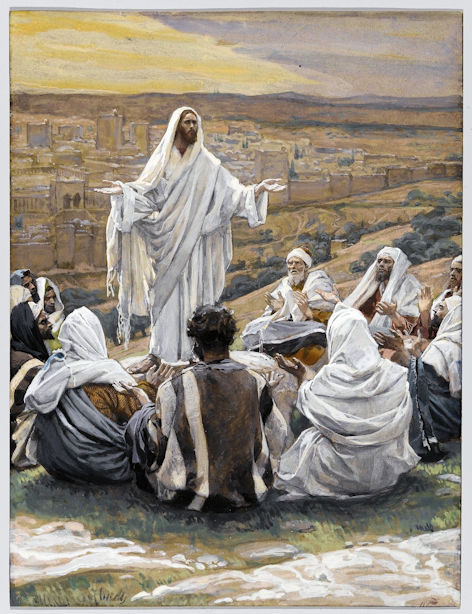
TL;DR:
The Lord’s Prayer, given by Jesus in Luke 11 and Matthew 6, is a powerful model of simple, heartfelt communication with God. It emphasizes reverence for God, trust in His provision, the importance of both receiving and giving forgiveness, and seeking His guidance.
What lessons can we learn from the Lord's Prayer?
Commentary on Luke 11
11 1 One day Jesus was praying in a certain place. When he finished, one of his disciples said to him, "Lord, teach us to pray, just as John taught his disciples."
2 He said to them, "When you pray, say:
"'Father,
hallowed be your name,
your kingdom come.
3 Give us each day our daily bread.
4 Forgive us our sins,
for we also forgive everyone who sins against us.
And lead us not into temptation.'"5 Then Jesus said to them, "Suppose you have a friend, and you go to him at midnight and say, 'Friend, lend me three loaves of bread; 6 a friend of mine on a journey has come to me, and I have no food to offer him.' 7 And suppose the one inside answers, 'Don't bother me. The door is already locked, and my children and I are in bed. I can't get up and give you anything.' 8 I tell you, even though he will not get up and give you the bread because of friendship, yet because of your shameless audacity, he will surely get up and give you as much as you need.
9 "So I say to you: Ask and it will be given to you; seek and you will find; knock, and the door will be opened to you. 10 For everyone who asks receives; the one who seeks finds; and to the one who knocks, the door will be opened.
11 "Which of you fathers, if your son asks for a fish, will give him a snake instead? 12 Or if he asks for an egg, will give him a scorpion? 13 If you then, though you are evil, know how to give good gifts to your children, how much more will your Father in heaven give the Holy Spirit to those who ask him!"
The Lord's Prayer, or the “Our Father” as it is sometimes called, is much more than something to be memorized to earn points in Vacation Bible School. Jesus gave it to His disciples after one of them, having watched Him pray, asked, “Lord, teach us to pray.”
These few short phrases recorded by Matthew and Luke can be a gold mine of spiritual truth for us. Among other things, this prayer says absolutely nothing about a special “prayer language.” When Jesus' disciples came to Him asking to be taught to pray, Jesus did not give them a lesson in unknown tongues or tell them to begin repeating some word of praise over and over again. [ more on speaking in tongues ]
What did Jesus present to His followers as a model for prayer? His response is simple, brief, and direct. Luke's account makes it clear that God wants us to communicate with Him in words that naturally express our thoughts and feelings. The Lord's Prayer, as we call it, contains no hollow repetition, artificial cadence, or unintelligible syllables.
Jesus' teaching clearly demonstrates that He doesn't want us to enter God's presence thoughtlessly. Prayer based on Jesus' model will include expressions of reverence and acknowledgment of the coming kingdom.
Jesus teaches us how to talk to God about our daily needs. He also gives us a model for praying for forgiveness—both receiving it and extending it to others—and shows us that we may ask for divine guidance.
He then follows this model prayer with an emphasis on perseverance. As we wait upon God—that is, as we trust and hope in Him—Jesus assures us of God's goodness and willingness to hear us.
In all this, there is no hint of a secret, heavenly language. Surely, if there were a better way to pray than the intelligent use of our native language, Jesus would have told us.
One of the most delightful books on prayer I've ever seen is based on the premise that God wants us to pray with words and phrases that truly reflect us. It is titled God Is No Stranger. I first saw a copy of it at the missionary editor's home in the mountains of Haiti.
The book is a collection of prayers by Haitian Christians, illustrated with black-and-white photographs of Haitian life. The prayers are colorful, simple, brief, and direct. They obviously flow right out of the daily lives of those believers. They are exactly the kind of prayer Jesus taught us to pray in Luke 11.
I have often heard this same kind of praying in Italy. Freed from dependence on highly ritualized forms, Italian evangelicals often pray directly from their hearts. Such natural, heartfelt prayer reflects what the Lord taught His disciples. [ Missionary stories from Italy ]
It's the kind of free, open communication with the Creator that our hearts long for. It is the type of relationship that He wants us to have with Him.
This devotional blog post was written while Barbara and I served as missionaries in Italy. It is one of a series of 52 brief devotionals written for The Standard, the take-home resource for adult Sunday school classes using the Faith Connections curriculum published by The Foundry.
— Howard Culbertson, hculbert@snu.edu
“God wants us to trust Him enough that we silence ourselves long enough to hear what He is saying to us.”
Nazarene Bible College chapel message about the Lord's Prayer
Noteworthy Quotes About Other Bible Verses
Does the Lord's Prayer express a desire that the Great Commission be fulfilled? The Lord's Prayer and World Evangelism
A prayer for the world's children
“Truly I tell you, unless you change and become like little children, you will never enter the kingdom of heaven.” — Matthew 18:3
 Use the fingers of your hand to remind you of how to pray for missionaries. [more]
The Lord's Prayer, also known as the “Our Father,” is a central prayer in Christianity. Jesus taught it to His disciples as a model for how to pray. Its six main emphases can be summarized as follows:
Matthew and Luke each have a version of the Lord’s Prayer, but they come from different settings. In Luke, the prayer flows out of a disciple’s heartfelt request: “Lord, teach us to pray,” echoing the way John the Baptist guided his followers. In Matthew, the prayer appears in the middle of the Sermon on the Mount. There, Jesus calls His listeners to pray with sincerity rather than for show. Though the settings differ, both versions of the prayer center our hearts on what matters most: honoring God, receiving His daily provision, seeking His forgiveness, and trusting His guidance.
Matthew’s version is a bit fuller and feels more formal. Over time, it has become the one most often used in public worship. This is fitting because Matthew frequently presents Jesus as a great teacher of righteousness. The Gospels tell us that people often called Him “rabbi,” meaning “teacher.” Jesus often repeated teachings in different settings and adapted their wording to His listeners. The two versions may reflect that teaching practice. Together, they remind us that Jesus’ words are not merely rigid formulas but living lessons meant to be prayed, lived, and cherished.
Do you like acrostics? Here are more of them.


 Responding to media appeals to help hungry children may be a waste of your money. [more]