TL;DR:
Rara is a Haitian processional music tradition associated with Vodou and especially prominent during Lent and Easter. This firsthand account describes a band near Gonaives, its homemade instruments, dancing, leadership, and interactions with traffic. It also reports local Nazarene pastors' explanations of the tradition and reflects on parallels with Haitian church music and organization.
The Haitian rara group shuffle-dancing around the area where I was standing had obviously been up all night. One of them was carrying a Coleman lantern they had used during their night of marching through and around their semi-rural neighborhood. It was about 9 a.m. on Sunday. I was on the edge of Haiti's National Highway No. 1 just south of the port city of Gonaives.
I was watching a rara band, one of the all-night dancing parades that slowly move through villages and towns in southern and central Haiti from Mardi Gras to Easter. Some elements of these parades resemble the giant Mardi Gras celebrations of New Orleans, Rio de Janeiro, and Haiti's capital city of Port-au-Prince. Rara has been compared to a rural Haitian Carnival procession, although its celebrations continue throughout Lent.
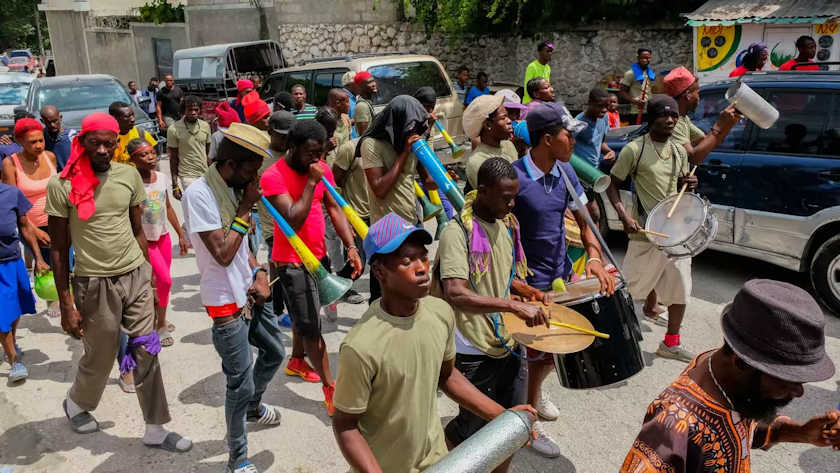
This particular rara that I was observing up close (almost too close!) had stopped to circle repeatedly in front of a cluster of houses in the Trou Sable suburb of Gonaives. Although some participants in these parades wear elaborate, colorful costumes, even when their financial resources are limited, most of the 50-plus participants in this particular rara wore normal clothing. The leader of the group appeared to be a man with a long whip. He also had a whistle of the type used by traffic policemen and sports referees. He occasionally tried to crack the whip (with limited success) and blew the whistle in short blasts in time with a rhythmic beat coming from the small "orchestra." I was later told that the whip was used to disperse unfriendly spirits, including those who might have been purposely left by rival rara groups.
Eight to ten members of the group were musicians carrying bamboo tubes, drums, and homemade horns or trumpets. The bamboo tubes were two to three feet long, perhaps three inches in diameter, and were used to produce a low-pitched, fog-horn-like sound. The drums were homemade, hollowed-out logs with animal skin covers held taut with pegs. The horns were made from sheet metal and resembled funnels with extended necks. These musicians were grouped together in front of the slowly moving group. They beat the drums and blew on their horns and bamboo tubes in a monotonous (to me, at least) rhythmic beat. During the time that I observed the group, there was no singing or chanting. Most of the group shuffled along with the beat while a few went into writhing dances as they circled and circled, kicking up dust. When they eventually went off down the road toward Gonaives, they marched along in the same manner and at a speed of probably no more than one mile per hour.
The group seemed quite happy. These rara parades are, in fact, considered to be a type of celebration according to my informants, who included Remy Cherenfant, Anel Masseus, Hector Gabriel, and Jean Ilfrid (all of them pastors of Haitian Nazarene churches). The group did not seem threatened by me, nor were they menacing in any way toward me. When a friend with me asked to take some pictures, they did not object.
When the group headed up the highway, they had no police escort. So, they provided their own traffic control. Automobile and truck drivers good-naturedly worked their way past the group, which at times blocked both lanes of the highway. Some members of the group gently guided dancers out of the paths of vehicles. A fellow in the rear of the procession also worked at keeping the group bunched up as much as possible.
The rara groups are closely associated with Haitian Vodou (often spelled voodoo in English). According to the pastors I consulted, the parades were commonly organized by a Vodou priest. Each group had an established leadership structure and held several parades during the Lenten season. In addition to the priest, there were an orchestra leader, people responsible for traffic control, and even a treasurer. My informants said that joining a band's orchestra required an audition.
In the group that I observed, there was no sign of spirit possessions or other phenomena associated with Vodou. According to the pastors I consulted, possession experiences were discouraged during rara parades.
I was told that the rara groups often sing songs that have more to do with local gossip than with religious themes. Often, someone will ask the group to make up a song ridiculing that person's enemy. In return, the person making the request is expected to give money to the rara group. An adulterous wife or husband will sometimes be the object of a song.
The Haitian Nazarene pastors I consulted said that members of their churches did not participate in rara bands and that the bands normally did not stop in front of those church members' homes. In some areas, they even respect church congregations, keeping noise to a minimum as they pass in front of their buildings where services are being held. In other areas, they seem to delight in disturbing church services.
My informants told me that although the parades could occur at any time, most took place from Saturday evening into Sunday morning. The particular group I observed was likely nearing the end of its procession. According to my informants, each rara group was supposed to return to its departure point before disbanding.
Reflecting on that experience and later conversations with my informants, I can see several elements of the rara band that find their parallels in Haitian Christian churches. These would include the writing of original songs by church musical groups, an active lay leadership structure in the local church, the use of rhythmic music accompanied by hand clapping, and the use of homemade musical instruments.
In the literature available to me when I wrote this account, I encountered descriptions of rara bands, but none explicitly connected them with Vodou. This contrasted with what the Haitian pastors had told me about the bands' religious associations and organization. I wondered whether those writers thought of rara as primarily a Lenten seasonal activity. It would have been interesting to ask them why they did not discuss its connections with Vodou.
Written for an assignment in Fuller Seminary's doctoral-level course in "Phenomenology and Institutions of Folk Religions"
A Haitian rara band is a dynamic and energetic musical ensemble that specializes in playing traditional Haitian rara music. Rara is a style of folk music that originated in Haiti. It is rooted in Afro-Caribbean culture and is often associated with religious and secular celebrations, particularly during the Lenten season and Easter.
Here's a description of a typical Haitian rara band:
A Haitian rara band is an important expression of Haitian popular culture. It blends music, dance, spirituality, and social commentary into an animated expression of community identity and celebration.


