“And there were shepherds living out in the fields nearby, keeping watch over their flocks at night.” — Luke 2:8, 2011 NIV
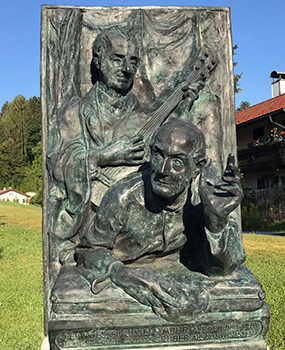
While Barbara and I were serving as missionaries in Europe, we visited the small Silent Night Chapel near Salzburg, Austria. The chapel stands near the site of St. Nicholas Church, where “Silent Night” was first performed. Repeated flooding damaged the church, and it was demolished in the early 1900s. Here is the story of how this famous Christmas carol came to be created:
In 1818, Joseph Mohr was serving as an assistant priest at St. Nicholas Church in Oberndorf, a village near Salzburg. According to the traditional account, the church organ was not working properly as Christmas approached. Some versions blame mice, while others point to rust or flood damage. Although the precise reason guitar accompaniment was chosen remains uncertain, the song was first performed with a guitar rather than the organ.
Mohr had written a six-stanza poem titled “Stille Nacht! Heilige Nacht!” in 1816 while serving in Mariapfarr, Austria. Its words reflected on the night the angels announced the birth of the Messiah to shepherds.
On December 24, 1818, Mohr took his poem to Franz Xaver Gruber, the church organist and a schoolteacher in nearby Arnsdorf. He asked Gruber to compose a melody with guitar accompaniment for the Christmas Eve service. Gruber completed the musical setting that day.
That evening, the congregation at St. Nicholas Church heard Mohr and Gruber perform their new composition. Mohr sang tenor and played the guitar; Gruber sang bass, and the congregation repeated the final two lines of each stanza.
Organ builder Karl Mauracher later encountered the song while working at St. Nicholas Church and took a copy home to the Zillertal region. There, two families of traveling singers—the Rainers and the Strassers—added it to their repertoires and helped spread it throughout Europe.
Silent night! Holy night!
All is calm, all is bright,
Round yon Virgin Mother and Child!
Holy Infant, so tender and mild,
Sleep in heavenly peace,
Sleep in heavenly peace.
The Strasser family helped spread the carol across northern Europe. By the 1830s, the song attracted the attention of King Frederick William IV of Prussia, who reportedly asked that it be sung by his cathedral choir each Christmas Eve.
In 1839, the Rainer Singers brought “Silent Night” to the United States and performed the original German version near Trinity Church in New York City.
In 1859, Episcopal priest John Freeman Young published the English translation most commonly sung today. He translated three of Mohr’s original six stanzas. The carol has since been translated into approximately 300 languages and dialects.
Artists who have recorded it in English include Bing Crosby, Elvis Presley, and Mariah Carey. Bing Crosby’s version is one of the best-selling singles of all time.
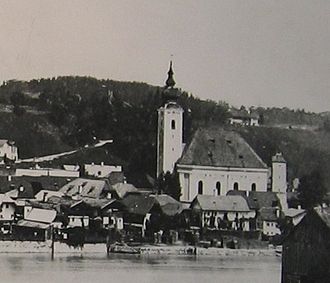
Image sources: Silent Night Chapel—Wikipedia and Stille Nacht Manufaktur.
“…the time came for the baby to be born, and [Mary] gave birth to her firstborn, a son. She wrapped him in cloths and placed him in a manger.” — Luke 2:6–7, 2011 NIV
 See the original German words and information about Gruber’s music.
A manuscript in Mohr’s handwriting, long thought to be lost, was discovered and authenticated in the 1990s. It confirmed that Mohr wrote the poem in 1816 and that Gruber composed the melody.
See the original German words and information about Gruber’s music.
A manuscript in Mohr’s handwriting, long thought to be lost, was discovered and authenticated in the 1990s. It confirmed that Mohr wrote the poem in 1816 and that Gruber composed the melody.
Find the lyrics to “Silent Night” in more than 100 languages on the Silent Night Web.
During World War I, soldiers on opposing sides of the Western Front sang Christmas carols in their respective languages on Christmas Eve in 1914. “Silent Night” was among the songs heard during the informal ceasefires that became known as the Christmas Truce. The shared carol expressed the soldiers’ common humanity despite the conflict.
In 2011, “Silent Night” was added to Austria’s national inventory of intangible cultural heritage, maintained by the Austrian Commission for UNESCO. The recognition reflects the song’s cultural significance, international reach, and enduring place in Christmas traditions.
Dave Hartley and Keith White Playing “Silent Night” on Pedal Steel Guitars
More music videos on this site
Each year on December 24 at 5 p.m. Central European Time (CET), Oberndorf honors Franz Xaver Gruber and Joseph Mohr with a commemorative celebration. Visit the official Silent Night website for current information about the celebration and any live broadcast.


|
Are we more interested in His presents than in His presence? [ more ] |
— Howard Culbertson, hculbert@snu.edu