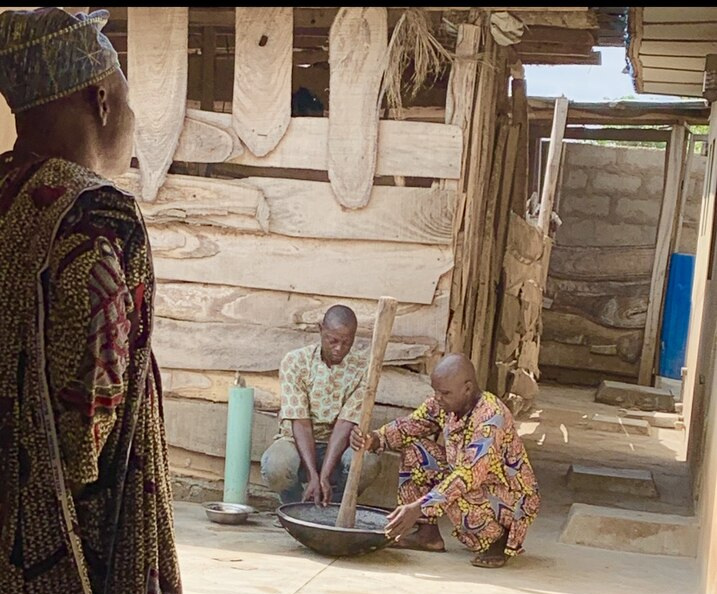
More classic art masterpieces used as illustrations
TL;DR:
This Traditional Religions course explores long-standing, community-rooted belief systems passed down through generations, usually through oral tradition. They are deeply embedded in a people’s culture, history, and social structures. Common features include ancestor veneration, animism, ritual ceremonies, a connection to nature, and a belief in multiple gods or spirits. A personal note highlights the instructor’s experience in Haiti, where voodoo (vodou) is the dominant animistic religion.
This page and the resources linked from it are Open Educational Resources (OER).
"Traditional religions" typically refer to belief systems, spiritual practices, and cultural customs that have been established over a long period within a particular community or society. These religions often have deep roots in the history and culture of a region or ethnic group and are passed down through generations via oral traditions, written texts, rituals, and ceremonies.
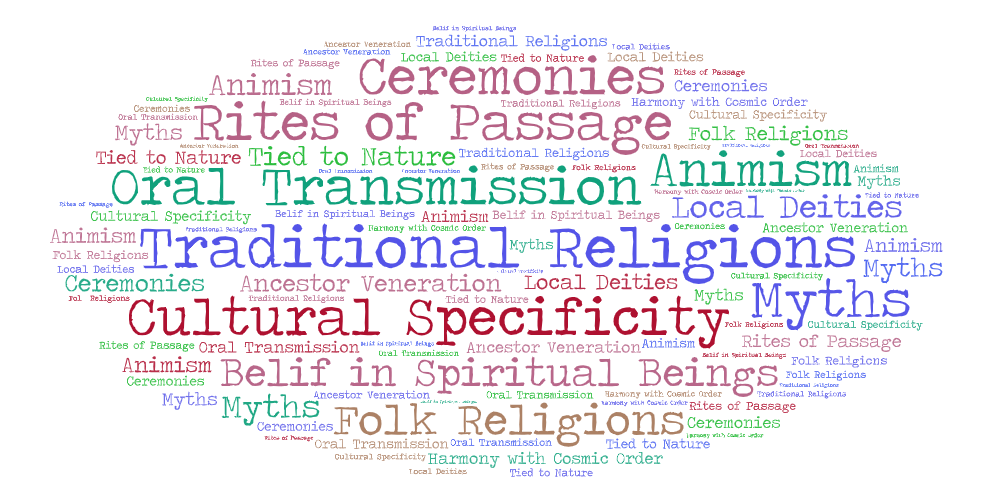
Traditional religions are diverse, but many share some of the following characteristics:
Examples of traditional religions include various forms of Indigenous spirituality, such as Native American religions, African traditional religions, Australian Aboriginal religions, and the traditional religions of many Indigenous peoples in Asia and the Pacific Islands. Additionally, certain forms of Hinduism, Shinto, and Taoism could also be considered traditional religions due to their deep historical roots and cultural significance within their respective regions.
Additional materials will be available during the course. Students will study in detail the religions—often associated with tribal peoples—that are sometimes described as animistic.
I have a very personal interest in this subject because we spent four years in missionary service in Haiti, where Vodou is deeply embedded in the country’s religious and cultural life (also spelled Voodoo or Vodun). [ e-book on Haiti ]
The professor’s firsthand observations of a Haitian rara band [ read article ]
Case studies to be used in class:
Are you doing some of your research on the internet? If so, be sure to cite those internet sources properly in your written work.
A – All of nature is believed to be infused with spiritual forces.
N – Nature spirits and ancestors are often venerated or appeased.
I – Interactions with spirits occur through rituals, offerings, and charms.
M – Magical practices are used to influence events and gain favor.
I – Individual and communal experiences of the supernatural shape daily life.
S – Sacred objects and symbols are believed to carry spiritual power.
M – Myths and oral traditions explain the origins and workings of the spirit world.

The letter grade for the course will generally be assigned according to the standard breakdown (A=90% or above, B=80% or above, etc.). The following percentages will be used to compute the course grade:
Assignments submitted late will be subject to a grade reduction.
| Date | Topic |
|---|---|
| Jan. 24 Jan. 29 Jan. 31 Feb. 5 Feb. 7 Feb. 12 Feb. 14 Feb. 19 Feb. 21 Feb. 26 Feb. 28 March 5 March 7 March 12 March 14 March 26 March 28 April 2 April 4 April 9 April 11 April 16 April 18 April 23 April 25 April 30 May 2 May 7 May 9 May 15 | Worldview, “Flaw of the Excluded
Middle” Mysterium tremendum / das ganz Andere / majestas Religious myths, rituals, and ceremonies Animism and animatism Sorcery, diviners, and magicians Magic, amulets, and charms Review day EXAM Sorcery Totemism and the manitou Individualistic cults Shamanistic cults Communal cults Ecclesiastical cults EXAM over pages 85-164 of Howells & Report #17 Spirit possession and glossolalia Voodoo Idols and images Syncretism Prophetic and nativistic movements Cargo cults Review day EXAM Folk churches Neopaganism in America (In “gods” we trust) Death, ghosts, and ancestor veneration Magical treatment of illness Folk psychiatry Film Review and catch-up (Wednesday) Final exam, 8:00–9:50 a.m. |
This bibliography is not exhaustive. It is simply a sampling of what is available in the library.
Adeney, Miriam. "What is 'Natural' About Witchcraft and Sorcery?" Missiology. 1974: 377-95.
Atkinson, Jane Monnig. "The Effectiveness of Shamans in an Indonesian Ritual," American Anthropologist. June, 1987, p. 342.
Booth, William. "Voodoo Science," Science. April 15, 1988. p. 274.
Brown, Kenneth I. "Worshiping with the Church of the Lord (Aladura)," Practical Anthropology. 1966: 59–84.
_______. "Forms of Baptism in the African Independent Churches of Tropical Africa," Practical Anthropology. 1972: 169-192.
Carpenter, Mark. "The Bible vs 'Brazilian Reality'," Christianity Today. December 13, 1985, p. 50.
Devillers, Carole. "Haiti's Voodoo Pilgrimages of Spirits and Saints," National Geographic. March, 1985, p. 395.
Gilliland, Dean. "Phenomenology as Mission Method," Missiology. 1979, 4:451-459.
Hiebert, Paul G. "The Flaw of the Excluded Middle," Missiology. 1982, 1:35.
Holmes, Lowell D. "Cults, Cargo and Christianity: Samoan Responses to Western Religion," Missiology. 1980, 4:471–487.
Kapenzi, G. Z. "Shona and Navaho: A Comparative Study of Beliefs and Practices," Missiology. 1974, 4:489–495.
Katz, Susan. "A Pantheon of Spirits: Haiti's Voodoo Mixes Faith and Magic," Newsweek. February 24, 1986, p. 64.
Levine, Art. "Mystics on Main Street: While Skeptics Cast Doubts, Psychics Count Dollars," U.S. News and World Report. February 9, 1987, p. 67.
Loewen, Jacob A. "Mythology and Missions," Practical Anthropology. 1969: 147-192.
McGregor, Donald E. "New Guinea Myths and Scriptural Similarities," Missiology. 1974, 1:35.
O'Brien, Patricia. "Prehistoric Evidence for Pawnee Cosmology," American Anthropologist. Vol. 88, 939–946.
Osborne, Kenneth B. "A Christian Graveyard Cult in the New Guinea Highlands," Practical Anthropology. 1970: 10-15.
Partain, Jack. "Christians and Their Ancestors: A Dilemma of African Theology," Christian Century. November 26, 1986, p. 1066.
Roberts, John M., Saburo Morita, and L. Keith Brown. "Personal Categories for Japanese Sacred Places and Gods," American Anthropologist. Vol. 88, Dec. 1986, pp. 807–824.
Saliba, John A. "Myth and Religious Man in Contemporary Anthropology." Missiology. 1973, 3:281.
Sass, Louis. "Voodoo Therapy: Do you believe in magic?" Vogue. Sept., 1986, p. 296.
Shaw, Daniel. "Every Person a Shaman," Missiology. 1981, 3:359–366.
Singleton, Michael. "Signs and Spiritual Direction: the Pastoral Counseling of the Possessed," Missiology. 1977, 2:185-194.
Taber, Floyd W. "How Real Are Dreams?" Practical Anthropology. 1972: 108–109.
Thornton, John K. "On the Trail of Voodoo: African Christianity in Africa and the Americas," The Americas: A Quarterly Review of Inter-American Cultural History, vol. 44, Jan. 1988, p. 261.
Tippett, Alan R. "The Evangelization of Animists," in Perspectives on the World Christian Movement, ed. Ralph Winter and Steven C. Hawthorne, pp. 629–640.
Toliver, Ralph. "Syncretism: A Specter Among Philippine Protestants," Practical Anthropology. 1970: 210–219.
Turner, Harold W. "Old and New Religions Among North American Indians," Missiology. 1973, 2:47.
Turner, Charles V. "The Sinasina Stone Bowl Cult," Practical Anthropology. 1970: 28-48.
Van Rheenen, Gailyn. "Cultural Conceptions of Power in Biblical Perspective," Missiology, January 1993.
Welton, Michael. "Themes in African Traditional Belief and Ritual," Practical Anthropology. 1971:1–18.
Wright, Michael. "Some Observations on Thai Animism," Practical Anthropology. 1968: 1–7.
Yancey, Philip. "Tree Trunks and Other Trivial Pursuits," Christianity Today, May 17, 1985, p. 8.
In microform:
"Christian response to the phenomenon of witchcraft in Ghana," an MA thesis by Vincent Boi-Nai.
"Elements of a strategy for the evangelization of Rastafarians with special reference to Jamaica," an MA thesis by Laurie Lind.
Beals, Ralph L., and Harry Hoijer. An Introduction to Anthropology, pp. 434–470.
Bessy, Maurice. A Pictorial History of Magic and the Supernatural.
Conn, Harvie. Eternal Word and Changing Worlds.
De Waal Malefijt, Annemarie. Religion and Culture.
Durkheim, Emile. Elementary Forms of Religious Life.
Diederich, Bernard, and Al Burt. Papa Doc and the Tonton Macoutes, pp. 345–357.
Eliade, Mircea. Shamanism: Archaic Techniques of Ecstasy.
Frazer, James George. The New Golden Bough. (Found in "reference" section)
Gehman, Richard J. African Traditional Religion in Biblical Perspective.
Haviland, William A. Anthropology, pp. 535–560.
Hiebert, Paul G. Cultural Anthropology, pp. 371–396.
Keesing, Roger M. Cultural Anthropology, pp. 385–405.
Kottak, Conrad Phillip. Cultural Anthropology, pp. 260–284.
Leach, Maria, ed. Funk and Wagnall's Standard Dictionary of Folklore, Mythology and
Legend, 1972. (Located in "Reference" section)
Leslie, Charles, ed. Anthropology of Folk Religion.
Lessa, W. A., and E. Z. Vogt, editors. Reader in Comparative Religions.
Levy-Bruhl, Lucien. Primitives and the Supernatural.
Lowie, Robert. Primitive Religion.
Melton, J. Gordon. Magic, Witchcraft and Paganism in America. ("Reference" section)
Nevius, John L. Demon Possession.
Nida, Eugene A., and William A. Smalley. Introducing Animism.
Taylor, Robert B. Cultural Ways, pp. 229–246.
Check also the 20-volume series Peoples of the Earth located in the "reference" section.
 | The gospel can never become contextualized until it is expressed in a people's native (or heart) language. [ more ] |
| Writing Standards Most courses at SNU contain a writing component. I expect students to produce written work that is focused, well-developed, organized, and relatively free of grammatical, punctuation, and spelling errors. Papers falling short of this standard will not be graded. That work will be returned to the students for further revision and resubmission. See my writing checklist. |
Tempted to cheat on some schoolwork? Before you do, read Southern Nazarene University's academic integrity policy.
— Howard Culbertson, hculbert@snu.edu


