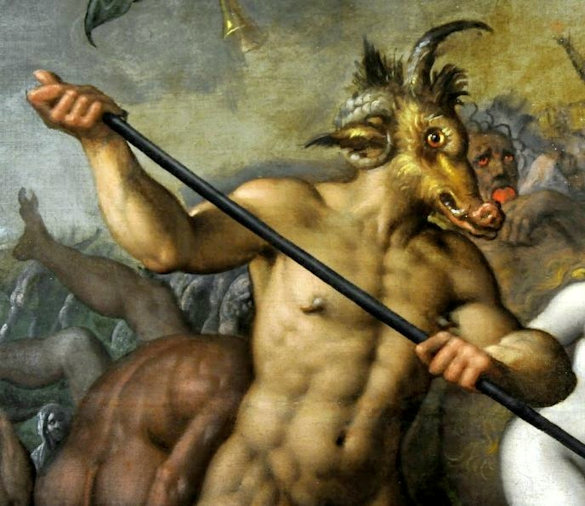
More classic art masterpieces used as illustrations
TL;DR:
The Bible portrays Satan as a real, personal adversary of God and humanity but warns against speculation beyond what Scripture reveals. Through His death and resurrection, Jesus Christ decisively defeated Satan. Christians should resist the devil by relying on Christ's authority and putting on the armor of God. Although Satan continues to deceive, tempt, and accuse, his power is limited by God's sovereignty, and his ultimate defeat is certain.
By Dr. Hal Cauthron, New Testament scholar and former chair of Southern Nazarene University's School of Theology and Ministry
To say that Satan is not real or does not exist is theologically inappropriate for at least two reasons:
Three affirmations drawn from Scripture can guide our understanding of Satan:
1. Jesus Christ has won a decisive victory over Satan and the powers of evil.
- John 12:31
- "Now is the time for judgment on this world; now the prince of this world will be driven out."
- John 14:30
- "I will not say much more to you, for the prince of this world is coming. He has no hold over me."
- John 16:8, 11
- "When he comes, he will prove the world to be in the wrong about sin and righteousness and judgment … and about judgment, because the prince of this world now stands condemned."
- 1 John 3:8
- "The reason the Son of God appeared was to destroy the devil's work."
- Ephesians 1:19–21
- "That power is the same as the mighty strength he exerted when he raised Christ from the dead and seated him at his right hand in the heavenly realms, far above all rule and authority, power and dominion, and every name that is invoked, not only in the present age but also in the one to come."
- Colossians 1:13–14
- "For he has rescued us from the dominion of darkness and brought us into the kingdom of the Son he loves, in whom we have redemption, the forgiveness of sins."
- Colossians 2:13–15
- "When you were dead in your sins and in the uncircumcision of your flesh, God made you alive with Christ. He forgave us all our sins, having canceled the charge of our legal indebtedness, which stood against us and condemned us; he has taken it away, nailing it to the cross. And having disarmed the powers and authorities, he made a public spectacle of them, triumphing over them by the cross."
- Hebrews 2:14–15
- "Since the children have flesh and blood, he too shared in their humanity so that by his death he might break the power of him who holds the power of death—that is, the devil—and free those who all their lives were held in slavery by their fear of death."
2. Believers need not fear Satan's power.
- Romans 8:38–39
- "For I am convinced that neither death nor life, neither angels nor demons, neither the present nor the future, nor any powers, neither height nor depth, nor anything else in all creation, will be able to separate us from the love of God that is in Christ Jesus our Lord."
3. Believers should not seek to engage Satan on their own but should trust in Christ's protection.
- Luke 10:18–19
- "I have given you authority … to overcome all the power of the enemy."
- Ephesians 6:11–13
- "Put on the full armor of God, so that you can take your stand against the devil's schemes. For our struggle is not against flesh and blood, but against the rulers, against the authorities, against the powers of this dark world and against the spiritual forces of evil in the heavenly realms. Therefore put on the full armor of God, so that when the day of evil comes, you may be able to stand your ground, and after you have done everything, to stand."
- 2 Corinthians 11:14
- "Satan himself masquerades as an angel of light."
- James 4:7
- "Submit yourselves, then, to God. Resist the devil, and he will flee from you."
- 1 Peter 5:7–11
- "Cast all your anxiety on him because he cares for you. Be alert and of sober mind. Your enemy the devil prowls around like a roaring lion looking for someone to devour. Resist him, standing firm in the faith, because you know that the family of believers throughout the world is undergoing the same kind of sufferings. And the God of all grace, who called you to his eternal glory in Christ, after you have suffered a little while, will himself restore you and make you strong, firm and steadfast. To him be the power for ever and ever. Amen."
"O Lord, help me sign the contract to fight the devil as long as I've got a fist, bite him as long as I have a tooth, and then gum him till I die. All this I ask for Christ's sake. Amen."
—Prayer attributed to Uncle Bud Robinson (1860–1942), pioneering Nazarene evangelist
Scripture quotations are from the Holy Bible, New International Version®, NIV®. Copyright © 1973, 1978, 1984, 2011 by Biblica, Inc. Used by permission. All rights reserved worldwide.
For further reading about Satan, also known as the devil, see "What's the Truth About Satan?" My former professor, Rob Staples, wrote it for Holiness Today.
In the Bible, both "the devil" and "Satan" refer to the same figure, the adversary of God and humanity. The word "devil" comes from the Greek diabolos, meaning "slanderer" or "accuser." "Satan" comes from the Hebrew satan, meaning "adversary" or "accuser"; in some Old Testament passages, it appears with the definite article as "the adversary."
Christians have traditionally understood Satan to be a fallen angel who rebelled against God and became an adversary of God's purposes and of humanity. Here is the picture that emerges:
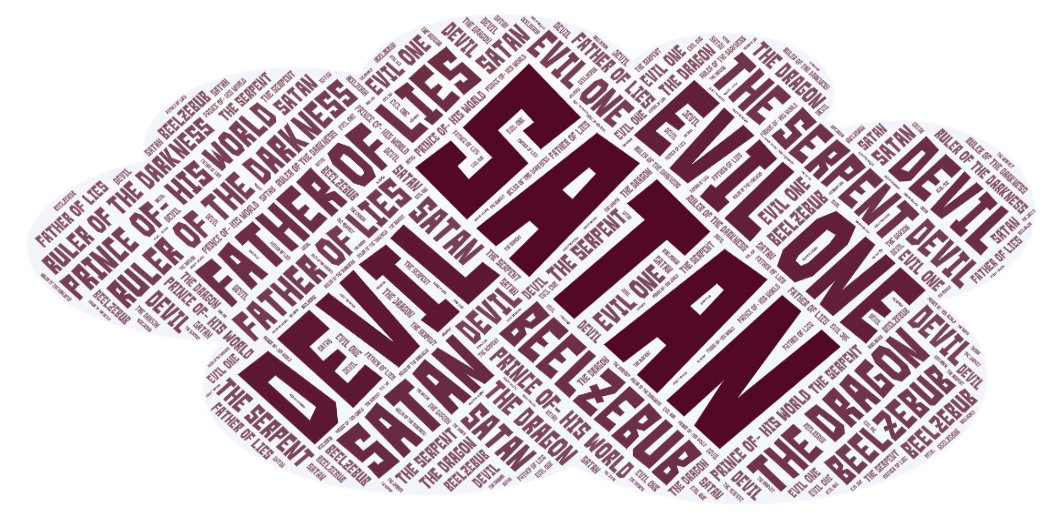
The Bible uses many names, titles, and descriptions for Satan:
S — Slanderer who seeks to lead hearts astray.
A — Adversary opposing God's righteous way.
T — Tempter who disguises evil as light.
A — Accuser of believers, hostile to what is right.
N — No match for the risen Christ, though still seeking to fight.
D — Deceiver of nations, sowing lies and doubt,
E — Enemy of truth, casting righteousness out.
V — Veiling his schemes, he tempts and betrays,
I — Inciting rebellion, leading hearts astray.
L — Lurking in shadows, the father of lies.
Like acrostics? Explore more biblical acrostics


