TL;DR:
Two historic Christian creeds—the Apostles' Creed and the Nicene Creed—summarize core beliefs. Creeds serve purposes such as doctrinal clarity, unity, teaching, worship, and historical continuity. They articulate essential truths in times of theological controversy. The page also contains links to materials used in a college-level course on Christian doctrine.
This page provides educational resources on Christian doctrine.
Christian Thought classes at Southern Nazarene University often began by reciting the Apostles' Creed aloud.
"Next to Scripture, the statement of faith most often used to communicate the essence of Christianity is the Apostles' Creed. For the Early Church, it provided a touchstone to guide both evangelism and discipleship in a vast world of diverse cultures and beliefs"
— cover blurb on
A Layman's Guide to the Apostles' Creed by H. Ray Dunning
Many evangelical Christian statements of faith affirm beliefs expressed in the Apostles' Creed. The Nicene Creed was formulated later. It is longer and responds to disputes about Jesus Christ. "What We Believe" - an example of modern affirmations of faith.
The creed developed from early Christian baptismal statements. Its name reflects the belief that it expresses the teaching of the Apostles.
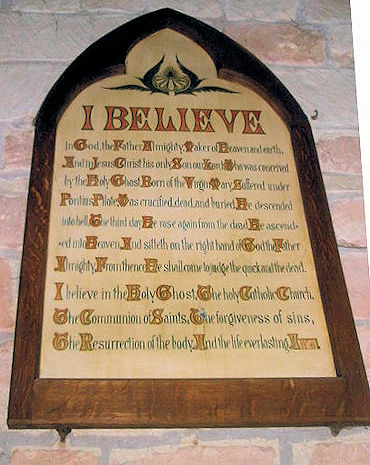
I believe in God, the Father Almighty,
Maker of heaven and earth;
And in Jesus Christ, His only Son, our Lord;
who
was conceived by the Holy Spirit,
born of the Virgin
Mary,
suffered under Pontius Pilate,
was crucified, dead, and buried;
He
descended into Hades;
The third day He rose again from the dead;
He ascended into
heaven,
and sitteth at the right hand of God the Father Almighty;
from thence, He
shall come to judge the living and the dead.
I believe in the Holy Spirit,
the Church universal,
the communion of saints,
the forgiveness of sins,
the resurrection of the body,
and
the life everlasting. Amen.1
Students often asked that question. The creed was not usually the subject of a memory quiz, but repeated recitation in class helped many students remember its phrases.
The creed's statements about Jesus' birth, suffering, death, and resurrection affirm His genuine humanity and counter teachings that denied it. Though brief, the creed also reflects belief in God as Father, Son, and Holy Spirit.
1The Apostles' Creed was not originally written in English. Since this is a translation, several versions with slightly different wording do exist. This version is from the hymnal Sing to the Lord.
Why was the Apostles' Creed written? The Apostles' Creed versus Gnosticism
C – Core beliefs that guide us
R – Rules or principles we follow
E – Ethical values we uphold
E – Expressions of faith or ideals
D – Deep convictions we live by
Like acrostics? Here are more of them
The Council of Nicaea adopted a creed in 325 AD. The fuller Niceno-Constantinopolitan Creed is traditionally associated with the Council of Constantinople in 381 AD. The version below includes the later Western addition "and the Son."
An interesting detail: The name "Nicene Creed" comes from the city where the first council met. That city was Nicaea (sometimes spelled Nicea), now called Iznik.
We believe in one God,
the Father almighty,
maker of heaven and earth,
of all things visible and invisible.
And in one Lord Jesus Christ,
the only Son of God,
begotten from the Father before all ages,
God from God,
Light from Light,
true God from true God,
begotten, not made;
of the same essence as the Father.
Through him, all things were made.
For us and for our salvation
he came down from heaven;
he became incarnate by the Holy Spirit and the virgin
Mary,
and was made human.
He was crucified for us under Pontius Pilate;
he suffered and was buried.
The third day he rose again, according to the
Scriptures.
He ascended to heaven
and is seated at the right hand of the Father.
He will come again with glory
to judge the living and the dead.
His kingdom will never end.
And we believe in the Holy Spirit,
the Lord, the giver of life.
He proceeds from the Father and the Son,
and with the Father and the Son is worshiped and glorified.
He spoke through the prophets.
We believe in one holy catholic and apostolic church.
We affirm one baptism for the forgiveness of sins.
We look forward to the resurrection of the dead
and to life in the world to come. Amen.
In Christianity, a creed is a formal statement of faith that summarizes the core beliefs of a Christian community. Creeds are declarations of what people believe. They are often recited in communal worship settings such as church services or ceremonies. They articulate fundamental theological truths and unify believers around shared doctrines. The most well-known Christian creeds are the Apostles' Creed, which developed from early baptismal statements, and the Nicene Creed (325 AD). Others include the Niceno-Constantinopolitan Creed (associated with 381 AD), the Chalcedonian Definition (451 AD), and the Athanasian Creed (fifth or sixth century). Some emerged in response to theological controversies; others developed in connection with baptism, teaching, and worship. These creeds affirm beliefs in the Trinity, the divinity of Jesus Christ, the nature of salvation, and other central aspects of Christian doctrine.
Christian creeds serve several important purposes within the faith. These include:
The Nicene Creed sought to address and clarify major theological controversies concerning the nature of Christ and His relationship to God the Father. Here are the key issues it sought to clarify:
The Nicene Creed established clear boundaries for orthodox Christian belief. It provided a unified theological foundation to combat heresies like Arianism and to promote unity within the Church. Because it defined the nature of Christ, the Trinity, and salvation, the Nicene Creed continues to be a cornerstone of Christian theology today.


Christian Thought was one of Southern Nazarene University's "General Education" courses. Required for all students, it was an introductory course in Christian doctrine taught from a Wesleyan-Arminian point of view.
"We do not use deception, nor do we distort the word of God. On the contrary, by setting forth the truth plainly, we commend ourselves to everyone's conscience in the sight of God" — 2 Corinthians 4:2, NIV
The following instructions were used when I taught Christian Thought.
See samples of devotional reflections I've written
There are many church congregations where the Sunday morning attendance is no larger than our class. Leading our class in our devotional time will prepare you to be a leader in your church.
Tempted to cheat on schoolwork? Before you do, read SNU's academic integrity policy
Most class assignments will be submitted online via Moodle.
| Writing Standards Most courses at SNU contain a writing component. I expect students to produce written work that is focused, well-developed, organized, and relatively free of grammatical, punctuation, and spelling errors. Papers falling short of this standard may not be graded. That work may be returned to the students for further revision and resubmission. See my writing checklist. |
— Howard Culbertson, hculbert@snu.edu
| Professors in the SNU School of Theology and Ministry believe that in Christ alone God has definitively and finally revealed Himself . . . [ read more ] |