TL;DR:
This degree-completion module provides an overview of the entire Bible, tracing its story from the beginning of the Old Testament through the end of the New Testament. Students consider major issues in biblical understanding and interpretation. In other words, this course helps beginners understand the Bible. By the end of the module, students should be able to summarize the Bible's entire story on one page.
Open Educational Resources
This page and the resources linked from it are Open Educational Resources (OER).
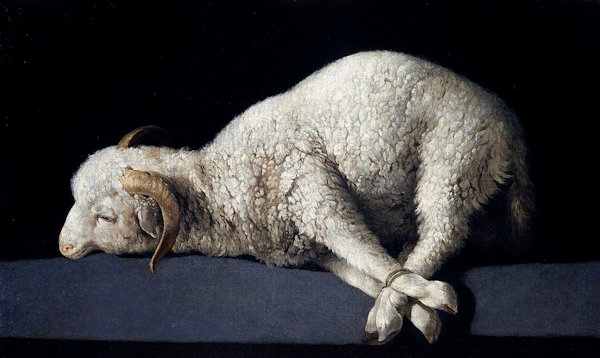
Agnus Dei (Lamb of God) oil painting by Francisco de Zurbarán, Museo del Prado, Madrid |
Image Source
Bible-search websites can help you find passages when you know at least one word used in them. The sites below provide access to numerous Bible translations and other study resources:
Bible Gateway
(Gospel Films — GospelCom)
— Versions listed above, plus NIV and RSV
— Versions in other languages, including German, French, Spanish, Italian, and Portuguese
Bible Study Tools
— Versions listed above, plus: New Living Translation, ASV, New King James, NRSV, RSV,
Today's English Version, New American Bible, Douay-Rheims, Bible in Basic English
— Other Bible study tools
I'm ready to get started!
Ready to get started looking at the Bible? Before you jump in, let's start with some very basic principles. [ more ]
Tempted to cheat on schoolwork? Before you do, read SNU's academic integrity policy
End-of-module integrative paper for this introduction to the Bible course
From the syllabus:
"A 6–8-page reflective paper describing insights from this
course that were new to you, how you respond to those new insights, and possible ways those
new insights might affect your life in the future. Due two weeks after the final class
session."
Need a question to get you started?
Have you successfully combined new material from the assignments and classroom lectures and discussions with
what you already knew?
Have some of your previously held ideas and positions been challenged?
Can you identify ways you have changed because of your participation in this learning
experience?
What new avenues of study would you like to pursue?
In what ways is your understanding of the Bible different now than before the module started?
At what points were you challenged to think and reflect?
Did you find yourself discussing material from this module with friends and family during the five weeks?
Did you go beyond the assigned work by reading more or pursuing one or more questions?
Your paper need not answer all or even any of these questions. They are offered simply to help you generate ideas.
The paper's appearance, grammar, and clarity will help determine its final grade.
A course called "Biblical Perspectives" typically explores the Bible's historical, cultural, literary, and theological dimensions. Here are some of the subjects such a course may cover:
An overview of the Bible's structure, content, and historical context, including its division into the Old and New Testaments
The Bible's historical background, including the political, social, and cultural settings in which it was written
The literary genres found in the Bible, such as narrative, poetry, prophecy, and apocalyptic literature, along with literary techniques used by biblical authors
Key theological themes in the Bible, such as creation, covenant, redemption, and eschatology (the study of the end times)
Different approaches to interpreting the Bible, including historical-critical methods, literary analysis, and theological interpretation
Important figures and events in biblical narratives, such as Abraham, Moses, Jesus Christ, and the apostles
The Bible's ethical and moral teachings and their relevance to contemporary issues
How biblical perspectives relate to contemporary issues such as social justice, environmental stewardship, and personal spirituality
Critical thinking through analysis, discussion, and reflection on biblical texts and their implications for faith and life