TL;DR:
The Old Testament reveals God’s nature, laws, and purposes through ancient writings that explore humanity’s origins, morality, suffering, and divine justice. Its books are arranged by subject—Law, History, Wisdom, and Prophets—rather than by chronology. Each section addresses vital spiritual and moral questions such as “Why do people do wrong and evil things?” and “How can we know what God expects of us?”
We say the Old Testament (or Hebrew Bible) is called “God’s Word.” Christians believe that God reveals Himself through these ancient writings. Therefore, discussion of the Hebrew Bible needs to move beyond the question, "How many books are in the Old Testament?" to the important questions raised and answered by these writings. The Jewish canon counts 24 books because it combines several books that Protestant Bibles separate, such as 1 and 2 Samuel.
What is the purpose of the Old Testament? What message might it have for us today? Well, here are some questions raised and answered by the Old Testament:
From The Bible — God’s Word for the Biblically Inept by Larry Richards. © Starburst Publishers. Used for educational purposes under the fair use provisions of U.S. copyright law.
“Your word, LORD, is eternal; it stands firm in the heavens.” — Psalm 119:89
Why are the Old Testament books in the order that they appear in the Bible?
“The gospel he promised beforehand through his prophets in the Holy Scriptures.” — Romans 1:1–2
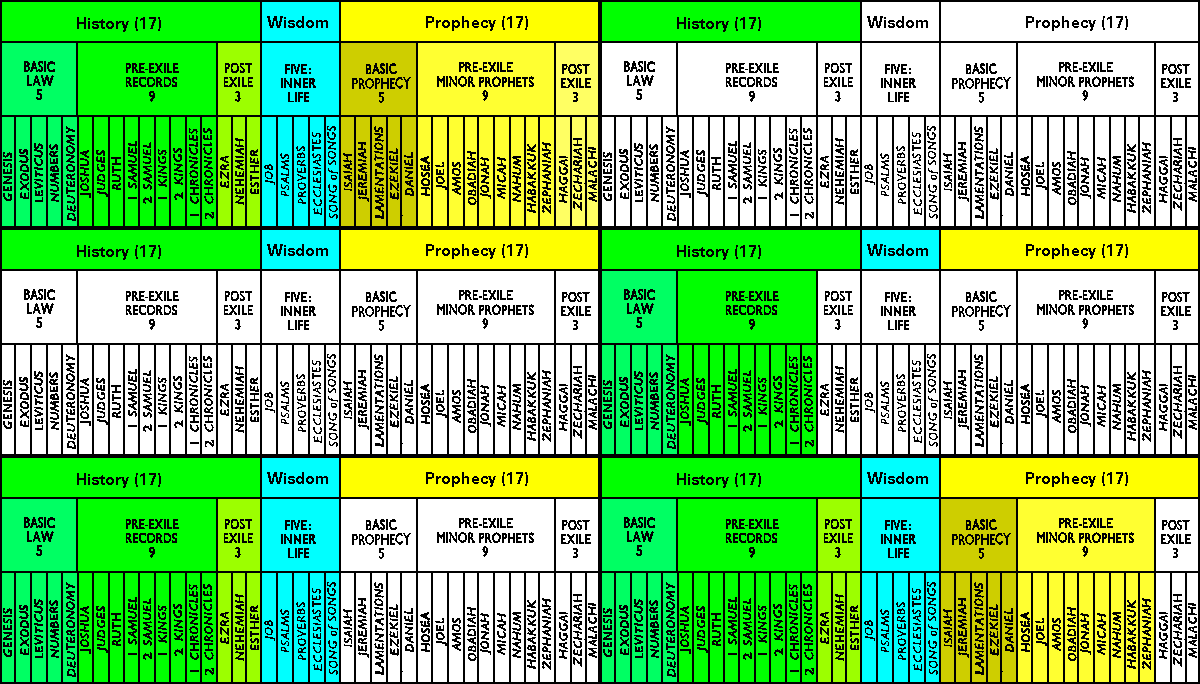
What is the logic behind the order in which the Old Testament books or documents appear in printed Bibles? Why does the book of Psalms appear in printed Bibles after the book of Nehemiah, although King David, to whom many of the psalms are attributed, lived hundreds of years before Nehemiah, who lived after the destruction of Jerusalem by the Babylonians?
As the graphic below makes clear, the Old Testament writings or books are arranged in the Bible by subject or genre rather than chronologically (although within the subject or genre groupings, there is considerable chronological order). Note: Many scholars separate the first five books (the Law or the Pentateuch) as a separate genre or type from the historical books. Some also use the label “Poetic and Wisdom” for the Wisdom section.
Questions to help you dig deeper
 | Although about 40 human authors wrote Scripture, Christians believe that God speaks through their writings. How do we know when it is His voice? [ more ] |
— Howard Culbertson, hculbert@snu.edu
The Old Testament is the first part of the Christian Bible. Written primarily in Hebrew, with some passages in Aramaic, it is foundational to both Judaism and Christianity. The Protestant Old Testament contains the same books as the Hebrew Bible, although they are counted and arranged differently. The Old Testament writings contain the history, laws, teachings, prophecies, and poetry of the Israelites. These documents, or “books,” were written over a period of several centuries by various authors.
O - Origin stories of the world and humankind
L - Laws given to guide a chosen people
D - Deliverance from Egypt, the great Exodus
T - Testimony of prophets calling for justice
E - Exile and return of a nation in sorrow
S - Songs and psalms that echo with praise
T - Tales of kings, both faithful and fallen
A - Alliance and covenant with the Divine
M - Miracles, judgments, and divine encounters
E - Ethical wisdom in proverbs and sayings
N - Narratives of struggle, hope, and redemption
T - Torah as the foundation of faith and law


Where they did not belong, Exodus 1:1–14 What does God have in mind for your kids? Exodus 2:1–15 “I am Who I am,” Exodus 3:1–10, 13–15 God’s man under pressure, Exodus 5:1–14 Unworthily? Exodus 12:1–14 I sing because I’m free, Exodus 14:10–16, 22–31 Another CIA plot? Exodus 10:1–9, 20–25 Is God shooting at us? (In a good way) Exodus 20:1–11 Stolen Watch, Exodus 33:12–23 Swimming upstream, Exodus 20:12–20 These hands I give to you, Exodus 24:3–18 Dancing around a golden calf, Exodus 25:1–9; 31:1–6 Emptiness versus God’s presence, Exodus 32:1–14 Trust the instruments, Joshua 1:9 Unlimited resources, 2 Chronicles 25:8 An appropriate humility — Job Blessed . . . Not so . . ., Psalm 1 Psalm 9:11 — “Proclaim among the nations” Telling tales, Psalms 14:1–3; 15; 16:8–11 Psalm 18:46 — Among the nations Psalm 22 — Missions declaration from the cross Sweet little baby Jesus, Psalms 22:1–5, 23; 24:7–10 He is my shepherd, Psalm 23 Leaning on the everlasting arms, Psalm 37:1–11 Psalm 48:10 — Missions exist because worship doesn’t Psalm 65:5 — God, the global hope Psalm 68:32 — Recruiting for the choir Psalm 87:6 — Register of the peoples of earth Getting the glory down, Psalm 103:8 Psalm 105:1 — “Make known among the nations” Psalm 113:3 — “From the rising of the sun” An active faith, not fatalism, Psalm 121:1–2 Fountain of youth, Isaiah 40:31 God’s splendor displayed, Isaiah 49:3 “To everyone who is thirsty,” Isaiah 55 A pastor’s work, Ezekiel 34:11–16 The disease of prejudice — Jonah 4:11 Measuring up, Micah 6:8 Fountain of joy, Habakkuk 2, 3